Episode 18. Names In The Margins: The Ghost Signs Guy Part 2
Duration 34 min
From the podcast series ‘Look history in the eye’
Produced and presented by Natasha Cantwell and Public Record Office Victoria
Music and sound design by Jack Palmer
Guest: Sean Reynolds, recorded at the Victorian Archives Centre, February 2026
Sean Reynolds: 0:07
Names kept popping up in research I was doing, and I would ask people, well, where's the primary source on this? So tell me a little bit more about this person, and they couldn't. So because I am the way I am, which some people might think is a little crazy, I just couldn't let that pass.
Natasha Cantwell: 0:24
That's Sean Reynolds explaining how he went from being "the ghost signs guy", famous on Instagram, for wandering the streets of Melbourne, photographing beautiful old faded signs, to spending his days deep in the archives, combing through criminal files and newspaper reports, unable to give up the chase, no matter how dark the stories became.
Sean Reynolds: 0:47
The talk tonight is called "Names in the margins", and the margins is basically where the archive put people they didn't know quite what to do with. So a lot of these stories, they're all from people who they didn't get plaques, they didn't get statues, they didn't get a ghost sign, they didn't have a business or anything like that. But these are still people who helped create the city that we know today. So these stories are still very important and still worth telling.
Natasha Cantwell: 1:57
I'm Natasha Cantwell and you're listening to the podcast "Look history in the eye" produced by Public Record Office Victoria, the archive of the state government of Victoria. One hundred kilometres of public records about Victoria's past are carefully preserved in climate controlled vaults. We meet the people who dig into those boxes, look history in the eye and bother to wonder why. This episode is part two of "The ghost signs guy". But in this talk, Sean is uncovering the stories hidden in the paper trails of Victoria's courts, and police files.
Sean Reynolds: 2:08
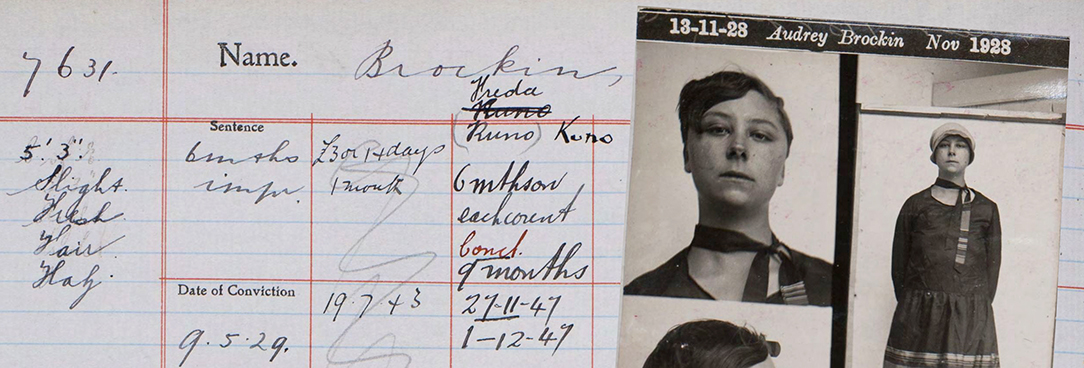
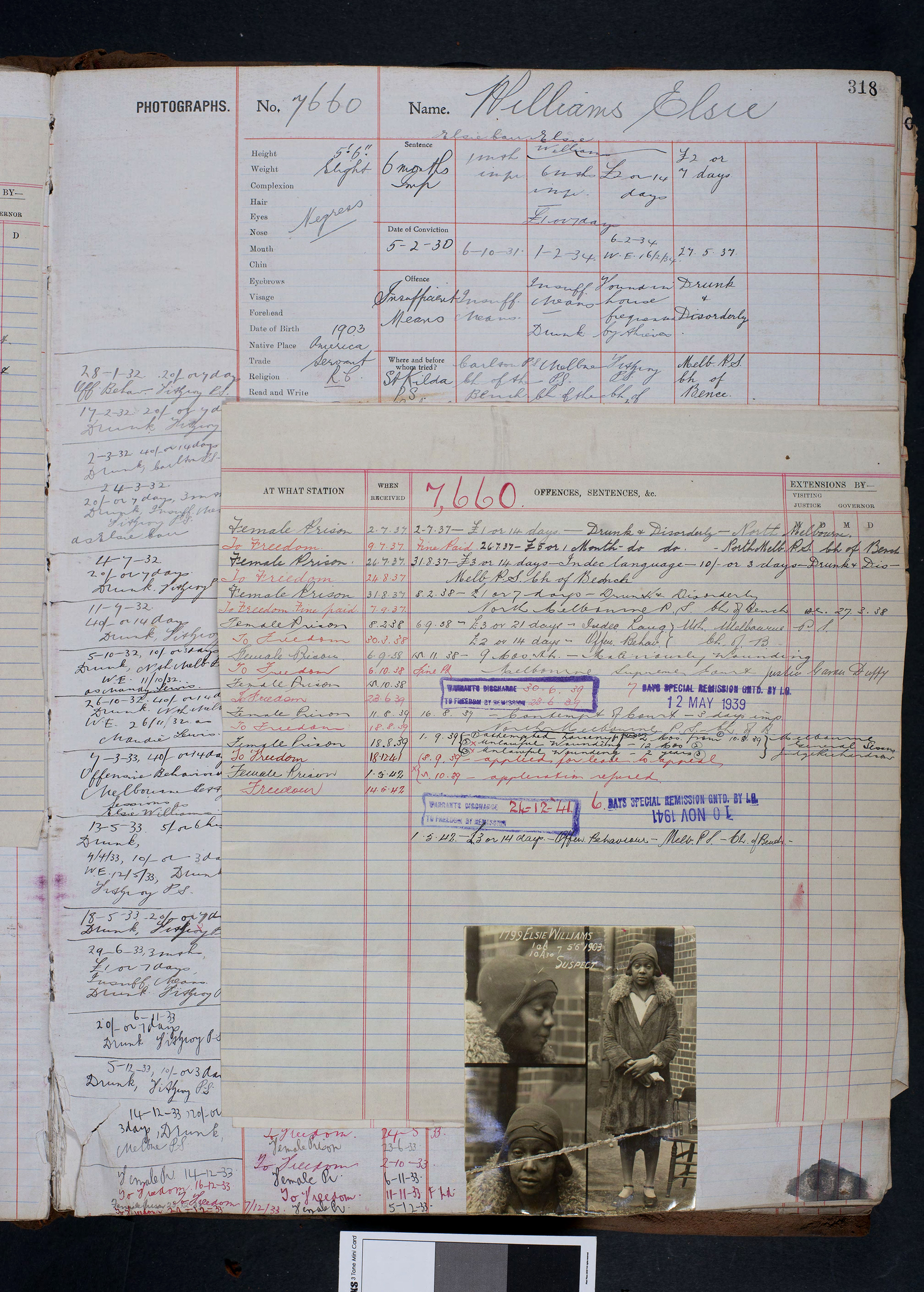
So all of these stories basically started with a photograph, with a mugshot. At least that's what we call them in America. I know I've said mugshot to some people here in Australia and they don't know what that is, but basically their prison photo. All three of these stories, they do belong to women. Now, there's a lot of stories with men as well, but I was interested because a lot of the men's stories tend to be a lot more violent, a lot more sensational, but a lot of the women's stories are quiet. And I wanted to know what is it that brought a woman to commit these crimes, or you know, why were what she did, why were they considered crimes? So each of these stories will reveal not just the lives of these individual women, but really what we're looking at is how the system worked. And I think that's very important to keep in mind. So, one thing I do want to point out, a content warning. So some of the stories tonight, they definitely include violence, they include addiction, incarceration, and racial slurs. Now, I'm not going to be up here saying anything that can get me in trouble but, you will see some headlines that are very racialised, very gendered. And that language is confronting. But the thing is, it was meant to be. Newspapers at the time, I know a lot of us probably agree that the media is not always putting forth its best foot in terms of reporting, and a lot of things seem very sensationalised or they're made for entertainment, but that is nothing new, as we will see here. So we will go ahead and begin. Here we go. Story one. So if a ghost sign is the story of a business that the city forgot, this woman here who I found about four years ago on the periphery of looking up a story about a ghost sign, this woman named Jane Vaughan is kind of the human equivalent of a ghost sign. Jane was incarcerated more than 60 times from the 1840s until her death in the 1890s. So, for all that attention, I did research and I've looked up, I've found probably about 50 of the times that she was arrested, posted in the newspapers, for all that time, no one ever seemed to ask, what would it have taken for Jane not to end up here? So let's all go back. 19th century Melbourne, up to its eyes in gold, right? It's on its way to becoming marvellous. Melbourne, you know, started off as this little port town. Because of the gold rush, it became one of the wealthiest, if not the wealthiest, cities in the world. I think it was the biggest city outside of London for a while in the British Empire. So a city like that needs people to come in and make it run, to put it together. So, Jane, Jane Vaughan, was born in Edinburgh sometime in the early 1820s. And I don't know her exact birth date, and I doubt that she even know the exact time, the exact day she was born. But she arrived in Melbourne in 1841. She came over as an apprentice. An apprentice to what? I'm not sure, but I think it was tailoring. She worked for about five years, and then she just kind of disappears into the margins. And then she starts showing up in the newspapers. And one of the first things I found out is that she was married, although I can't find a marriage certificate exactly, but she was, in the eyes of most people, she was married to a man named Thomas alias Richard Vaughan. So her relationship to Richard Vaughan, whether or not they were married, what the relationship was like is brutally clear in the archive. Basically, alcohol, violence, repeated charges, and many times she refused to testify. At least once she is found on the street with her face bloodied in Castlemaine. Another time he gets arrested because he's beating her in public and she refuses to testify against him. We don't need the archive to tell us why, obviously. Times like that, women were boxed in a position where if you weren't married, you had very few options. If you were were married, you had maybe even less options. So if she testified against him, she risked retaliation. She would have risked another brutal beating. If he's put away for too long, she doesn't have a lot of options in terms of being able to get a job and take care of their kids, which they had two children, two boys. But yeah, so both of them spent a lot of time in and out of jail. And in fact, I'm relatively certain that they met in the drunk tank. So the court always referred to them both as great drunkards. So Jane shows up in the record under multiple names. So all three of the women we're going to talk about tonight had multiple aliases. Ellen Vaughan, Jane Jamieson, Jane Williams, Jane Vaughan. She went through three or four different aliases. So the archive kind of treats this every time they write about it in the newspaper, they kind of treat it as proof of deception, like she's a slippery character. But I think the more you read about it, when you start doing the research on this stuff, you start to see like a lot of times people change their names, not because they were trying to come up with a criminal alias. They were doing it because they wanted some room to breathe. They didn't want to walk into a court with a name that had already had 40 pieces of evidence against it. They wanted to come in as something clean slate. So Jane's list of offences repeats pretty much over and over again. Drunk and disorderly, obscene language, vagrancy, small thefts, boots, buckets, cloth, photographs, umbrellas, a frying pan, a tin dish. She stole a lot. Now, I would never go as far as to say she was a kleptomaniac or anything like that, but I think we can tell a little bit about what was going on there. All these crimes, none of them are heists, right? So they're not crimes of ambition. They're crimes of keeping yourself alive. She's drunk, and why is she drinking? Well, she's got a horrible home life, right? She's using obscene language. Well, why is she like that? Well, she's probably that's what she's heard her entire life. She's picked up, basically, taken to court, thrown in the drunk tank, receives a fine that she can't pay, so they send her back to prison, and then they release her, and she's got no safety net or anything like that, and the whole cycle repeats over and over again. So, why someone can be incarcerated 60 times. In 1892, she's arrested for stealing boots, because when she's arrested, she says, well, the reason she stole the boots is because she needs new boots. She doesn't have any money for them. The magistrates during this time seem to sympathise with her. But because there's no welfare system, there's no place to put her, really, he basically says, well, I'm gonna send you to jail where you can receive medical attendance and all the comforts. Which is a chilling way to think about this. Is how things operated. If you wanted a bed or a meal or medical attention, the really only way the state could see helping you with that is to put you in prison. And when once you're in prison, prison at the time was like prison now, is very violent. It was not a pleasant place, so it's not something that someone would want to go unless things were pretty, pretty dire. The other thing, so we've got, you know, the police know her name, the courts know her name, and the newspapers, they all know her name. And they don't just report Jane, they turn her into a character. So they basically frame her in language that makes her look like the drunken hag, the violent woman, the street nuisance. You can see up here they call her a notorious old thief. Some of the other things that she is called in some of the newspaper articles are a wretched woman, a woman of immoral character, a perfect nuisance. One article describes her as an uncomely damsel with a black eye and other honourable marks. So this is basically the newspapers, the media basically revelling in this woman's misery and turning it into entertainment. It's a way for people at home to look at a newspaper and kind of look back at themselves and say, oh yeah, things are bad for me, but at least I'm not her. Right? So it's violence in a different way. So I do want to say though, none of this stuff, you know, the living in a world like that, being married to an abusive drunk, not having a social safety net, these are all terrible things, but they don't absolve Jane. So I don't want anyone here to think that I'm saying, oh, this this poor woman, she was innocent, because she did assault people. She could be violent. She may have hurt her children. Her husband used to, when she would get thrown in jail, her husband would chain her children to the radiator when he went to work for 12 hours because he didn't want them running out in the streets. Now, I hear everyone going, oh my god, it's terrible. And it is. That is terrible. But at the same time, this guy was also someone operating under the influence of alcohol, living very poor. They literally lived, at one point, they lived in a canvas lean-to shack. He had no social safety net either. He didn't want his kids running out into the streets, so he chained them up rather than letting them run out and get run over. Now, obviously, that's going about it the wrong way. And I hope that no one here is going to write a blog or an article saying that I'm excusing child abuse in any way. But I think it's important for that context to think about what this person was going through. His wife is in jail, right? Now, in 1852, Jane is actually charged with stabbing Richard in the back. He's bent over a kettle making his tea. So even though she stabs this guy in the back, it's really hard, it's hard to look at it in both ways. In one way, you think, my god, she stabbed this guy in the back, but it's really, when you think of the larger context, it's the latest salvo in this ongoing domestic war they've got going on. In fact, he doesn't press charges against her, so they stay together. I didn't write about it in here, but as I was doing this research, so I kind of take these things as far as I can go without, you know, just making someone's entire life story a multi, multi-volume thing. So but I do keep every once in a while, I will go back in the archives and see, oh, maybe I can find just one little piece, one more little piece. Well, Richard Vaughan kind of disappears, and what happened was they went out, 1860s. There was a one small town, and I forget which town it is at the moment, but they went up there because he wanted to dig for gold. Well, he was so drunk and everything, he didn't he couldn't get a job even working with anyone else to to dig for gold as a miner. But around their house were all these deep pits. Well, one night it rained. Richard Vaughan, drunk fell into a pit and drowned. And they took her to trial for it, but she had nothing to do with it. In fact, she was upset that he was gone, you know, for all that violence. She didn't kill him and she didn't want him to die. By the time Jane herself dies in Melbourne Hospital in 1893, she's 70 years old and has been convicted more than 60 times. She's never rehabilitated, she's never redeemed, she's never supported, she's just processed. The system had one move, which was punish, release, punish again. So Jane Vaughan, who came here in 1841 and lived through the gold rush up until 1893, she is what I think of as the underside of Melbourne's gold rush dream. You have all this wealth that we're building these huge, huge buildings, many of which are still around today. And the only safety net this woman had was to go back to jail. Not that I think she wanted to go back to jail, but jail had a roof and it had food, it had warmth. So one thing I want to point out. So people will ask, why did you want to tell this story? Well, one, I think it's fascinating. I think it's important because a lot of these people don't get these. I can't imagine since 1893 anyone has gone back in the archive and thought too much of Jane. So, in a way, it's bringing this person's story back to light. I think the other thing to think about is today, Australia's fastest growing prison population is women. And many of these women are incarcerated for similar offences, poverty-driven offences. And Jane's story basically, I think, reflects some of the uglier truths that we see today. That a lack of compassion, a lack of community, a lack of support dressed up as personal responsibility that sets people up for the same thing. So you can look at Jane Vaughan and her story, and you can see the same thing happening today. I realise, you know, probably a lot of you who have come to my other talks, I talk about ghost signs, and it's usually a little lighter. So tonight's a little bit heavier, but very important. Our next person here, she was someone I wasn't, again, wasn't looking for, and I kind of just came upon her photo as I was chasing something else. And I saw this picture of her, and you know, you look at a picture of like Jane Vaughan's, looks very old, she's an older lady. You see someone that looks like this, and I had to stop and go, wow, that's like you know, like a modern 1920s woman right here. So this woman standing here, she's got this cloche hat on, the little bell hat. She's got her scarf on. Her name at the top, you can see it says Audrey Brockin. Well, Audrey Brockin was not her name. So she was born Freda Marie Kuno in Yarraville around 1909. She was the eldest daughter in a very large working-class family. And like many of these women, she had alias upon alias upon alias. So her first collision with the criminal court comes in 1928. So that's when that picture was taken, right there in the middle of the 1920s. She was 18 years old. And basically, when she gets picked up, she's known under two names: Audrey Brockin, the one we saw there at the top of her photo, and the other one was Phyllis Shaw. So she basically found work as a domestic servant, working for a couple of people in North Carlton. I know it's Carlton North, the paper says North Carlton. And one day she left and she took with her a diamond ring, a travelling rug, clothing, and about 15 pounds in cash. So nothing too nefarious, but just enough. When the police finally caught up with her, it was here at the Belgrave Coffee Palace under another alias she was using at the time. So the first time they pick her up, she's already known by four different names. Then she's sentenced to three months in Pentridge prison. So she goes there, spends her time in Pentridge, and as far as I know, she is a model citizen of Pentridge and gets out after three months. So after she gets out, she decides to go straight. Freda Marie Kuno marries a man named Hammy George Waits, who is the naval petty officer. They got married on the 7th of January 1930. They moved around frequently because he was in the armed forces. They lived in Victoria, they lived in New South Wales for a bit. They had a son whose name was Terrence, known as Terry. If anyone here is a Collingwood football fan, Terry Waits played for Collingwood in the 1950s. He's still around. I saw a picture of him not too long ago. He's still seeing matches. So I was half afraid he would show up because you look up these stories and you start telling these stories about people, these are real people, these are people's relatives and stuff. And you know, I'm not sure how much Terry knows about his mom, to be honest. So I didn't know if this information would be new to him or not. But you know, Terry's got his own story. He was obviously successful, he's still around today. So we're just going to focus on the the story his mother left behind. So in 1938, Hammy, her husband, Hammy filed for divorce on the grounds of desertion. In court filing, so I also go through reading a lot of these things. So I have read, I know a lot about Australian law, especially from the 1890s to the 1950s. So that's more than anyone should have to know about it. Yeah, so basically he lays out, you know, as they were married, he would have shopkeepers coming to his door, unpaid accounts showing up in his wife's name, her disappearing for a couple days at a time. In 1935, they were living in Beecroft, New South Wales, and she basically just left with no explanation, no forwarding address, no note, nothing like that. So he took her to divorce court three years later. So she didn't show up, she didn't come to divorce courts. The notice was served to her mother in West Footscray, her mom did not know where she was. The divorce was granted uncontested. So I have no idea why she left. I don't know if they had a good relationship, a bad relationship, if she felt under pressure. I don't know. The record doesn't say. What I do want to say though is what you see oftentimes with stuff like this, you see the way that people will rush to judgements about the person, right? Especially the woman. So women that kind of leave their families like this, they're called selfish or unstable. A man will leave and it's that couldn't handle the pressure, or he wanted to start a new life, or the kid is better off without him. So I'm not making any judgements, but it is interesting the way we frame motherhood and fatherhood, isn't it? She disappears. So that was 1938, it was the last time anyone really saw her. About a decade later, 1947, she resurfaces in Alice Springs. This time she's under another name, Margaret Waltham. So she was working as a maid for a very wealthy woman, a woman named Lady Smyth, when Freda disappeared with diamond rings and jewellery worth 730 pounds. That's $54,000 today. So her heists kept getting bigger. The newspapers fixated, though, on one detail. She was one of the few, if any, white women inmates of the Alice Spring jails. That's what they were most impressed with, I guess. The other thing that was interesting that the newspaper fixated on was they flew up, the police flew up a woman, a policewoman. Policewoman Jean McInnes was flown up to pick Freda up for trial. Now, I had a harder time finding anything about Jean McInnes than I did Freda Kuno, which is really interesting. Just real quick, Jean McInnes was one of the first five policewomen in Victoria. After she got married a few years later, they made her stop being a policewoman because married women couldn't be police officers. So but one of the big things she did is she flew up to Alice Springs to escort Freda back to Melbourne to face trial. The press loved that, you know, women chasing women across the country. And once she got back, once Freda got back to to Melbourne, she was charged not just with theft, but with impersonation. So she had walked into the Myer Emporium, signed the name Lady E. O. Smyth, and walked out with a brand new wardrobe. So not only did she still steal about $54,000 worth of jewellery, she also bought herself a new a new wardrobe under this woman's name. But she was sentenced to nine months in Pentridge, which is with hard labour, which is a very pretty steep thing. But you know, if we read between the lines on that, she wasn't just caught stealing, she wasn't just caught impersonating, she was caught trespassing into the upper class. A lot of these are class based, as you'll see, you can see. So that's basically the story of Freda Kuno. And I started to think, well, what drove her to be like that? And then really, because she didn't keep a diary or anything like that, she disappears. There's no way to know. But what I did find was an earlier bit about her life here. So in July 1927, when she's 16, 16 and a half years old, she appears in this newspaper as a missing person. So she was found wandering around Richmond and taken to the hospital. She couldn't remember her name, she didn't know where she was from. She was carrying a bag with some other woman's name on it, and she was there for about two weeks. They finally tracked down her mother, and when she saw her mother, she had no recognition this was her. So I don't think she was faking it. I think this was a very real thing, and I can't diagnose her, and I have looked up some of these things, what this could have been, but no matter what it was, I think what this particular incident was was basically a woman who was under pressure, a young woman who was under some kind of pressure, had some kind of episode. But what she took away from that was how easy it was to change your name and step into another life. And she did it basically the rest of her life. So after 1947, the trail ends, which I hate saying, but nothing ever pops up about her again. I have no idea if she got remarried. I don't know if she just moved somewhere and kept her real name and just stayed out of the papers. I don't know if she died and was buried under another name that never belonged to her. The archive kind of goes cold. Because she moved around if she never came back and saw her family again, you know, and she passed away. There's no death certificate, at least none with her name. So I don't know what happened to her. But again, not to excuse this woman, right? So obviously she had some problems. She was she learned to live the way she could in a world that you know didn't understand her. She had to make her own way, she had no safety net. Again, there's no such thing as going to see your psychiatrist or psychologist. So I don't want to turn her into a good guy or a bad guy. I'm just trying to point out that how often now these days do women or people change their names to avoid bad domestic lives or things like that? So again, not too dissimilar from things that we see today. So this is gonna be our last one, Elsie Williams. And our first one, Jane Vaughan, was about Gold Rush era, Melbourne, our last one, Freda Kuno, 1920s to the 1940s. This is also about early 1900s to the 1940s, Elsie Williams, but I will caution everyone this is probably the saddest and definitely the most racialised. So Elsie Williams' prison photograph, but it just says 'suspect'. So the police picked her up repeatedly on suspicion of things. Suspicion of being drunk, suspicion of being a vagrant, suspicion of being a nuisance, and she was often characterised as being a quote, 'violent coloured woman'. Now, before I get into this, I will just go ahead and get this out of the way. What I'm going to talk about, she's not a saint, she's not a caricature, she could be violent for sure. She did have a problem with drinking, but she was a human being, and you're going to see the way that she's portrayed in the press, they don't really treat her that way. So, before she became what the newspapers dubbed the notorious Nightingale of Dudley Flats, she was born in Bendigo. Her parents were Afro-Caribbean, and they were very well respected in the neighbourhood, in the community. Her father was a builder, and they were both, they were all members of the Wesleyan church. Her mother, Pauline, died in 1907 when she was a little girl, when Elsie was a little girl. And the funeral was huge, it was well attended. A few years later, their house burned down, ironically, as the family was at a church anniversary concert. So their house burned down, it was insured, but not for much, and her father had to declare bankruptcy, and so the family moved to Melbourne. Now, in the 1920s, Elsie joined the Fisk Jubilee singers, which I had no, I didn't know about this, but this was actually something kind of interesting. They were a group of people from the southern United States that toured around the world, around the country here, singing spirituals and popular songs of the day. They first did that in the 1880s and then did it again here in the 1920s, the Fisk Jubilee Singers from Fisk University. So Elsie actually got a job as a backup singer with them because she had a great voice. So she toured around with them for a while, and then Elsie got a job performing in the musical showboat in Melbourne. So she was an actress for a while. But as she was getting her career going and off the ground, she was also fighting some personal demons. So she did get into drinking, she started to get picked up for vagrancy laws and started to have repeated run-ins with the police. So trying to understand this woman's life, right, I had to kind of separate the types of crimes she was charged with, you know, because not all of them were violent crimes. So there's some crimes that she's charged with, and she was charged quite a few times, closer to what Jane Vaughan was arrested, so somewhere in the 30 times she was arrested, something like that. So some of the things she's arrested for are drunkenness, being idle and disorderly, vagrancy or indecent language. So these crimes, then these are basically crimes that the police had incredible leeway in who they could charge people with, who they could say was idle and disorderly or anything like that. So basically these are laws when they want someone to not be on the street, someone who's being too loud or someone that they don't want around because it makes, in their eyes, makes the street look bad. She's basically picked up quite a bit in the newspapers, they participate basically in this violence, right? So I had to step back and think, you know, what does it do to someone to be interrogated constantly, to be picked up always as a suspect, to be assumed that they're guilty before they speak, right? Of course, of course she was she was drinking, you know. She was anytime she went outside, she ran the risk of basically being picked up for anything. So here you can see, here's the headline. I will not read it out loud, but you can see the headline, and this obviously is not neutral reporting, right? This language is doing harm, and it's already pre-judging, you know, pre-sentencing this woman. Look, she did have offences when she would lash out at people. There were stories about her using a razor, stories about her attacking people. This is where she starts to get the moniker as a dangerous woman. But I think we can hold her accountable for these kinds of crimes without you know kind of wallowing in the lurid entertainment that the newspapers used. All three of the different newspaper headlines, it's always race first, then the crime, then the story. So at her final trial in 1939, a judge wondered aloud if she was Aboriginal. She was not. Then he suggested that maybe she was Aboriginal, she didn't know, and that would make her subject to temptations and passions different from white people. So, you know, look, you walk into a courtroom and that's the first thing the judge says to you, you kind of already know where you stand. During this, she basically stood up and said, you know, I don't care if you give me a life sentence, you're never going to break my spirit. She did get sentenced to a couple of weeks in jail and a fine, but she was not put in prison for life. By the 1930s into the early 1940s, Elsie was living in a place called Dudley Flats, which basically was a shanty town in the wetlands behind the docks there at Docklands. The place was built up of old scrap among the rubbish tip. So it was basically a dumping ground for what the city didn't want, and that included people. The flats were described as lawless, they were described as filled with filth and squalor. Basically, any time that the newspaper needed to you know paint a picture of the vice and crime in Melbourne, they would go to Dudley Flats here. And this is where Elsie ended up living. This is where she spent her final days. Oh, okay. So this is gonna get a little... here we go. So one of the last witnesses to see Elsie alive was a child. So there was a radio interview done a few years back. This woman named Phyllis McIlvenie. She described going down to the tip with friends. She said it smelled, it was rat-infested, there was smoke, everything was like kind of, you know, they had little fires burning and everything. But the local kids loved to go there because it was a playground full of treasure. But one day they went there and they saw Elsie lying on the ground naked in a vegetable patch, and she was crying. She said that her man had punched her into the fire and left her there, and she was asking the kids for a drink of water. The kids were all scared of her because she had this horrible reputation, but they said, well, we'll go get help. And for whatever reason, help never came. And by the time the police did eventually show up, Elsie had passed away. The newspaper is fixated on the squalor and the horror of it. All of the all the headlines are pretty pretty graphic and gruesome. At the time, the Harbor Trust, this was kind of the last straw. They finally decided they were going to demolish the shanties, patrol it so people couldn't camp out there. Basically, trouble removed, area cleared, problem solved. So, you know, her tragic death obviously it doesn't negate the bad thing she did. Like I said, she she did attack people sometimes, she could lash out, she could be dangerous, but she could sing, she was very talented. She clearly, under the right circumstances, would have flourished, I think. She could be defiant, you know, we heard her in court. After her death, this woman named Sister Ellis of the Bethesda Aborigines Mission gave an interview with the the Herald and talked about she would go and visit Elsie, even though she wasn't Aboriginal, but she would go and visit her and they would talk. Whenever Elsie was drunk, she refused to see Sister Ellis because she was embarrassed. It was something that she didn't want this woman to see. She would sing for Sister Ellis, and Sister Ellis talked about how she was never really given a fair shake because of her race and her problems with alcohol. And in fact, at her, at Elsie's funeral, a plainclothes policeman came and said that even though he had run into her a few times, he actually found her to be quite a delightful person. So you look at this and you start to question, you know, you know, what it not really like what did she do? Because, you know, we can read in the the files, you know, what she was picked up for, but you know, what options did someone like this have? Someone, a black woman who had a record, who had a drinking problem, who every time the newspaper wrote about her, it was always about her race in a very negative way. You know, what else, where could she go? I guess it was either prison or Dudley Flats. So we kind of know how that goes. So my hope with this is basically, you know, her story has actually been told before. I found someone else had done it, but I think it's really important to go through this and talk about someone like that because this was a person. And I think we can look back at these records and it's incredibly fascinating. And if you ever get a chance, go on the public records website. You can go through and look at a lot of these these files. And it's I think in a way we're lucky to be able to do that because you know that's a piece of history, and I think a lot of us probably have people related to in our past that have an interesting history. And it's important to go and look at those things and realise that there's a human being behind that. It's not just this list of crimes, right? So the three women that I spoke of here tonight, Jane, Freda, and Elsie, so they're just three of the hundreds and hundreds of people who are banished to the margins of Melbourne. And I hope that tonight we learn that, yeah, these women did, they broke the law, and some of the laws obviously were, you know, designed to keep people like that, you know, locked up or out of sight. The system was also designed for oftentimes women to be second-class citizens. Like I said, if you were not married, you had very few options to you, and then if you were married, you had very few options. So basically, the only move the system had was punishment. There was no safety net. And things aren't perfect today, but they're better than they could be. So there are many more women like this waiting in the archive, misremembered, misnamed, misunderstood. I think it's important to remember that cities don't forget about people, they do record them, but they decide which version survives. So I've kind of taken it upon myself to read in between the margins and give you a different story.