
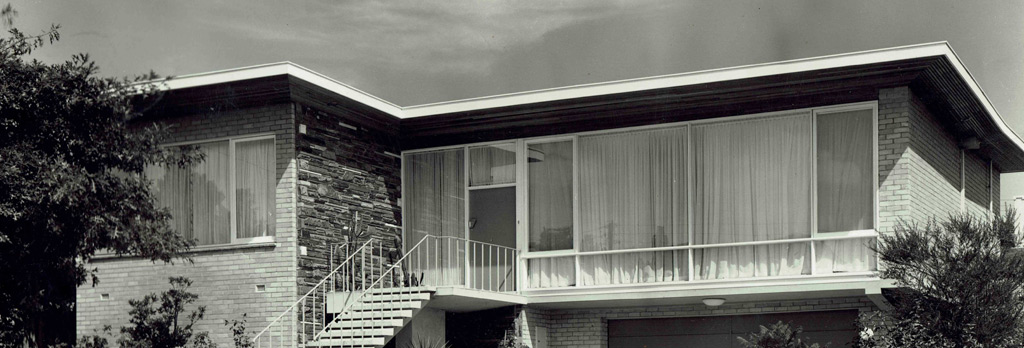
Last updated:
‘Bernard Slawik, the real brutalist: a Holocaust survivor architect builds a new life in the New World’, Provenance: the Journal of Public Record Office Victoria, issue no. 23, 2026. ISSN 1832-2522. Copyright © Catherine Townsend and Natica Schmeder
This is a peer reviewed article.
Propelled by Brady Corbet’s award-winning cinematic representation of fictional Hungarian Holocaust survivor and architect László Tóth in The Brutalist, émigré architects, their architecture and migration experiences are again receiving media attention. In contrast to the superabundance of research on émigré architects who migrated prior to the outbreak of World War II, there is scant research documenting the experiences of those who survived the war years in Europe. This article discusses the phenomenon of migrant Holocaust survivor architects, in particular, Janowska concentration camp–survivor Bernard Slawik, who migrated to Melbourne, Australia, comparing his career to the fictional representation of Tóth. Slawik’s biography and career, like the fictional Tóth’s, had an epic cinematic quality and demonstrates the sheer diversity of experiences, homelands, migration journeys and architectural practice among émigré architects and their transnational stories.
Introduction
Propelled by Brady Corbet’s award-winning cinematic representation of fictional Hungarian Holocaust survivor and architect László Tóth in The Brutalist, émigré architects, their architecture and migration experiences are again receiving media attention.[1] ‘Émigré architect’ is the term architectural discourse has embraced to denote the group of architects from Central Europe who fled Hitler’s Europe.[2] Central figures of architectural modernity, Walter Gropius, Mies van der Rohe and other Bauhaus figures, such as Marcel Breuer who migrated to the United States of America in the 1930s, epitomise the émigré architect. Canonical architectural histories often characterise these architects and their migration as a pivotal narrative whereby avant-garde modern architecture was transferred to the United States and across the world.[3] While the understanding of émigré architects in Australia is somewhat different, most research here similarly focuses on the transfer of modernism and the most successful individual émigré architects, such as Harry Seidler, Frederick Romberg and Ernest Fooks.[4]
Despite the superabundance of research on émigré architects who migrated prior to the outbreak of World War II, documentation of the experience of those who survived the war years in Europe is scant, both in Australia and globally.[5] Starting from member files of the Architects’ Registration Board of Victoria (ARBV) at Public Record Office Victoria (PROV), this article discusses the phenomenon of migrant Holocaust survivor architects, in particular Janowska concentration camp–survivor Bernard Slawik (Figure 1), who migrated to Melbourne, Australia, comparing his career to that of the fictional Tóth.[6] Other key primary sources utilised in the preparation of this article are naturalisation and migration records held at the National Archives of Australia, the Slawik family’s archive (some of which is now held at the Australian War Memorial), and Polish sources about Slawik’s education and early work.
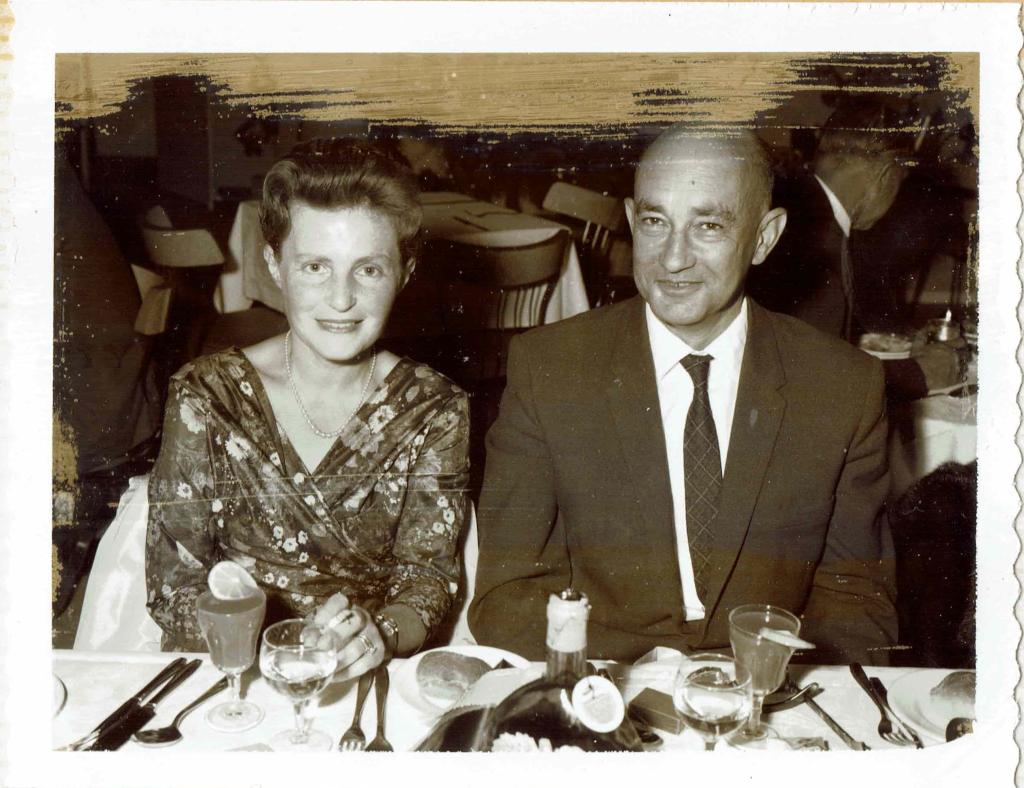
Figure 1: Bernard and Alma Slawik, Monash Hotel-Motel, Ariem Studios, c. 1955–66. Source: Slawik Family Collection.
The Brutalist has amassed praise from film critics, award givers, and those who warm to the film’s depiction of the immigrant experience, trauma, art, patronage, and the relationship between the United States and Europe.[7] In contrast, the architectural community has, for the most part, denounced and disparaged the film and its depiction of László Tóth, a Hungarian Bauhaus-educated architect who migrates to Philadelphia in the late 1940s after surviving Buchenwald concentration camp.[8]
Architectural opposition to the film has centred around three main themes. First, critics have noted the anachronistic depiction of architecture in the film. Rather than reflecting designs of the 1940s and 1950s, much of Tóth’s work is representative of architecture of the late 1990s and the new millennium. Similarly, architectural critics have noted that while the film’s title references brutalism, an architectural style best known for its use of expressive concrete structure throughout the 1950s–70s, this style is entirely unrelated to Tóth’s output. Indeed, it is difficult to ascertain any connection between the architectural style brutalism and Corbet’s film beyond the use of concrete, a material ubiquitous to twentieth-century architecture. Second, many architectural critics object to the film’s hackneyed portrayal of the architect as a lone, tortured genius, rather than the collaborative reality of architectural production. A third, and more debatable, architectural criticism levied at the film is that László Tóth’s difficulties establishing himself in America are improbable given the network of highly successful émigré architects in the United States, in particular those from the Bauhaus.[9] Critics posit that any architect with Tóth’s background would have readily found work with appreciative clients in the United States and not the abusive relationships he endured.
While many of these criticisms are accurate, this article argues that the certainty with which architects and others have damned the characterisation of Tóth is misplaced. The dearth of research on, and built work by, Holocaust survivor architects shows that they were not as successful as Mies, Gropius, Breuer, Seidler or Romberg—architects who managed to leave Europe ahead of the war’s outbreak. Moreover, it is difficult to imagine that the deprivations and trauma of years in Nazi concentration camps would have no effect on an architect’s life and career. Thus, the presumption of the easy assimilation of survivor architects into postwar American careers is misplaced. This is not to say that The Brutalist’s depiction of Tóth is accurate; rather, given the absence of research into émigré architects who spent time in concentration camps, it is difficult to say whether the Tóth character is implausible or not.
PROV holds records amid the files of the ARBV of a number of Holocaust survivor architects who migrated to Australia, including Bernard Slawik, John Beer and Erwin Kook.[10] Like The Brutalist’s protagonist Tóth, they attempted to rebuild their careers in the new world. Instead of drawing attention to the deficiencies of The Brutalist, this article initiates a discussion of one of these Holocaust survivor architects, Slawik, drawing out thematic aspects of his life that are foreshadowed in The Brutalist, such as the difficulty of re-establishing an architectural career and finding patronage in a new country, Jewish identity, visual Holocaust testimony, the ongoing difficulties of life as a Holocaust survivor and architectural expression in the postwar era. Unlike the easy assimilation of prestigious Bauhaus architects in America and canonical stories of the transmission of modernism, Slawik’s biography and career, like the fictional Tóth’s, demonstrates the ‘extremely diverse social, professional and intellectual contexts’ in which émigrés practised architecture, both in their homelands and destination countries.[11]
Biography
Bernard Slawik was born Bernard Teitelbaum on 27 April 1904 in Gliniany (now Hlyniany), a small town near Lwów, Austro-Hungary (now Lviv, Ukraine), a region that, at the time, had a large Jewish population. Teitelbaum’s early life was disrupted by fighting on the Eastern Front during World War I. His family evacuated westward, moving to Kraków, Vienna and Brno, finally resettling in Lwów after the war. Involved in Hashomer Hatzair (a Zionist youth movement) from the age of 13, Teitelbaum left school aged 17 and became a member of the Jewish youth movement Hehalutz (The Pioneer) at the Hachsharah (literally 'preparation', an agricultural training centre that taught skills necessary for migration to Palestine) in the Lwów suburb Sygniówka. The Polish–Soviet War (1919–21) interrupted this training and Teitelbaum returned to, and graduated from, high school. Teitelbaum then studied architecture at the Lwów Polytechnic from 1924.[12] This course was, like most in Europe at the time, traditionally focused: the first years were devoted to foundational studies including fine arts, with design and technical subjects introduced in the final years.[13] Teitelbaum graduated in 1930; he took six years to complete the four-year course so he could work, first as a tutor, and then for local Jewish architect Józef Awin between 1928 and 1932.[14]
Awin was an important Lwów architect in the early twentieth century whose influence stretched well beyond the Jewish community. He was the only Jewish board member of the Association of Polish Architects, Lwów Branch, and is recognised as a leading Lwow designer in the Secessionist and Modernist styles.[15] He was the driving force behind the establishment of the Lwów Commission for the Preservation of Jewish Art in 1925 (also known as the Kuratorium).[16] The Kuratorium’s activities were counterparts to the preservation and documentation of historic synagogues undertaken by Professor Oskar Sosnowski and art historian Szymon Zajczyk from 1923 with the help of their students at Warsaw Polytechnic.[17] The Kuratorium was hailed for documenting Jewish cemeteries, synagogues and contents, as well as ‘scientifically and knowledgeably’ conserving them.[18] Teitelbaum was the Kuratorium’s assistant conservator. He spent his summers documenting synagogues (Figures 2, 3 and 4) and gravestones, participated in the Exhibition of Jewish Art (part of the 1928 Lwów Book Exhibition) and presented a paper on the Kuratorium’s work at a conference on the preservation of Jewish art at Mainz, Germany.[19]
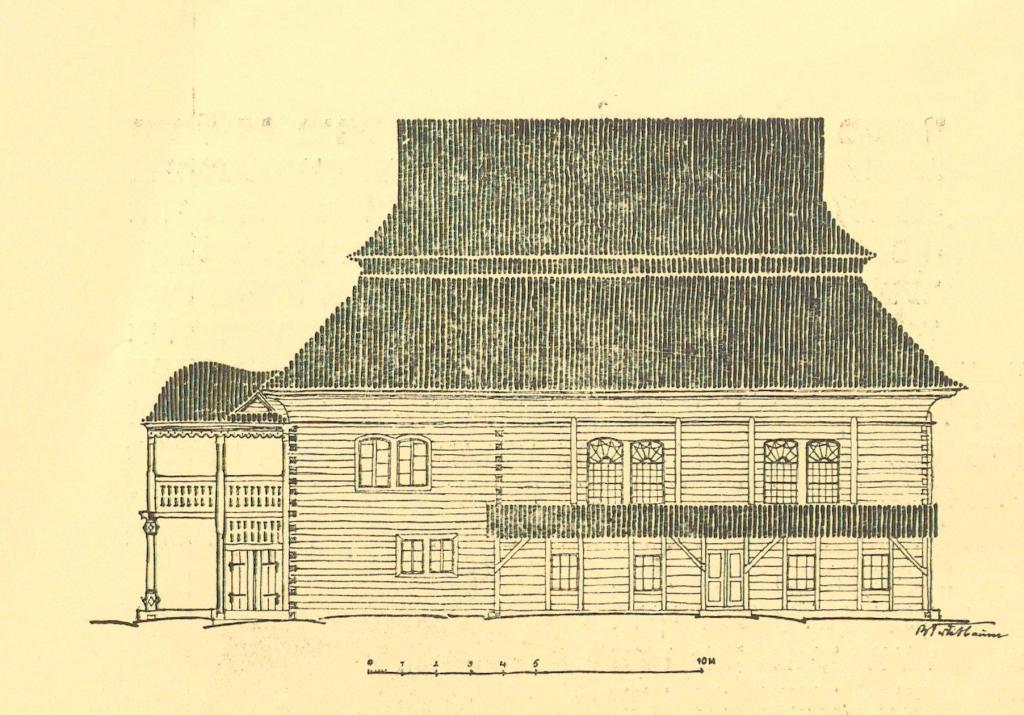
Figure 2: Elevation of the Kamionka Strumiłowa Synagogue (now Kamianka Buzka, Ukraine), drawn by Bernard Teitelbaum as part of his work with the Kuratorium (note his distinctive signature at lower right). Source: Sprawozdanie Kuratorjum Opieki nad Zabytkami Sztuki Żydowskiej przy Żydowskiej Gminie Wyznaniowej we Lwowie, 1928, p. 16.
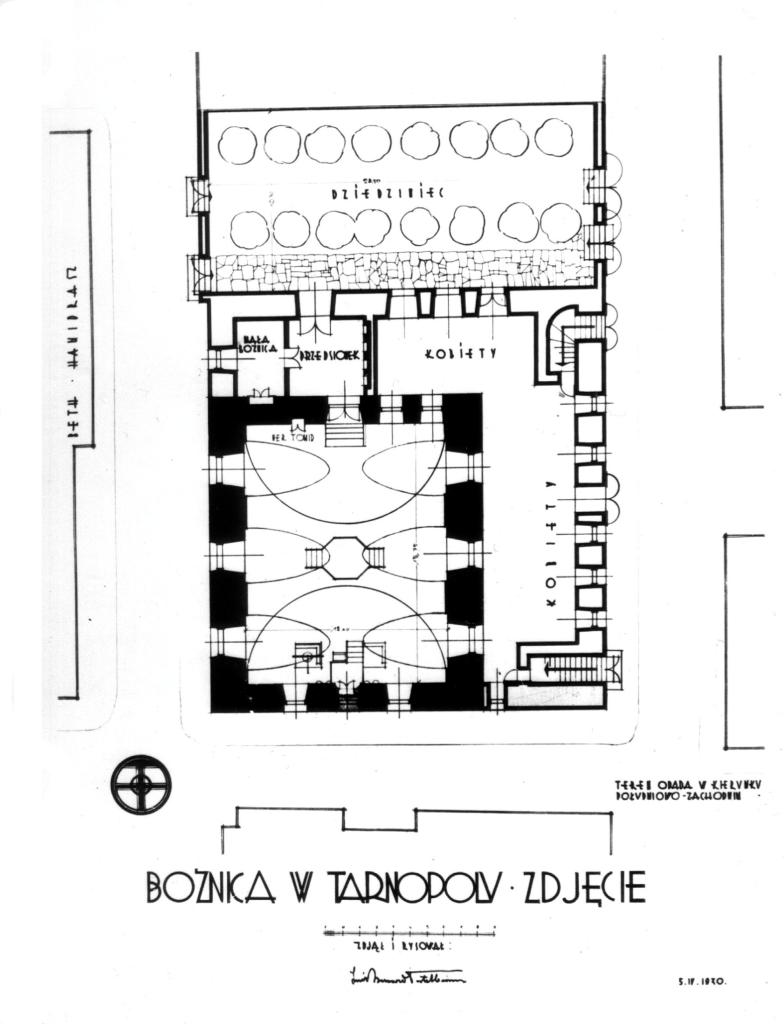
Figure 3: ‘Synagogue in Tarnopol – Survey. Surveyed and drawn by: Eng. Bernard Teitelbaum, 5 May 1930’ as part of his work with the Kuratorium. Source: Museum of Ethnography, Arts and Crafts in Lviv, Kuratorium File U, Tarnopol: the synagogue and old cemetery, call no. 12617.[20]
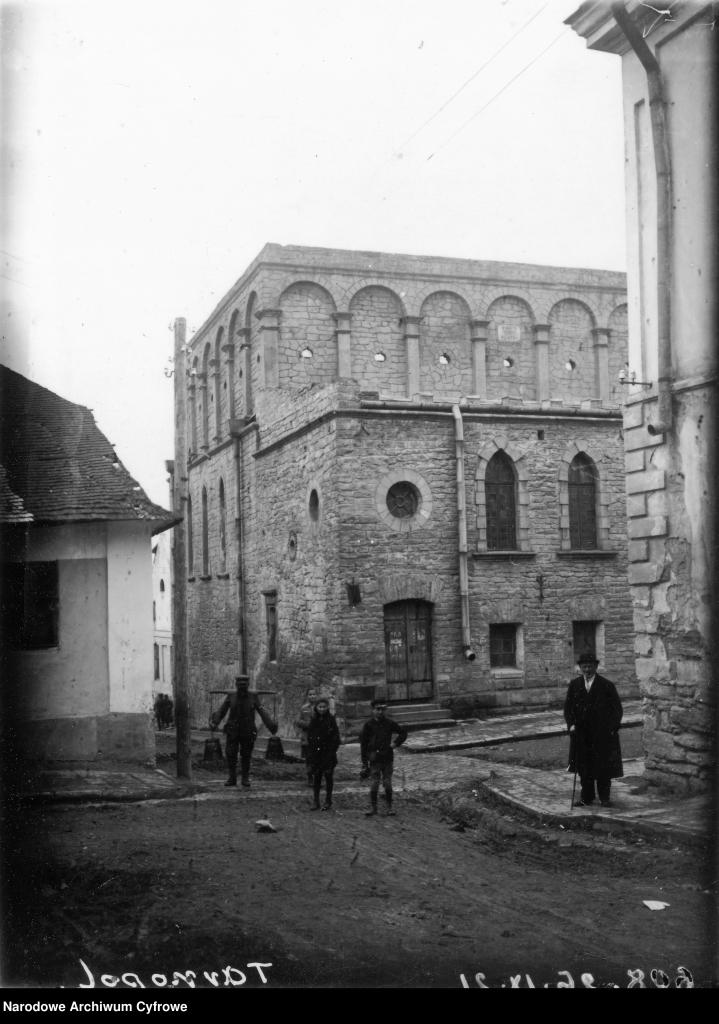
Figure 4: Tarnopol Synagogue (now Ternopil, Ukraine), 1921. Source: Polish National Digital Archive, Collection of photographs of Lwów and environs, call no. 3/41/0/-/1178/1/.
In 1930, Teitelbaum undertook a study tour of Roman and Renaissance architecture in Italy that left a deep impression. More than 50 years later, he wrote page upon page lauding the architectural treasures of Venice (‘like in a dream’), Florence (‘absolute harmony’) and Rome (‘a city of cities’).[21] While working for Awin, Teitelbaum assisted with the design of the Jewish Students’ Sanatorium in Worochta (now Vorokhta, Ukraine), completed in 1934, and supervised works to the Lwów Jewish Academic House in 1930–31.[22]
In 1932, Teitelbaum established his own private practice in Warsaw. His work included refurbishing insurance company office buildings across Poland, and he designed a group of new apartment buildings in Kraków (Figure 5). In the late 1930s, Teitelbaum returned to Lwów for several industrial projects and, in 1939, prepared to defend his doctoral thesis on the fortified synagogues of eastern Poland.[23] During this decade, he also made regular study tours to see new residential architecture, hospitals, industrial buildings and multistorey garages across Europe.[24]
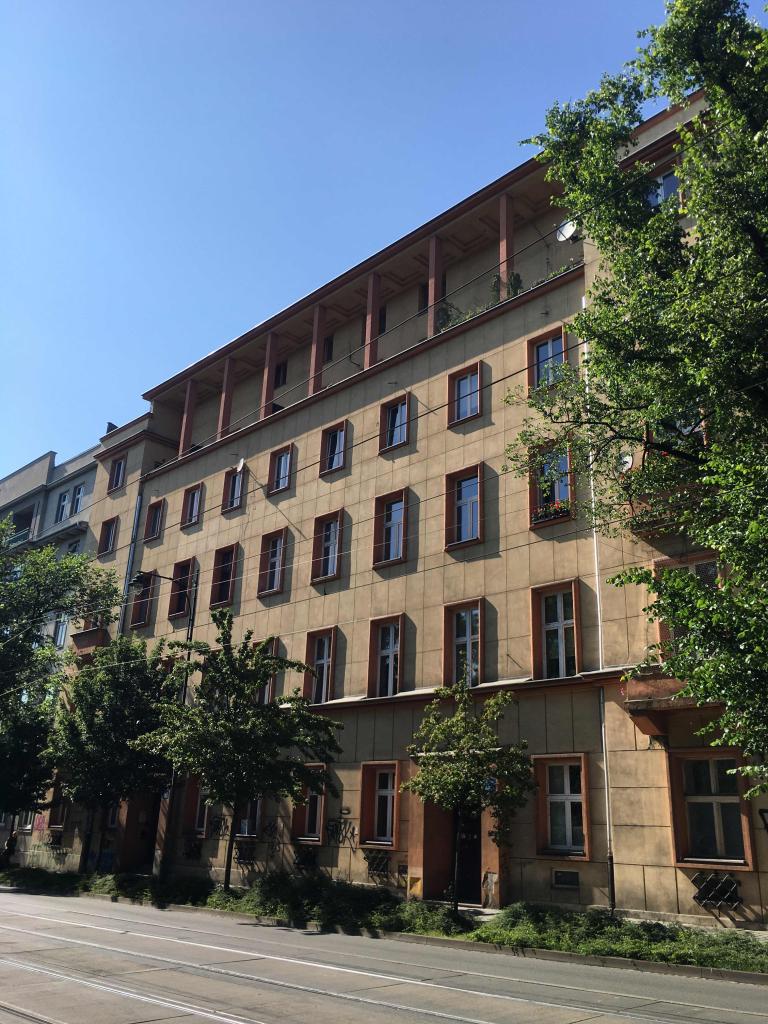
Figure 5: Apartment building at 5-5A Basztowa Street, Kraków, designed by Bernard Teitelbaum in 1934. Of Slawik’s Polish-built work, this apartment block is the most inspired by International Style architecture; his other works are more conservative. Even so, this apartment block can be read as a modernist adaptation of a neoclassical urban typology, and was perhaps influenced by Teitelbaum’s travels in Italy and the Novecento architecture of Giovanni Muzio and Marcello Piacentini. Source: Photograph by Tomasz Tomaszek, 2025.
After German troops reached Warsaw in September 1939, Teitelbaum and his new wife, Alma Parnes, set out on foot to Lwów. They left behind the only copy of Teitelbaum’s unsubmitted doctoral thesis, which is presumed destroyed (Figure 6). Russia seized command of Lwów shortly after their arrival. Teitelbaum managed to find work as an engineer at a tannery, but, on 30 June 1941, German troops entered Lwów.[25] A pogrom took place the following day, 1 July. Teitelbaum was attacked and thrown into a prison, watching as German soldiers photographed the horrors. He later described seeing an unconscious older Jewish man: ‘Two Ukrainians grab him by the legs and drag him across the cobblestones across the courtyard. It leaves a bloody trail. His head surrenders helplessly, bouncing up and down.’ Teitelbaum approached a German soldier to explain that ‘innocent people were grabbed from their homes or kidnapped off the street’. The soldier smiled and responded: ‘You Jews are all communists; the war is your fault’[26]—a trope frequently used by participants to justify the pogrom.[27] While Teitelbaum was freed thanks to a Ukrainian co-worker from the tannery who identified him as a ‘Pole’ (i.e. a Catholic), the day weighed heavily on him, leading him to question his belief in humanity and to conclude that: ‘Man is a beast and a vile one.’[28]
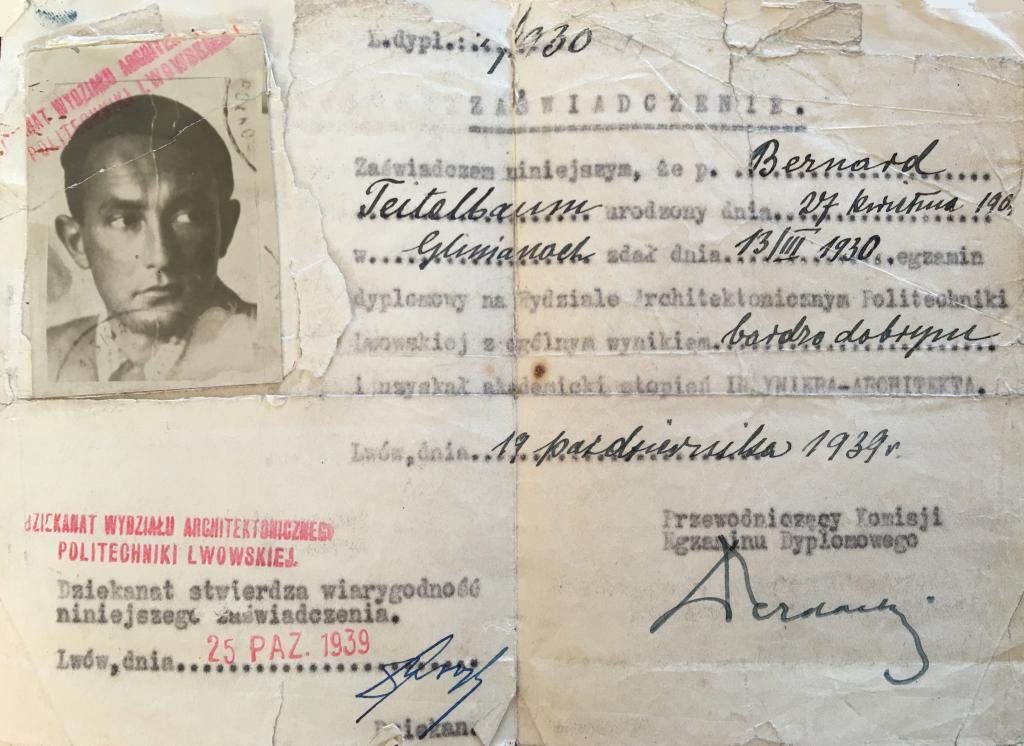
Figure 6: Certification that Bernard Teitelbaum, born 27 April 190[4], in Gliniany, passed the graduation exam on 13 March 1930 with honours at the Architecture Faculty, Lwów Polytechnic, and earned an engineer-architect degree. This was issued on 19 October 1939, replacing Teitelbaum’s original diploma, left behind in Warsaw. Source: Australian War Memorial, Slawik, Bernard (b.1904–d.1991), AWM2016.810.4.
German troops established the Lwów Ghetto in early November 1941. Hoping to evade capture, the Teitelbaums split up, placing their baby daughter Ewa into the care of a Catholic family. Alma exchanged her engagement ring for Catholic identify papers and went to Warsaw under the name Maria Kołtuniak.[29] Despite these steps, Teitelbaum was incarcerated in the Janowska concentration camp in Lwów, where he was set to work in the drafting office (Figure 7). Fortuitously, this work included site management of barrack construction, which enabled Teitelbaum to leave the camp regularly. Alma managed to send him false papers, which he hid on the building site. When he believed his forged papers had been discovered he fled, hiding for days in a snowdrift in nearby woods.[30] Bernard Teitelbaum then took on a new identity with the counterfeit papers: he retained his original birthdate, but became the Polish Catholic Zygmunt Sławik (Figure 8).[31] He kept this surname, even in Australia, leading to confusion about his original name (often cited as ‘Zygmund [sic] Teitelbaum’) and whether he survived the war.[32]
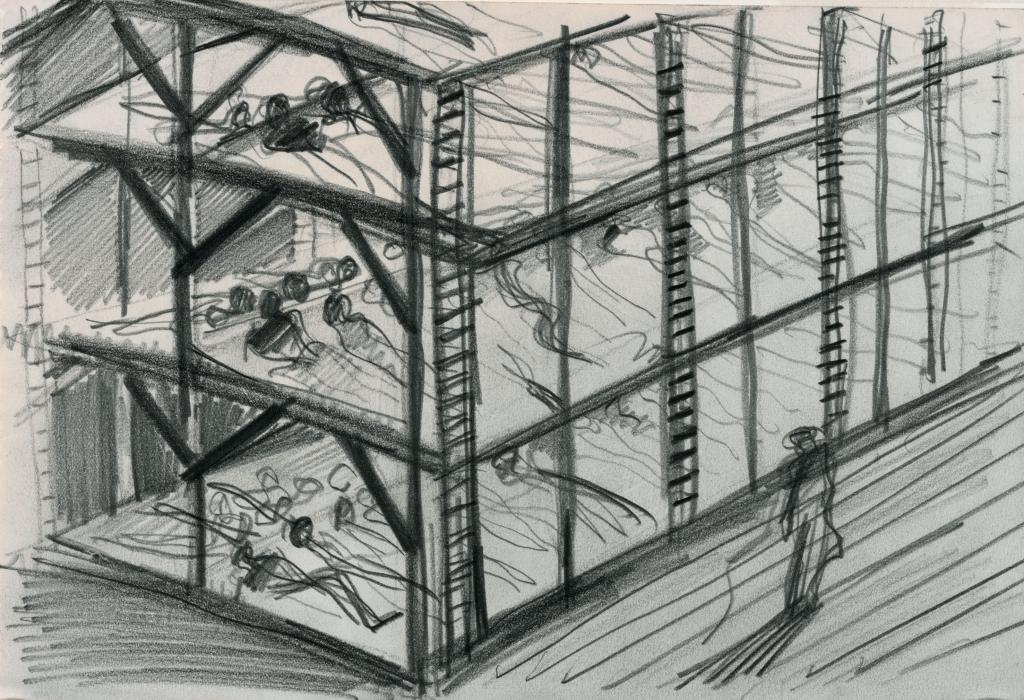
Figure 7: ‘Bunk beds’, by Bernard Teitelbaum, c. 1943. This sketch depicts three-storey bunkbeds in the Janowska concentration camp, constructed of wooden planks, with barely enough room to sit up. When Teitelbaum was in the concentration camp, in 1943, he had not yet adopted the name Slawik. Source: Australian War Memorial, cited as Bernard Slawik, ‘Bunk beds’, c. 1943 (Pencil on paper, 16.0 x 24.0 cm) AWM ART 90351, available at <https://www.awm.gov.au/collection/C287259>, accessed 20 April 2026.
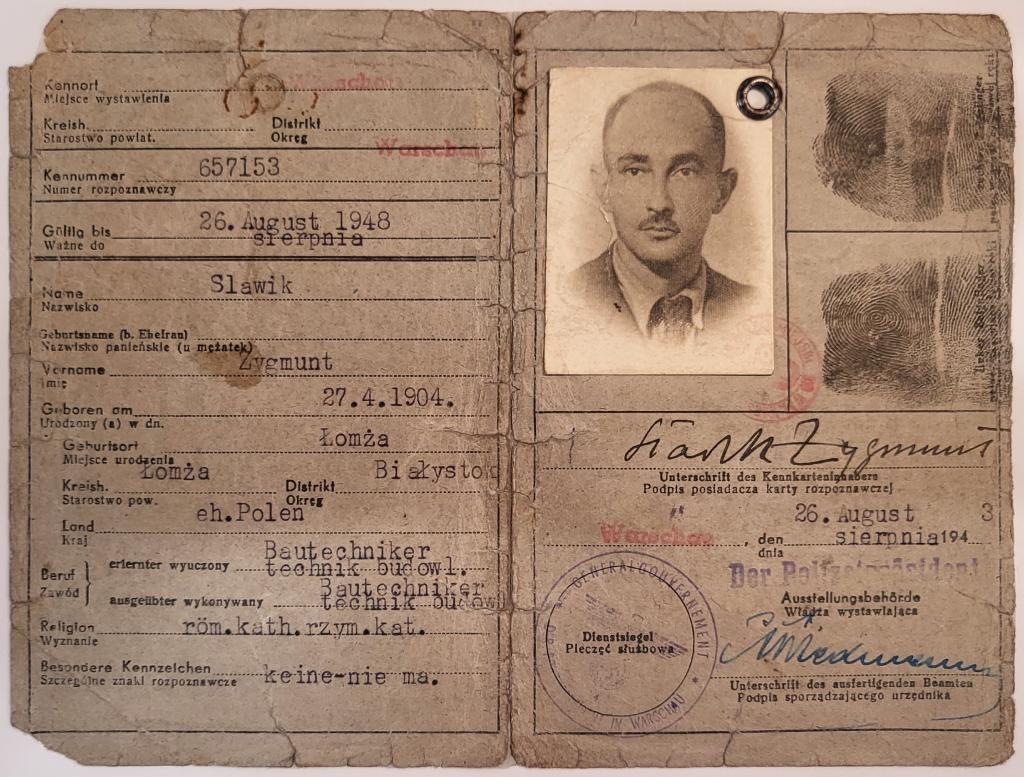
Figure 8: Teitelbaum’s false German General Gouvernement ID, dated 26 August 1943 and valid until 26 August 1948. It gives his name as Zygmunt Sławik, a Catholic structural engineer born in Łomża, Poland, on 27 April 1904. Source: Australian War Memorial, Slawik, B, AWM2017.1330.1[33]
After his escape, Sławik reunited with Alma in Warsaw. They arranged to be sent to Germany for forced labour, as they believed they could better pretend to be Catholic Poles there. Sławik worked as a carpenter’s assistant for the remainder of the war. After Germany surrendered in May 1945, the Sławiks travelled to Kraków, and then Alma retrieved their daughter from Lwów.[34]
Once reunited, the family, now known as Zygmunt, Alma and Ewa Sławik, moved to Warsaw, which had been bombed in 1939 and then largely destroyed by German troops after the Warsaw Uprising. Sławik was engaged as an engineer-architect and then, from June 1945 to July 1946, as deputy chief of the Economic Planning Department within the Warsaw Reconstruction Office. The Warsaw Reconstruction Office’s aims included returning Warsaw to a functioning capital and reconstructing its historic centre, which was intended as an act of resistance against the Nazis’ attempts to erase the city and the Polish nation.[35] Slawik supervised the ‘plan of rebuilding [which] included detailed schedules for restoration of the power, light, water mains, sewerage, for rebuilding schools with a time table for each job’. He also helped to develop gruzobeton (rubble concrete), a ‘method where rubble was mixed with concrete—and building blocks formed on the site’.[36] Entire suburbs were reconstructed using this rubble concrete.[37] Sławik also took on independent commissions, designing warehouses for the Central Depot for Buildings Materials. Later he assisted Rabbi Dawid Kahane (at that time chief rabbi of the Polish Army, later chief rabbi of Argentina) to repair the only surviving synagogue in central Warsaw, the Nożyk Synagogue, for the 1946 High Holidays.[38]
Despite improving fortunes, the Sławiks could see the impact of antisemitism on their daughter and decided to leave Poland, hoping to settle in the British Mandate of Palestine. In late 1946 they went to Sweden, where Sławik worked for the municipal architect of Gavle, preparing plans for an aged care home, kindergarten and theatre. In his spare time, he sketched Gavle’s Old Town.[39] Migration to the British Mandate of Palestine was illegal at this time and was considered too risky for young Ewa, thus the Sławik family considered other potential destinations. In 1947, Sławik placed advertisements in the Australian Jewish press seeking Leopold Weintraub, a friend from Lwów, who, after contact was made, sponsored the family’s immigration to Australia in September 1948.[40]
Once settled in Melbourne, Sławik anglicised his name to Slawik and found a temporary post with prominent modernist architects Yuncken, Freeman Brothers, Griffith and Simpson. Five months later, he was engaged by architect-planner Frank Heath for the remainder of 1949.[41] Heath helped many émigré architects relaunch their careers in Australia, including Ernest Fooks, Kurt Popper, Charles Lipsett, Slawik, Oscar Gimesy and others.[42] After leaving Heath’s office in 1950, Slawik spent six months unsuccessfully attempting to establish his own private practice, designing a doctor’s surgery and residence (client and location unknown).[43]
For the next five years, Slawik was employed by the Public Works Department (PWD) of Victoria, first in a temporary role then, from December 1954, as a permanent architectural assistant.[44] During this time, he participated in developing the standardised design for Light Timber Construction school buildings,[45] a method used to establish dozens of new high schools and technical schools from 1953.[46]
European architectural qualifications were not recognised by the ARBV, thus, in 1948, Slawik began the arduous process of architectural registration (Figure 9).[47] He sat many of the ARBV’s exams over the coming years, finally achieving the status of a registered architect in May 1952. Over these years, he referred to himself as Zygmunt Bernard Slawik, then Z. Bernard Slawik, and finally Bernard Z. Slawik, reclaiming his first name.[48]
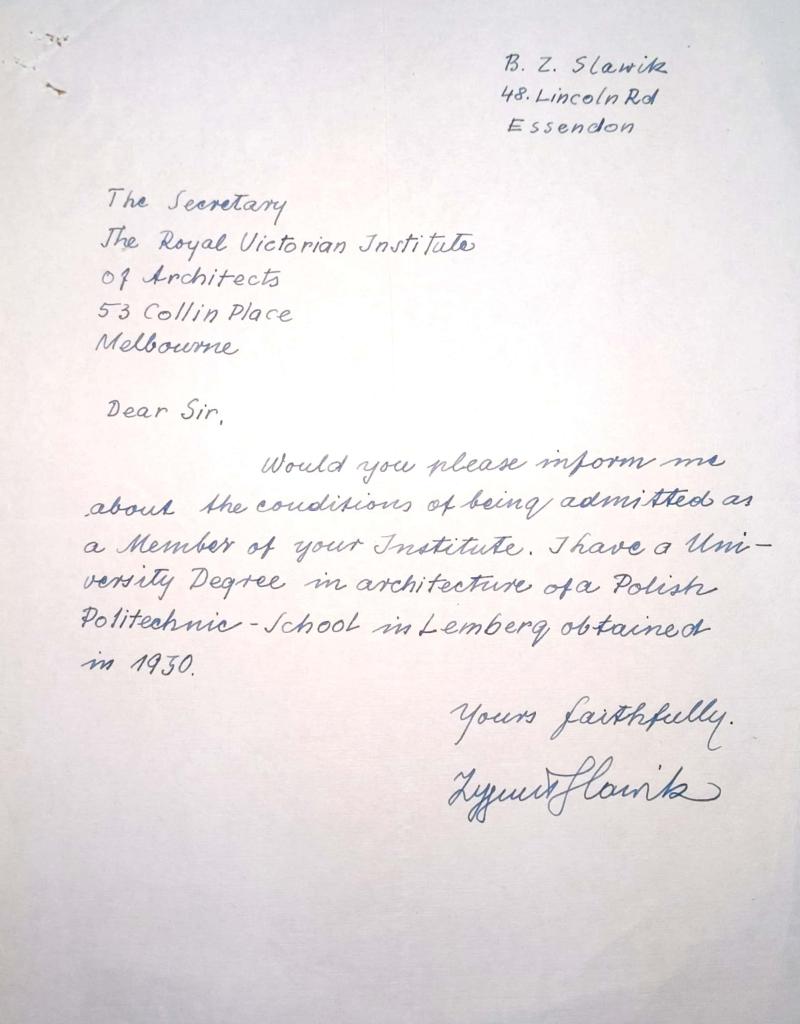
Figure 9: Letter to the Royal Victorian Institute of Architects, enquiring about registration, signed ‘Zygmunt Slawik’, 1948. Slawik notes his architecture degree from the Polytechnic in Lemberg, the German name for Lwów/Lviv. Source: PROV, VPRS 8838/P2, Unit 13, File ‘Slawik, Zygmunt Bernard 1952-1981’.
While at the PWD, Slawik also designed private commissions, such as a weekender in Kalista, and promoted his expertise more broadly. In 1953, Slawik and Bernard Joyce, a British migrant colleague at the PWD, entered a design to the Small Homes Service competition that was awarded a special prize (Figure 10).[49] Slawik also spruiked his idea for a ‘permanent building centre which would concentrate on the collection and dissemination of all the world’s latest information on building materials and methods’.[50] Slawik was professionally active in the Jewish community, delivering lectures on art, architecture and planning.[51] He was a founding member of both the Technion Society of Australia, which brought together Jewish architects, engineers, scientists and technicians, and the Jewish Association of Galicians and Silesians.[52]
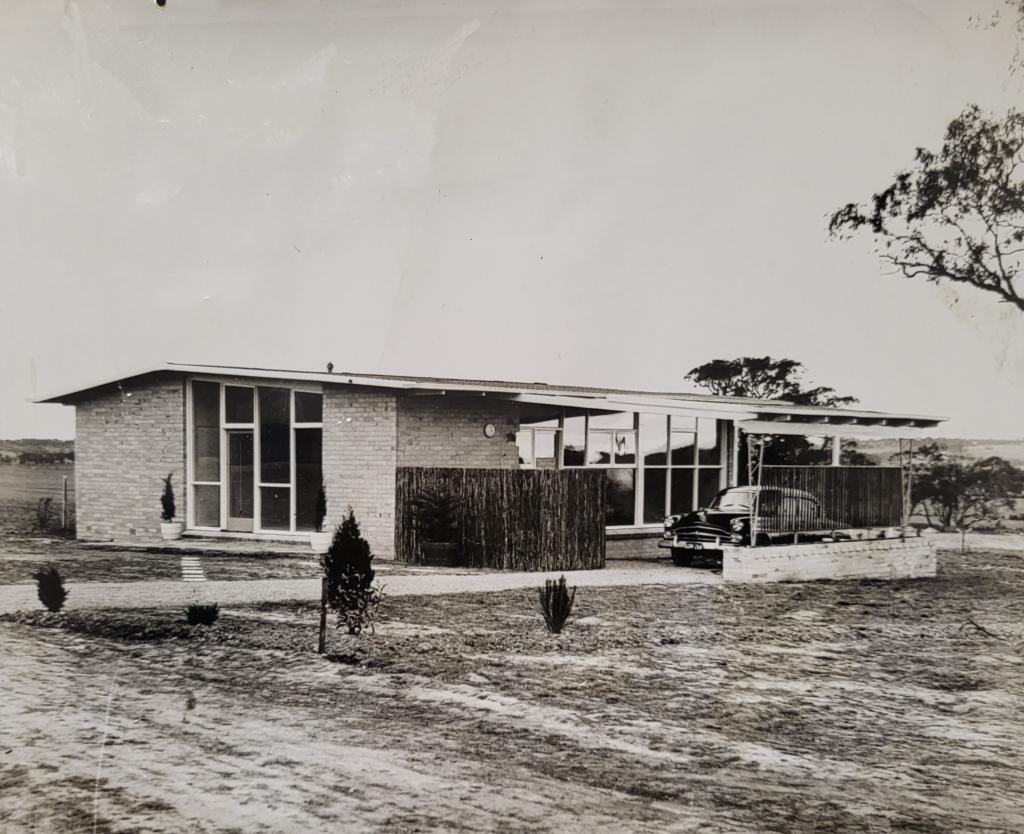
Figure 10: Bernard Slawik and Bernard Joyce’s award-winning Small Homes Service design of 1953, Model V256. Undated photograph of an example erected in Dromana. Source: Australian War Memorial, photograph album related to Bernard Slawik, AWM2016.810.8.
In 1956, Slawik left the PWD and successfully established his own private practice.[53] Most of his clients were compatriots: Jewish émigrés, often Polish, who commissioned Slawik to design their residences (Figures 11 and 12). Slawik also designed a number of apartment buildings (Figure 13), several light-industrial buildings (both his own investment property and factories for others) (Figure 14), and a shopping centre, location unknown.[54] His greatest satisfaction was the Stanmark Reception Centre, East St Kilda, completed c. 1957, which served as an important gathering place for the Melbourne Jewish community for many years.[55]
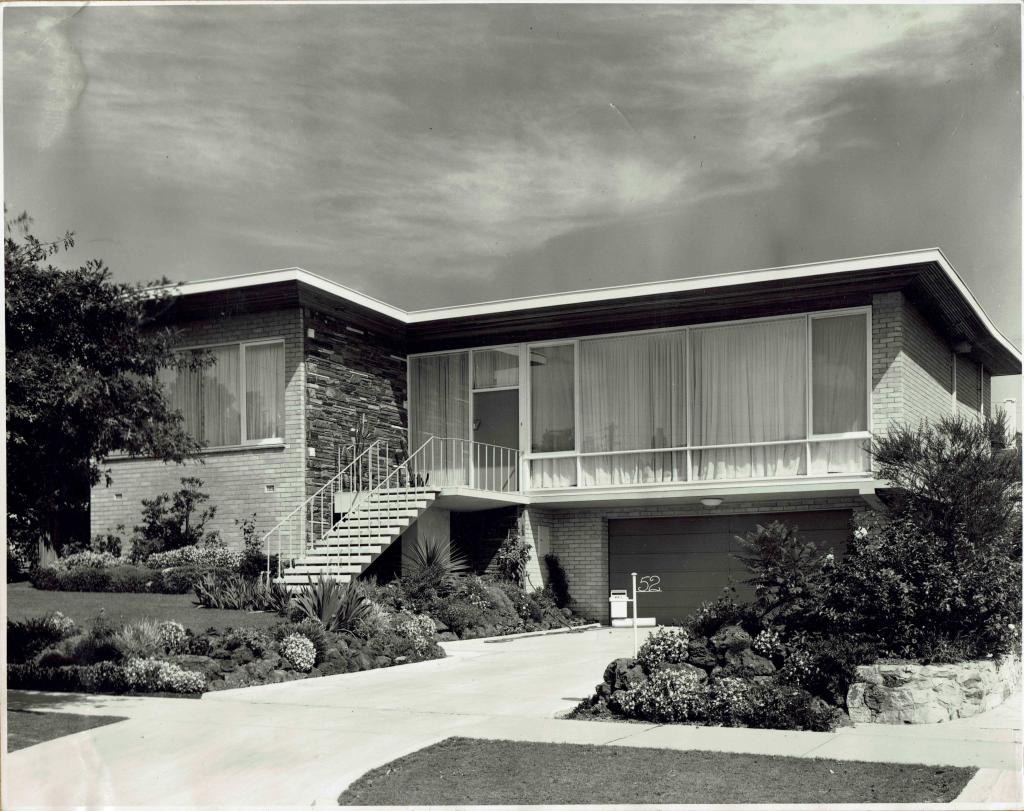
Figure 11: Ilin House, 52 Walbundry Avenue, Balwyn North, 1958. Source: Slawik Family Collection.
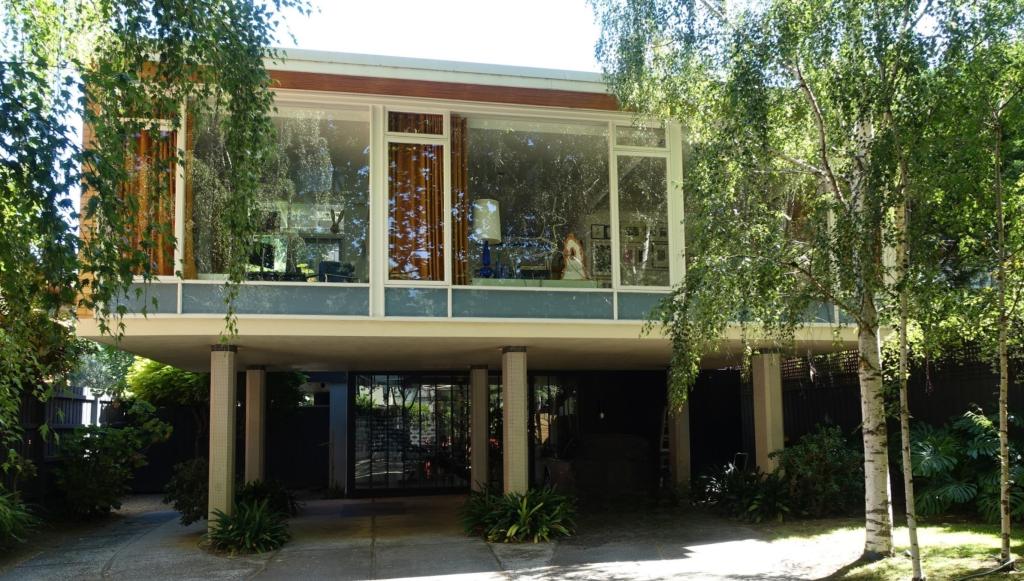
Figure 12: Maurice and Stephanie Fast House, 35 Larnook Avenue, Prahran, 1959. Source: Photograph by Natica Schmeder.
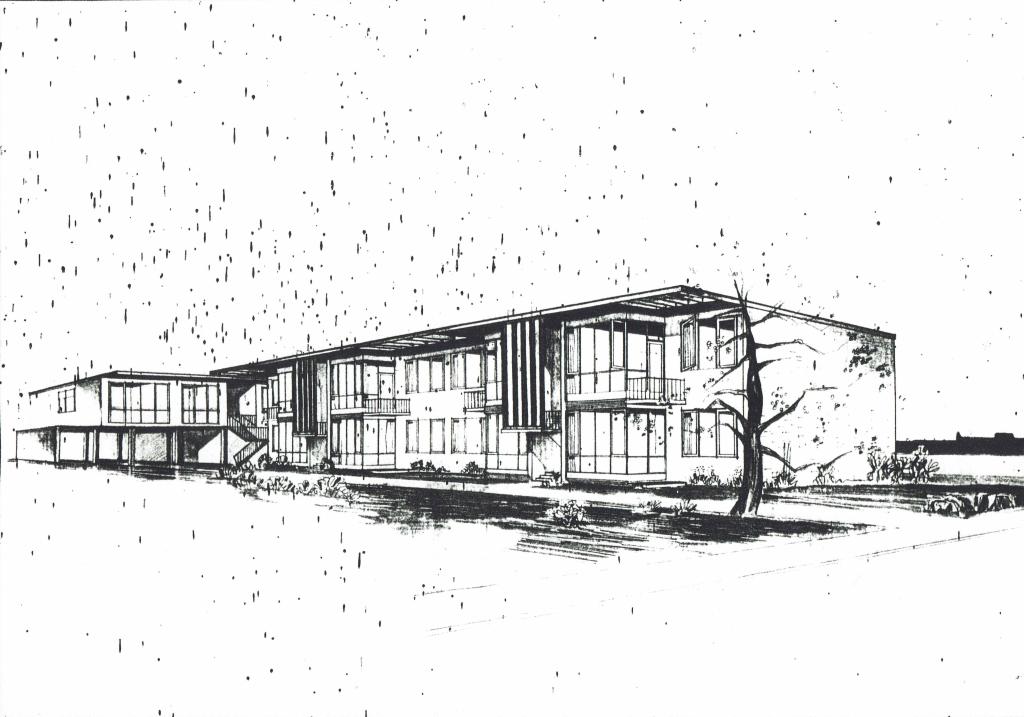
Figure 13: Perspective of Edme Court flats, 578 Glenferrie Road, Hawthorn, c. 1962–63. Source: Slawik Family Collection.
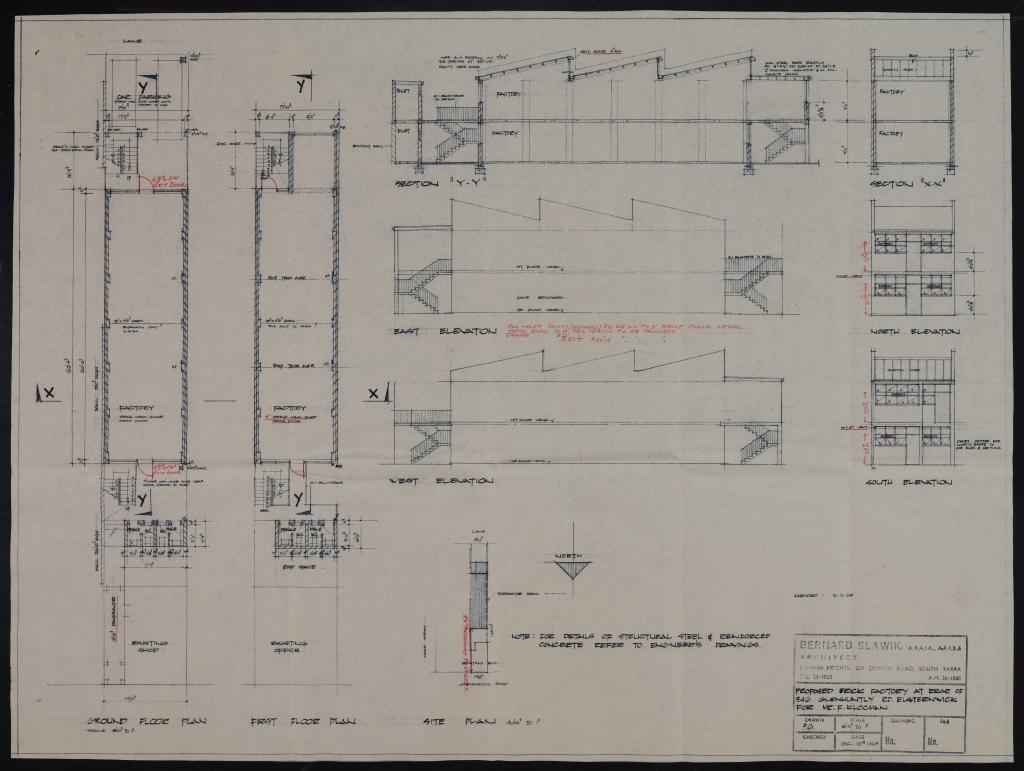
Figure 14: Plans of a clothing factory at 346 (rear) Glenhuntly Road, Elsternwick, for F Klocman, 1964. Source: PROV, VPRS 10150/P0, Plan 8526 File Red 5290.
After 1967, Slawik’s design output dropped due to ill health, and he considered giving up his architect’s registration. He fully retired in 1981. While he had never abandoned fine arts, in the late 1960s, Slawik seriously studied printmaking. He spent his final years focused on his art practice, exhibiting in Victoria and Queensland. His work was collected by museums in Australia, Britan, Israel, Sweden and Switzerland.[56] He died on 7 February 1991, leaving behind Alma, Eva and two grandchildren.[57]
Re-establishing an architectural career
Slawik’s biography demonstrates a similarly winding professional career to that of Tóth. Central to The Brutalist are the difficulties Tóth encounters re-establishing his architectural career—his periods working as a labourer loading coal, designing and building furniture, as well as his varied architectural practice. Slawik’s career was even more wide-ranging. In Poland, his early professional work included historic preservation work on Jewish art and architecture, and his postwar years in Warsaw were devoted to reconstructing the city, including repairing the Nożyk Synagogue. Slawik’s prewar private practice in Poland included modernist design and more conservative outputs. During the war, he worked cleaning rifles for the German army in Warsaw, at Janowska concentration camp as a draughtsman and building supervisor, and as a carpenter’s assistant in Germany.[58] In Sweden, his output was largely civic. In Melbourne, Slawik worked for large- and medium-sized private firms and in the public service (in the PWD) before ultimately establishing a successful private practice. Slawik even turned his hand to furniture design, as does Tóth in The Brutalist, establishing a short-lived furniture company, Arden Design, as part of his private architectural practice (Figure 15).
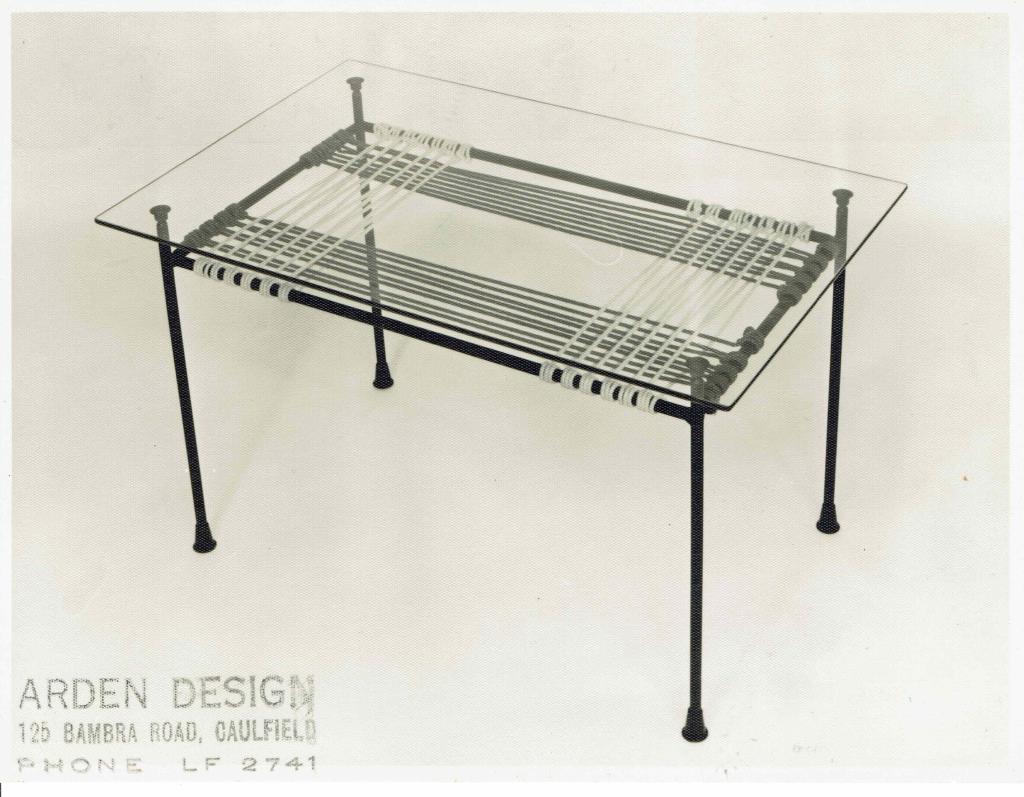
Figure 15: Coffee table of glass, metal and cord, designed by Slawik under the Arden Design label. The address, 125 Bambra Road, Caulfield, was the family’s home from 1953, and Slawik’s design studio from 1956 to 1959.[59] This coffee table from Arden Design bears a strong similarity to the work of then Melbourne-based Clement Meadmore’s industrial design, employing his signature Venetian blind cord windings and rubber knobs, alongside glass and painted steel.[60] Source: Photograph by the Kenneth Ross Studio, Melbourne, Slawik Family Collection.
Careers as diverse as Slawik’s and Tóth’s were not uncommon among émigré architects. Many other émigré architects in Melbourne needed to adjust their professional output to maintain an income: for example, prewar émigré architect Herbert Tisher diversified into furniture design and construction, and, at the end of his career, sold church organs.[61] Prewar émigré architects Hermann and Anneliese Baum, and Andor Meszaros, changed their careers entirely, becoming, respectively, a wooden toy manufacturer, a domestic cleaner and a sculptor in Australia.[62] Such career changes were primarily driven by the lack of professional recognition afforded to émigré architects in Australia. While not as obstructive as the medical field, none of the professional architectural bodies in Australia recognised Continental European qualifications.[63] Thus, to join the architectural profession, and receive concomitant financial remuneration, émigré architects needed to pass the ARBV’s examinations. The financial burden of retraining weighed especially heavily on those with children, and many émigré architects—like the Baums—could not afford the process.
Similarly, the expertise émigré architects arrived with was not always recognised or rewarded with comparable job opportunities. When Slawik arrived in Australia in 1948, few, if any, local architects had as much experience as he in architectural preservation, restoration and reconstruction. Certainly, none had undertaken doctoral theses in these areas. Even so, Slawik’s involvement in historic art and architecture in Australia was limited to lectures on Jewish art and synagogues delivered to Jewish groups and as an organiser of the 1964 ‘Hebrew Art and Culture’ exhibition at the National Gallery of Victoria.[64] When Slawik was establishing his architectural career in Australia, organisations such as the National Trust of Australia (Victoria) were dominated by white Anglo-Saxon Protestant members from ‘the intellectual wing of the Australian establishment’[65] who showed little interest in Jewish heritage or Slawik’s skills.[66] There is no record of Slawik working in heritage conservation in Australia.
Postwar conditions in Australia and the United States were not analogous. Yet it is clear from Slawik’s career, and that of many other émigré architects recorded in the files of the ARBV, that, at least in Australia, re-establishing careers could be a circuitous process. Critics of The Brutalist overlook the fact that, even in the United States, Mies van der Rohe faced difficulties registering as an architect in New York, such that he had to enter into an architectural partnership of sorts with Philip Johnson to allow him to design the Seagram Building, now considered one of the iconic buildings of the International Style.[67] Once removed from the professional associations and patronage networks of Europe, happenstance, patronage, and economic and regulatory conditions in the migration country played a significant role in career paths for architects, and The Brutalist is not wrong in highlighting these impediments to architectural practice.
Jewish identity
Another element frequently overlooked in discussions of Jewish émigré architects, but present in The Brutalist and Slawik’s biography, is the importance of Jewish identity, both personally and professionally. Tóth’s religious commitment is an important aspect of his character throughout The Brutalist and the epilogue reveals that the project that meant the most to him was a synagogue he designed. While many of the twentieth-century’s Jewish diaspora led assimilated lives prior to Hitler’s rise to power, Slawik’s biography makes it clear that Jewish identity was a central force throughout his entire life. From his early involvement with Zionist groups, his synagogue and Jewish art–focused heritage practice and research in Poland, to his private practice dominated by work for Melbourne’s Jewish community, Slawik’s Judaism was only relegated when he assumed a false identity to survive Nazi persecution. Both architects saw the foundation of Israel as of paramount importance for Jewish people. Years after the outbreak of the 1967 Arab–Israeli War, Slawik remembered his passionate desire to serve in the conflict.[68] Like Tóth, the buildings Slawik took most professional pride in were for the Jewish community: in Slawik’s case, it was repairing the Nożyk Synagogue in Warsaw and designing the Stanmark Reception Centre. To discuss these émigré architects’ careers without attending to their Jewish identity would be to overlook a fundamental underpinning of their work.
Similarly, Jewish identity was important for émigré architects professionally. Both the fictional and the real architects’ careers were bolstered by Jewish patronage, with substantial numbers of their private practice commissions designed for Jewish clients. Slawik’s clients were mainly drawn from his social circle, which consisted almost exclusively of Polish and Austrian Jewish émigrés.[69] The overlap between Slawik’s clients and friends makes it difficult to ascertain whether his clients hired him primarily based on friendship, a shared aesthetic sensibility, or in an ethno-supportive fashion due to shared Polish and/or Jewish backgrounds. In Melbourne, 12 single-family homes have been identified as designed by Slawik: of these, eight were for Polish–Jewish clients,[70] two were for Jewish émigrés from other countries,[71] and two were for Anglo-Australians.[72]
Slawik also designed a number of apartment buildings and these tended to have a more varied clientele (one Polish–Jewish client, two from other Central European countries and two for Anglo-Australians), hinting that European-trained architects may have been recognised more widely for their knowledge in this sphere.[73] Despite such strong correspondence between Jewish identity and the careers of émigré architects, this aspect is often omitted from scholarly discourse.[74] In part, this may be because, frequently, the émigré architects who were the most successful in the United States, Australia and elsewhere were not Jewish. This, in itself, is a notable feature largely unexplored among current émigré architect scholarship that warrants further attention. For all its deficits, The Brutalist does not shy away from representing Jewish identity and highlighting its centrality for Tóth. As such, the film gives expression to a vitally important aspect of the life and experience of the majority of architects displaced from Europe by Hitler’s rise to power.
Surviving the Holocaust and visual testimony
Concentration camp experiences left indelible imprints on both Slawik and Tóth. A solemn and serious man, Tóth turns first to heroin, and later to obsessive work in his architectural practice to stave off the horrors of his memories. As a form of a visual testimony to his Holocaust experience, Tóth encodes the dimensions of his cell and camp in the institute he designs for the Van Burens.[75] Equally serious minded, Slawik documented his time in the Janowska concentration camp via sketches that bore visual witness to the architectural form of the camp and the atrocities he experienced (Figure 16).[76] As Janet Blatter and Sybil Milton demonstrate in Art of the Holocaust, artists and architects have used various artforms to bear witness to, and emotionally process, their Holocaust experiences.[77] Slawik wrote of his art practice and its role in managing his memories and emotions in a short memoir penned in c. 1978:
The everyday tasks of the profession did not stop me … [pursuing] my need for expression in other spheres of art.
Weekends, holidays, times between other work were devoted to active work in painting drawing sculpture and later in etching and lithography & this diversion from constant work in architecture, did give an outlet of the need to express myself … despair, would draw my attention, and hundred [sic] of drawing, sketches in black and white or colour would stay [sic] be gradually collected in drawer.[78]
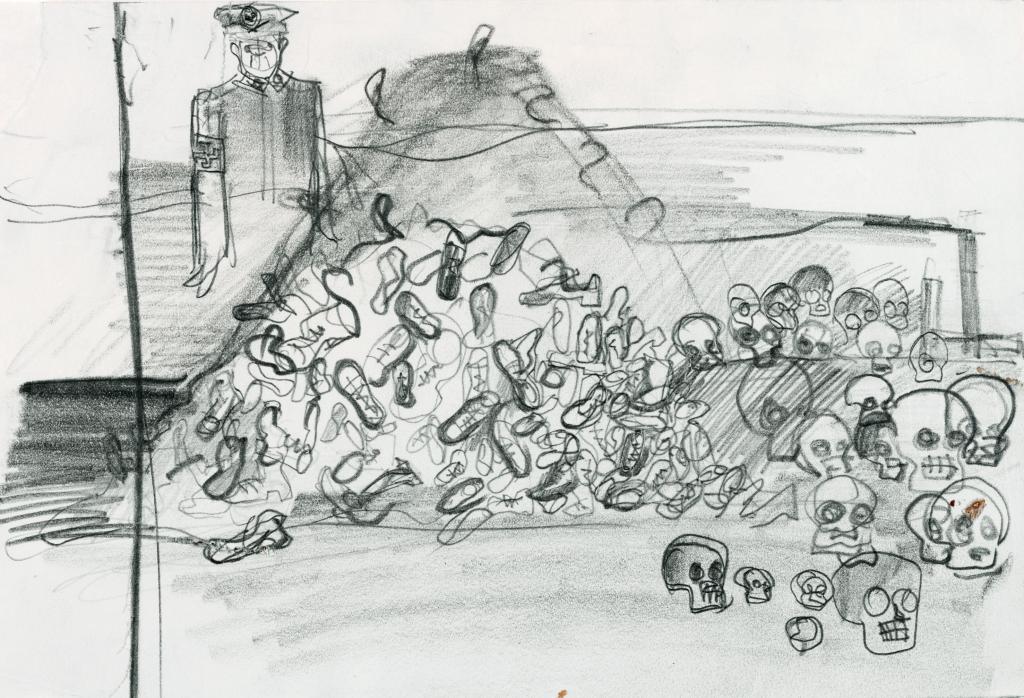
Figure 16: ‘Pile of skulls and shoes’, by Bernard Teitelbaum, c. 1943. Source: The Australian War Memorial (Pencil on paper, 16.1 x 24.2 cm) AWM ART90358.
Janowska was a significant theme in Slawik’s artistic output throughout his life, along with architectural sketches and biblical-themed works.[79] Eminent art curator Betty Churcher believed that the Janowska sketches donated to the Australian War Museum by the Slawik family were drawn during Slawik’s incarceration in the camp.[80] Slawik’s ability to contemporaneously document the camp was rare; unlike most inmates, he had access to drawing materials in the camp drafting office. The larger amount of Holocaust art was produced after war ended. Even so, Slawik was not the only incarcerated architect to record the atrocities at Janowska. Wilhelm Ochs (later Ze'ev Porath), another graduate of Lwów Polytechnic where Slawik studied, also worked in the Janowska drafting office and used his skill with a pencil to record the traumatic events surrounding him.[81] The horrors Slawik, Porath, and the fictional Tóth endured while incarcerated stand in marked contrast to the lives of émigré architects who were already rebuilding their careers in new countries in the late 1930s. Slawik’s memoir demonstrates that, like Tóth, the memories of his experiences in Janowska required ongoing active management. While we can quibble with the cinematic choice of heroin addiction in The Brutalist, Corbet, unlike the majority of architectural critics of the film, was right to realise that camp experience would leave its mark on all who endured its terrors.
Slawik’s modern architecture in postwar Melbourne
Perhaps the only way that Slawik’s and Tóth’s lives, careers and experiences correspond to canonical notions of émigré architects is in the last successful stage of their careers in private practice. Critics of The Brutalist are correct to note the improbability of Tóth’s designs. Slawik’s work of the 1950s and 1960s adopted the architectural modernism promulgated by architects such as Mies and Gropius in the United States. Even so, Slawik’s work does not slavishly adhere to the strictures of the International Style; his architectural experiences in Sweden, Poland and Melbourne moderated his approach. His early work in partnership with Joyce is among that most mediated by Australian architectural practice. Slawik and Joyce captured the Small Homes Service’s approach in their competition-winning design (Model V256, 1953), which was later built in Dromana (Figure 10). Their small, economically and pragmatically built house met the local architectural establishment’s notions of what constituted correct planning and modern design, and was the only architectural competition Slawik won in Australia.
Once Slawik established his own private practice, he diverted from the local profession’s orthodoxy, designing buildings in the manner of other locally based émigré architects such as Ernest Fooks and Kurt Popper. Colloquially known among the local Jewish community as ‘Yiddisher Modern’, these brick dwellings of one or two storeys had asymmetrical facades with balustraded terraces, corner porches, large windows, flat roofs with expansive eaves and stonework feature walls.[82] Influenced more directly by Southern Californian Case Study houses than Australian sources, Slawik and other émigré architects designed houses that were often constructed with rich and lavish interiors; had intricate timber cabinetry, screens and built in furniture; and, à la Tóth, had lustrous decorative marble—all features and materials their European clients expected.[83] Slawik’s work ranged from the stripped modernism of the Caroline Street Batchlor Flats and the Baker House, Caulfield (1963), to the more eclectically decorated and suburban vernacular–infused Ward House, Eaglemont, c. (1960–63) and the Abrahmovits House, Caulfield North (1964). All his works show an aesthetic process of mediation rather than direct transplantation of European modernism. As his client, Olivia Criseide Coates, noted about Slawik’s elegant design for a block of bachelor flats for single women in Caroline Street, South Yarra, in 1967: ‘I think the flats are very modern, but not ugly modern’ (Figure 17).[84] Despite the quality of design, and perhaps because of the previous paucity of research, only a few of Slawik’s buildings have received heritage protection.[85]
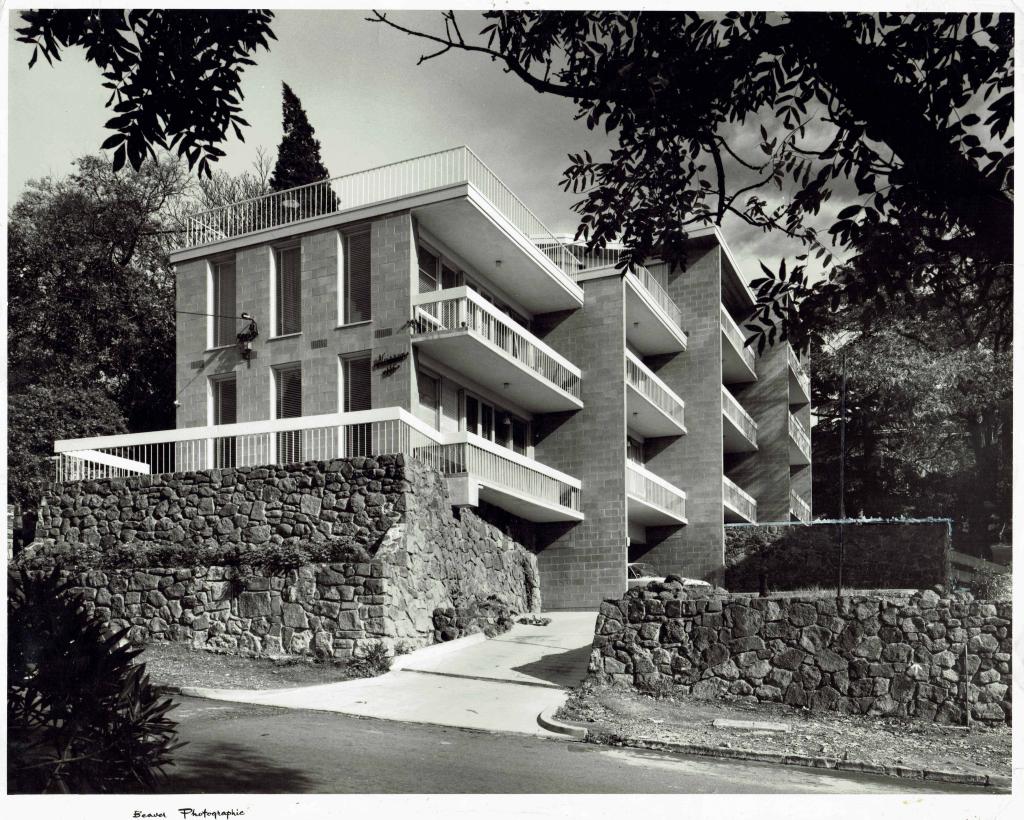
Figure 17: Batchelor Flats, 115 Caroline Street, South Yarra, 1967. Source: Slawik Family Collection.
Conclusion
Slawik’s life, like Tóth’s, had an epic cinematic quality: the numerous swings, turns and reversals of fortune he experienced, and ultimately triumphed over, aptly illustrate a monomyth or hero’s journey. Remarkably, Slawik is only one of several such little-known Holocaust survivor architects whose story is housed in the files of the ARBV at PROV and State Library Victoria.[86] This suggests that, at least in part, critics of The Brutalist are incorrect as to the plausibility of the Tóth character. The individual member file records carefully collated and preserved by the ARBV, and files of the ARBV and Royal Victorian Institute of Architects’ Board of Architectural Education, provide a springboard from which émigré architects, both Holocaust survivors and those who arrived before the war, can be investigated. The sheer diversity of experiences, homelands, migration journeys and architectural practice among these architects means that there can be no straightforward template for understanding their transnational stories. However, the proliferation of record keeping in the twentieth century, and the archival storage of it, facilitate the recovery of these stories, allowing more complex, and, in this instance, cinematic, stories to be told about the architectural diaspora of the twentieth century.
Endnotes
[1] The awards the film has won include Best Director and the Arca Cinema Giovani Award for Best Film at the 2024 Venice Film Festival; Best Motion Picture, Drama, Best Director, Performance by a Male Actor in a Motion Picture, Drama at the 2025 Golden Globe awards; Best Director, Best Cinematography and Best Original Score at the 2025 BAFTA awards; and Best Actor, Best Cinematography and Best Original Score at the 2025 Academy Awards. See below for examples of media attention the film has received.
[2] See, for example, Roger Butler (ed.), The Europeans: émigré artists in Australia 1930–1960, National Gallery of Australia, Canberra, 1997; Stephanie Barron with Sabine Eckmann (eds), Exiles + émigrés. the flight of European artists from Hitler, Harry N Abrams, New York, 1997.
[3] See, for example, Nikolaus Pevsner, Pioneers of modern design: from William Morris to Walter Gropius, Yale University Press, New Haven, 4th ed., 2005 (first published 1936); Sigfried Giedion, Space, time architecture: the growth of a new tradition, Harvard University Press, Cambridge, Massachusetts, 5th ed., 1967; Henry Russell Hitchcock, Architecture: nineteenth and twentieth centuries, Yale University Press, New Haven, 4th ed., 1987; Vincent Scully, Modern architecture: the architecture of democracy, G Braziller, New York, 3rd ed. 1979; Kenneth Frampton, Modern architecture: a critical history, Thames & Hudson, London, 5th ed. 2020; William JR Curtis, Modern architecture since 1900, Phaidon, London, 3rd ed., 1996; Spiro Kostof, A history of architecture: settings and rituals, Oxford University Press, New York, 2nd ed., 1985; Colin Davies, A new history of modern architecture, Laurence King Publishing, London, 2018.
[4] A full literature review of the extensive field of émigré architecture research in Australia is beyond the remit of this paper. The first to locate the phenomenon as a distinctly Jewish one was Harriet Edquist. See Harriet Edquist, ‘The Jewish contribution: a missing chapter’, in Ronnen Goren (ed.), 45 storeys: a retrospective of works by Melbourne Jewish architects from 1945, Jewish Festival of the Arts, 1993, pp. 6–11. Key examples, which, like the majority of the field focus on the transfer of modernism, include Butler, The Europeans; Rebecca Hawcroft (ed.), The other moderns: Sydney’s forgotten European design legacy, New South Books, Sydney, 2017; Kenneth Frampton & Philip Drew, Harry Seidler: four decades of architecture, Thames & Hudson, London, 1992; Harriet Edquist, Frederick Romberg: the architecture of migration 1938–1975, RMIT University Press, Melbourne, 2000. In recent years, three Australian studies that take broader thematic views have been published. See, Catherine Townsend, ‘Making modern Jewish Melbourne: schools, synagogues, aged care facilities and community buildings 1938–1979’, in Remaking Cities: Proceedings of the 14th Australasian Urban History Planning Conference 2018, Melbourne, 2018, <https://apo.org.au/node/212861>, accessed 20 April 2026; Philip Goad, Ann Stephen, Andrew McNamara, Harriet Edquist & Isabel Wünsche, Bauhaus diaspora and beyond: transforming education through art, design and architecture, Miegunyah Press, Melbourne, 2019; RMIT Design Archives Journal, special issue ‘Vienna Abroad’, vol. 9., no. 1, 2019.
[5] The only book dedicated to a Holocaust survivor architect is the German language work by Andreas Schenk, Fritz Nathan—architekt: sein leben und werk in Deutschland und im Amerikanischen exil, Birkhäuser, Berlin, 2015. Not architecturally focused but written by a Holocaust survivor architect is Norbert Troller’s memoir of his incarceration in Theresienstadt: Norbert Troller, Theresienstadt. Hitler’s gift to the Jews, translated by Susan E Cernyak-Spatz, edited by Joel Shatzky, University of North Carolina Press, Chapel Hill, 1991. A rare example of discussion of an émigré architect who survived WWII in hiding is Rebecca Hawcroft, ‘Ferdinand Silberstein-Silvan: loss and legacy’, in Rebecca Hawcroft (ed.), The other moderns: Sydney’s forgotten European design legacy, New South Books, Sydney, 2017.
[6] PROV, Architects Registration Board of Victoria, VPRS 8838/ P0002, Individual Architects Registration Files, Slawik, Bernard.
[7] See, for example, Gwilym Mumford, ‘Why The Brutalist should win the best picture Oscar’, Guardian, 1 March 2025, available at <https://www.theguardian.com/film/2025/feb/28/why-the-brutalist-should-win-the-best-picture-oscar>, accessed 1 May 2025.
[8] Oliver Wainwright, ‘Backlash builds: why the architecture world hates The Brutalist’, Guardian, 30 January 2025, available at <https://www.theguardian.com/film/2025/jan/29/architecture-the-brutalist-marcel-breuer>, accessed 1 May 2025; Architecture Writers Anonymous, ‘Why The Brutalist is a terrible movie’, podcast, 20 December 2024; Owen Hatherley, ‘The loneliest Bauhaus in America—The Brutalist, reviewed’, Apollo Magazine, 6 February 2025, available at <https://www.apollo-magazine.com/brutalist-film-brady-corbet-bauhaus-architecture-review/>, accessed 1 May 2025; Edwin Heathcote, ‘What the movies get wrong about architecture’, Financial Times, 30 January 2025, available at <https://www.afr.com/life-and-luxury/arts-and-culture/what-the-movies-get-wrong-about-architecture-20250129-p5l7z9>, accessed 1 May 2025.
[9] For this criticism, see, in particular, Architecture Writers Anonymous, ‘Why’; Wainwright, ‘Backlash’.
[10] PROV, Architects Registration Board of Victoria, VPRS 8838/ P0002, Individual Architects Registration Files, Beer, John and Kook, Erwin.
[11] Andrew Leach, ‘Helmut Einhorn: dislocation and modern architecture in New Zealand’, Fabrications, vol. 14, nos. 1–2, 2004, pp. 59–82, doi:10.1080/10331867.2004.10525194.
[12] Bernard Slawik, ‘8-page letter to Rabbi John Levi, Temple Beth Israel, c. 1982’, AWM2016.810.4; photographs of the Sygniówka Hehalutz training farm in the 1920s are reproduced as H-009 to H-013 at <http://www.eilatgordinlevitan.com/>, accessed 1 January 2026.
[13] ‘Zygmunt Bernard Slawik-Teitelbaum’s syllabus at Lwów Polytechnic, Faculty of Architecture’ (sworn translation), AWM2016.810.4.
[14] Bernard Slawik, ‘Professional Qualifications’, c. 1953, AWM2016.810.4.
[15] Bohdan Cherkes & Andrzej Szczerski, Lwów: miasto, architektura, modernizm, Muzeum Architektury, Wrocław, 2016, pp. 46, 59, 448.
[16] Sergey Kratsov, ‘Józef Awin on Jewish art and architecture’, in Jerzy Malinowski, R Piątkowska & T Sztyma-Knasiecka (eds.), Jewish artists and Central-Eastern Europe, Wydawnictwo DIG, Warsaw, 2010, pp. 131–144.
[17] Marta Ziętkiewicz, ‘Discussing shared heritage: politics of photomechanically illustrated publications on synagogues in Poland (1895–1957)’, Photography and Culture, vol. 18, no. 2, 2025, pp. 203–228, doi: 10.1080/17514517.2025.2560162.
[18] Mejer Bałaban, Zabytki historyczne Żydów w Polsce, Spółdruk, Warsaw, 1929, pp. 29–31.
[19] Sprawozdanie Kuratorjum Opieki nad Zabytkami Sztuki Żydowskiej przy Żydowskiej Gminie Wyznaniowej we Lwowie, 1928, pp. iv, 6, 16, 28 (thank you to Sergey Kratsov for pointing us to this invaluable resource); Bernard Slawik, ‘Letter to the Jewish News, c. 1982’, AWM2016.810.4; Jüdisch-liberalen Zeitung, 28 January 1931, p. 5.
[20] Photograph of the original taken by Marek Münz (1872–1936), reproduced by Sergey Tartakovskii (1942–2010) and kindly shared with us by Sergey Kratsov.
[21] Bernard Slawik, ‘25-page autobiographical manuscript, c. 1978’, AWM2016.810.4.
[22] PROV, VPRS 8838/P2, ‘Slawik, ZB’, ‘Personal and Professional Statements’, c. 1948; Sergey Kratsov, ‘The Life of Józef Awin’, The Galitzianer, vol. 26, no. 3, 2019, p. 29; Sprawozdanie Roczne Wydziału Towarzystwa Rygorozantów (Żydowski Dom Akademicki) we Lwowie, Ul. Św. Teresy 26A. za rok administracyjny 1931, 1932, p. 5.
[23] Eight apartment buildings on Sereno-Fenna Street, and at 5-5A Basztowa Street, Kraków; PROV, VPRS 8838/P2, ‘Slawik, ZB’, ‘Personal and Professional Statements’, c. 1948; Andrzej Szczerski (ed.), Modernizmy. Architektura nowoczesności w II Rzeczypospolitej, vol. 1, Kraków, Dodo Editor, Kraków, 2014, p. 83.
[24] Bernard Slawik, ‘CV on 125 Bambra Road letterhead’, c. 1983, AWM2016.810.4.
[25] Slawik, ‘8-page letter’.
[26] Bernard Slawik, ‘Niemcy, pierwszy dzień we Lwowie’ (The Germans, first day in Lwów), 3-page Polish manuscript, n.d., Slawik Family Collection (transcription from Polish by Wisława Pisz; translation Natica Schmeder).
[27] John-Paul Hinka, ‘The Lviv Pogrom of 1941: the Germans, Ukrainian Nationalists, and the carnival crowd’, Canadian Slavonic Papers/Revue canadienne des slavistes, vol. LIII, nos. 2–4, June–December 2011, pp. 225, 237.
[28] Slawik, ‘Niemcy, pierwszy dzień we Lwowie’.
[29] Slawik ‘8-page letter’; Alma Slawik, personal testimony, AV 661, video interview by Paul Kaufman at Melbourne Jewish Holocaust Centre, 12 July 1995, Melbourne Holocaust Museum; Maria Kołtuniak, birth certificate and General Gouvernement identity card, AWM2016.810.4.
[30] Alma Slawik, personal testimony; Karen Rosauer, interview by Catherine Townsend & Natica Schmeder, 30 September 2024; Betty Churcher, The art of war, Miegunyah Press, Melbourne, 2005, p. 94. Churcher presents a different version of events in which it is the discovery of sketches of the Janowska concentration camp that provoked Teitelbaum’s flight from the camp. Our extensive archival research cannot confirm this version of events; therefore, we rely on Alma Slawik’s personal testimony in this article.
[31] German General Gouvernement identity card for Zygmunt Slawik, AWM2017.1330.1; Zygmunt Slawik birth certificate, AWM2016.810.4.
[32] Bernard Teitelbaum, born 1904, graduate of Lwów Polytechnic in 1930, was listed among Polish architects who died in WWII in Komunikat SARP [Association of Polish Architects Communique], no. 8, August 1999, p. 10. This has since been corrected on SARP’s ‘In Memorium’ website.
[33] ‘General Gouvernement’ refers to the part of Poland controlled by Germany during WWII (the General Governorate).
[34] Alma Slawik, personal testimony; travel permit, 18 May 1945, notarised statement, 4 June 1945, and travel certificate, 19 June 1945, AWM2016.810.4.
[35] Grzegorz Piątek, Najlepsze miasto świata: Warszawa w odbudowie 1944–1949, Warsaw, GW Foksal Ebooki, 2020.
[36] Employment reference from Warsaw Reconstruction Office, 17 August 1946; Slawik ‘8-page letter’.
[37] Adam Przywara (ed.), Zgruzowstanie. Przeszłość i przyszłość ruin w architekturze, Muzeum Warszawy, Warsaw, 2023.
[38] Employment reference from Central Depot for Building Materials Pty Ltd, Warsaw, 14 September 1946, AWM2016.810.4; plans on tracing paper for previous bakery and new warehouse at 5–7 Prądzyńskiego Street, Warsaw, Slawik Family Collection; David Kahane, interview, 1995.A.1272.28 | RG Number: RG-50.120.0028, United States Holocaust Memorial Museum.
[39] PROV, VPRS 8838/P2, ‘Slawik, ZB’, ‘Personal and Professional Statements’, c. 1948; employment reference, 2 March 1948, AWM2016.810.4.
[40] Sydney Jewish News, 18 July 1947, p. 9; Hebrew Standard of Australia, 16 October 1947, p. 5; ‘Report on Application for Naturalization [sic] or Registration as an Australian Citizen’, NAA A435, 1950/4/6624; Alma Slawik, personal testimony. See also William Rubinstein, ‘Australia and the refugee Jews of Europe, 1933–1954: a dissenting view’, Australian Jewish Historical Society Journal, vol. 10, no. 6, 1989, p. 503, for a discussion of the reasons Holocaust survivors migrated to Australia. The majority were sponsored by relatives.
[41] PROV, VPRS 8838/P2, ‘Slawik, ZB’, ‘Personal and Professional Statements’, c. 1948.
[42] Catherine Townsend, David Nichols & Robert Freestone, ‘Advancing regional and community planning in Australia: the contribution of the Office of Frank Heath 1939–1948’, Planning Perspectives, March 2025, pp. 1–27, doi: 10.1080/02665433.2025.2478556; Catherine Townsend & David Nichols, ‘European modernism and town planning in wartime Australia’, in Zaida Garcia Requejo & Kristin Jones (eds), Silent collaborators: on authorship in architecture, London, Routledge, forthcoming.
[43] PROV, VPRS 8838/P2, ‘Slawik, ZB’, ‘Personal and Professional Statements’, c. 1948; plans of a doctor’s surgery and residence, 5 June 1949, Slawik Family Collection.
[44] PROV, VPRS 8838/P2, ‘Slawik, ZB’, ‘Personal and Professional Statements’, c. 1948; Victoria Gazette, no. 854, 22 November 1955, p. 6170.
[45] This attribution is based on a c. 1991 typescript biographical text about Bernard Slawik’s career in the Slawik Family Collection. This states that Slawik’s designs included ‘the prototype of a high-school, later built in many locations’. The only corresponding project is the PWD’s LTC design, developed for technical and high schools. Files of the PWD and Department of Education held by PROV do not document the person(s) responsible for the LTC school prototype. PWD Chief Architect Percy Everett (who retired in June 1953) and Commissioner of Public Works Sam Merrifield are noted as having ‘evolved’ the LTC design. See LJ Blake (ed.), Vision and realisation, vol. 1, Education Department of Victoria, Melbourne, 1973, p. 530; Charles Peterson, ‘Historic government schools: a comparative study’, Victorian Department of Planning and Development, 1993, p.2/13. Slawik’s biographical text demonstrates that he believed he also played some role in the evolution of the LTC schools.
[46] Twenty-three new LTC schools were constructed in the first financial year of the scheme, 1953–54. See Report of the minister of education for the year 1953–54, Victorian Government Printer, Melbourne, 1955, p. 6.
[47] Catherine Townsend, ‘Architects, exiles, “new” Australians’, in Philip Goad, Andrew Hutson & Julie Willis (eds), Firmness commodity de-light? Questioning the canons: papers from the 15th SAHANZ Conference, Melbourne, 1998, University of Melbourne, 1998, pp. 379–387.
[48] PROV, VPRS 8838/P2, ‘Slawik, ZB’; Australian Jewish News, 9 May 1952, p. 15.
[49] Slawik, ‘Our forefather our family and our own life’, undated manuscript, AWM2016.810.4; Age, 26 October 1953, p. 6.
[50] ‘Time we used world’s best brains in our new building projects’, Argus, 18 July 1953, p. 7.
[51] Transcripts of lectures in the Slawik Family Collection; Australian Jewish News, 3 July 1953, p. 11, and 27 November 1959, p. 8.
[52] Australian Jewish Herald, 16 October 1959, p. 3; Australian Jewish News, 19 December 1952, p. 11.
[53] Australian Jewish News, 25 May 1956, p. 15.
[54] Plans of 33 Korong Road, West Heidelberg, 1965, Slawik Family Collection; PROV, VA 1027 Department of Labour and Industry, VPRS 10150/P0 Factory Plans Standard, Plan 8526, File Red 5290 and Plan 7730 File Red 5292, ‘F Klocman 346 Glenhuntly Road Elsternwick; New Factory Bernard Slawik’, 1963; Bernard Slawik, undated CV, Slawik Family Collection.
[55] Since demolished. Stanmark Reception Centre’s official opening was recorded in Australian Jewish Herald, 25 June 1954, p. 4. It is not clear if this occurred in the building of Slawik’s design or in ‘Tutuila’, the mansion that was demolished to make way for it. Slawik’s authorship and the construction of Stanmark is noted in Architecture and Arts, October 1957, p. 40. Stanmark became the City of Caulfield’s Arts Centre from 1975 to 1987. See Geulah Solomon, Caulfield’s cultural heritage, vol. 2, City of Caulfield, 1989, pp.123–124.
[56] Slawik, ‘CV on 125 Bambra Road letterhead’, c. 1983, AWM2016.810.4.
[57] Australian Jewish News, 15 February 1991, p. 32.
[58] Alma Slawik, personal testimony.
[59] Australian Jewish News, 25 May 1956, p. 15, and 11 December 1959, p. 2. In 1959, Slawik moved his office to Domain Heights, 259 Domain Road, South Yarra, a building he had designed.
[60] The Industrial Design of Clement Meadmore: The Harris/Atkins Collection, 23 March – 14 July 2024, TarraWarra Museum of Art.
[61] PROV, Architects Registration Board of Victoria, VPRS 8838/ P0002 Individual Architects Registration Files, Tisher, Herbert; Frank and Miriam Tisher, interview by Catherine Townsend, 10 May 2025.
[62] PROV, Architects Registration Board of Victoria, VPRS 8838/ P0002 Individual Architects Registration Files, Tisher, Herbert; Veronika Baum, interview by Catherine Townsend, 31 March 2025.
[63] Townsend, ‘Architects, exiles’; Suzanne Rutland, Take heart again: the story of a fellowship of Jewish doctors, Australian Jewish Historical Society, 1983.
[64] ZB Slawik delivered a lecture on ‘Monuments of Jewish art’ to the Jewish Students’ Study Group (Australian Jewish News, 3 July 1953, p. 11) and another on ‘Jewish art’ to a discussion group (Australian Jewish Herald, 27 November 1959, p. 8). See also Bernard Slawik, ‘Synagogues of Eastern Europe’, illustrated typescript, undated, Slawik Family Collection; Bernard Slawik, introduction to Hebrew art and culture, exhibition catalogue, National Gallery of Victoria, 1964.
[65] Graeme Davison, ‘A brief history of the Australian heritage movement’, in G Davison & C McConville (eds), A heritage handbook, Allen & Unwin, North Sydney, 1991, p. 18.
[66] Founded in 1956, the National Trust of Australia (Victoria) was the first heritage organisation formed in the state. It relied on volunteer honorary architects for its restoration projects until the 1980s. See James Lesh, Values in cities: urban heritage in twentieth-century Australia, Routledge, New York, 2022, p. 66. Among the 640 historic buildings the trust registered during the first 10 years of its activities, only one was explicitly related to Jewish heritage: the Ballarat Synagogue. See David Saunders (ed.), Historic Buildings in Victoria, Jacaranda Press, Melbourne, 2nd ed., 1967.
[67] Jean-Louis Cohen, Ludwig Mies Van Der Rohe, Birkhäuser, 2018, p. 141.
[68] Slawik, ‘8-page letter’.
[69] Alma Slawik, personal testimony.
[70] Buckstein House, 62 Stevenson Street, Kew, c. 1956; Ilin House, 52 Walbundry Avenue, Balwyn North, 1958; Fast House, 35 Larnook Avenue, Prahran, 1959; Czapnicki House (demolished), 50 Lucas Street, Brighton East, c. 1960–64; Baker House, 2 Edinburgh Avenue, Caulfield, 1963; Debinski House (demolished), 635 Inkerman Road, Caulfield North, 1964; Bursztyn House, 1 Lansell Court, Toorak, 1965; Klepfisz House, 52 Lumeah Road, Caulfield North, 1967.
[71] Abrahamovits House, 6 Labassa Grove, Caulfield North, 1964; Silberberg House, 34 Maxwell Grove, Caulfield, 1962.
[72] Ward House, 32 Mount Eagle Road, Eaglemont, c. 1960–63; Sherratt House, 14 Mount Eagle Road, Eaglemont, c. 1964. The two clients were business partners, owners of foundry Ward & Sherratt PL, according to an undated article by Harry Perrott, ‘Partners build at Ivanhoe’, Herald, clipping in Slawik Family Collection.
[73] For a Polish–Jewish client: Domain Heights (flats and addition to Victorian house), 259 Domain Road, South Yarra, c. 1958. For other European Jewish clients: Anita Court flats, 55 Alexandra Street, St Kilda East, 1959–60; Edme Court flats, 578 Glenferrie Road, Hawthorn, c. 1962–63. For Anglo-Australian clients: Clearview Flats, 27 Hill Street, Hawthorn, 1958–59; Batchelor Flats, 115 Caroline Street, South Yarra, c.1967. See Slawik Family Collection; ‘Photograph album related to Bernard Slawik’, AWM2016.810.8.
[74] Prominent Jewish émigré architects Ernest Fooks and Kurt Popper similarly had client groups that were almost entirely from Melbourne’s Jewish community. See Harriet Edquist, Ernest Fooks: architect, RMIT, 2001; Harriet Edquist, Kurt Popper: from Vienna to Melbourne, architecture 1939–1975, RMIT School of Architecture and Design, c. 2002.
[75] Tóth designs the institute in direct correspondence to the dimensions of the cell and camp he was interned within.
[76] Bernard Slawik, ART90341-ART90360, AWM.
[77] Janet Blatter and Sybil Milton, Art of the Holocaust, Rutledge Press, 1981.
[78] Bernard Slawik, ‘25-page autobiographical manuscript’.
[79] Department of Veterans’ Affairs, ‘Stolen years: Australian prisoners of war’, Anzac Portal, available at <https://anzacportal.dva.gov.au/resources/stolen-years-australian-prisoners-war>, accessed 17 June 2025.
[80] Churcher, The art of war, pp. 93–96.
[81] Waitman Wade Beorn, ‘Unravelling Janowska: excavating an understudied camp through spatial testimonies’, in Christopher R Browning (ed.), Beyond ‘ordinary men’, Leiden, Boston, 2019. According to Department of Veterans’ Affairs, ‘Stolen years’, Slawik’s drawings were the only contemporaneous visual record of Janowska camp. This is incorrect, as both Porath’s sketches and contemporaneous photographs of the camp taken by Herman Lewinter are still extant. See Herman Lewinter photographs, 1990.135, United States Holocaust Memorial Museum.
[82] Built Heritage Pty Ltd, ‘City of Glen Eira Post-War & Hidden Gems Heritage Review 2020 Stage Two Citations’, draft dated 11 February 2020, p. 174.
[83] See, for example, Baker House, 2 Edinburgh Avenue, Caulfield, 1963; Bursztyn House, 1 Lansell Court, Toorak, 1965, prior to its alteration.
[84] Robert Clarke, ‘These flats are for bachelor girls, too’, Sun News Pictorial (Melbourne), property guide, 13 May 1967, p. 1.
[85] Slawik’s designs are protected by Victorian municipal heritage overlays as of 2 January 2026. This applies to Baker House, 2 Edinburgh Avenue, Caulfield; Abrahamovits House, 6 Labassa Grove, Caulfield North (assessed by Built Heritage PL); Fast House, 35 Larnook Avenue, Prahran; Buckstein House, 62 Stevenson Street, Kew (assessed by Lovell Chen).
[86] Series III: Minute Books, Board of Architectural Education Minutes, Records of the Victorian Chapter of the Royal Australian Institute of Architects, MS 9454, State Library Victoria.
Material in the Public Record Office Victoria archival collection contains words and descriptions that reflect attitudes and government policies at different times which may be insensitive and upsetting
Aboriginal and Torres Strait Islander Peoples should be aware the collection and website may contain images, voices and names of deceased persons.
PROV provides advice to researchers wishing to access, publish or re-use records about Aboriginal Peoples