
Last updated:
‘Life of a house: 45 Mackenzie Street, Melbourne’, Provenance: the Journal of Public Record Office Victoria, issue no. 23, 2026. ISSN 1832-2522. Copyright © Erica Cervini
This article explores the early life of 45 Mackenzie Street, a house in Melbourne’s central business district (CBD), from the late 1860s to 1903, to tell the ‘upstairs, downstairs’ story of its owners and renters. The latter, a Jewish family who lived there for 74 years, were my family. The research and resultant story illuminates the different socio-economic and religious and cultural lives of the owners and renters, and retrieves lost stories about the CBD’s early identities and its small but vibrant Jewish population, as well stories about the CBD’s changing landscape. It also highlights the connection the renters and owners had to the CBD through living in the city.
Introduction
What can the ghosts of a vanished house tell us? This question guides my research about the life of a house that once stood on the edge of Melbourne’s central business district (CBD) at 45 Mackenzie Street. Specifically, I examine how a house and its owners and renters can illuminate the story of the CBD’s changing social and economic landscape, migration stories and stories about the growth and disappearance of the city’s once vibrant Jewish community. To achieve this, I tell an ‘upstairs, downstairs’ story about the house’s wealthy owners and the Jacobs family, my Jewish ancestors, who rented it for 74 years from 1887 until it was demolished in 1961.
The significance of my research lies in its novel approach—exploring the life of a house and its owners and renters across time. The research brings the house alive by using archival materials from Public Record Office Victoria and State Library Victoria, and family memories and photographs, finding and weaving the narrative threads together to produce a story about a house and its occupants. Bringing the house alive prompts questions about the emotional relationship of the renters (and owners) to the house that became their home, as well as their various connections to the CBD. Excavating 45 Mackenzie Street in this way—an address just 350 metres from State Library Victoria—may prompt an emotional response from readers as they reflect on their own connections to lost homes and the people who lived in them.
My larger research spans the 1860s to the early 1960s; however, due to space limitations, this article presents only a small section of my research, focusing on the beginnings of 45 Mackenzie Street until 1903. For context, I provide a brief overview of the house’s history up to the early 1960s. The body of the article reveals a contrast between the socio-economic circumstances and religious affiliations of the house’s early owners and renters, the Jacobs family. I explore why the house was built, provide details about its early owners, and uncover how the home was central to the Jacobs family’s religious and cultural life.
Maps
To help readers familiarise themselves with the streets and landmarks mentioned in this article, I have provided three maps that show Mackenzie Street in 1895 and today. Figure 1 is an 1895 Melbourne Metropolitan Board of Works map showing Mackenzie Street and the streets surrounding it. Figure 2 is a detailed section of this map that shows Mackenzie Street and its proximity to Victoria and La Trobe streets. Figure 3 is a modern-day map that shows Mackenzie Street and important landmarks such as the East Melbourne Synagogue, which I refer to later in the article.
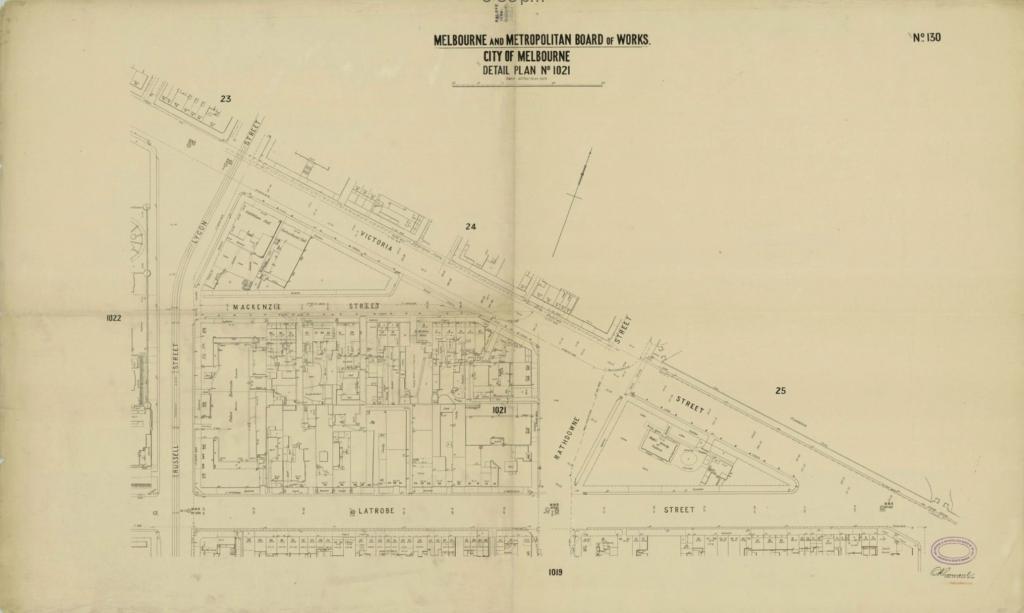
Figure 1: The Jacobs family was living at 45 Mackenzie Street at the time this map was produced in 1895. Mackenzie Street was the gateway to Carlton, where many Jews also lived at the time. The original police barracks are also shown. Source: Melbourne Metropolitan Board of Works, Detail Plan, 1895, State Library of Victoria.
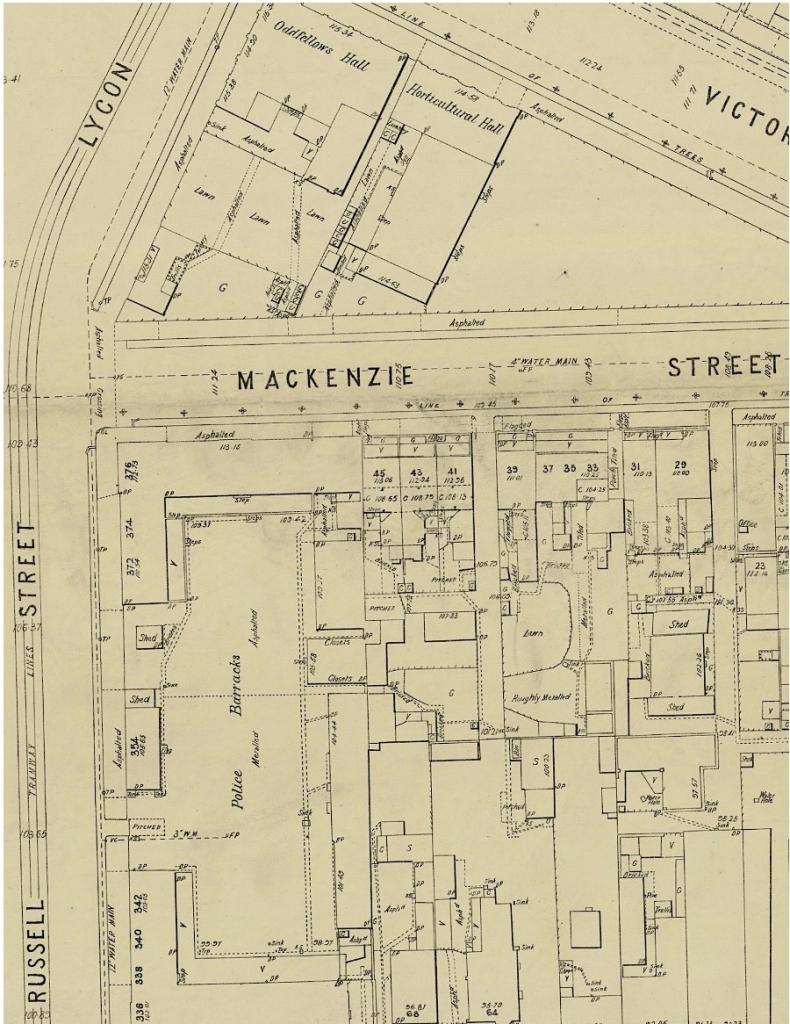
Figure 2: This detailed section shows important buildings, such as the hall of the Victorian Horticultural Society (see Figure 18), on Mackenzie Street. It also shows the dimensions of numbers 41, 43 and 45 Mackenzie Street that were built and owned by the same person, George Moody. Source: Melbourne Metropolitan Board of Works, Detail Plan, 1895, State Library of Victoria.
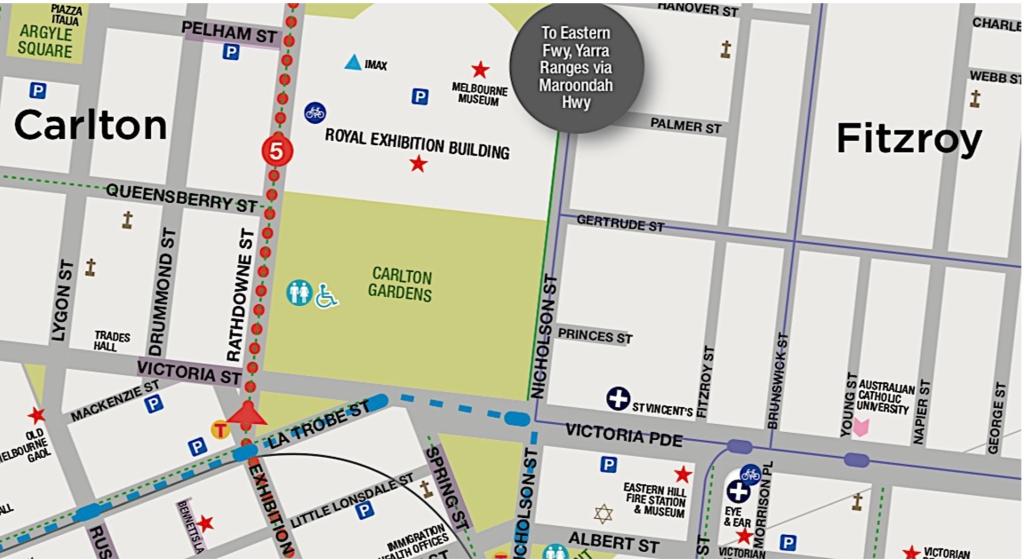
Figure 3: This modern-day map shows Mackenzie Street to the east of the Old Melbourne Gaol (left-hand side). The East Melbourne Synagogue on Albert Street is identified with a Star of David. Source: City of Melbourne.
The builder and owner: George Moody
On 4 June 1873, just after 9 am, George Moody, aged 63, and his wife Sarah Moody, aged 59, sailed through the Port Phillip Heads on the steamship Lord Warden.[1] It was the beginning of winter, but the day was fine with only moderate waves, which was lucky for the passengers and the captain because the heads are notorious for appearing calm and welcoming but actually being treacherous. The last time the couple had sailed through the heads was in 1841, more than 30 years earlier.[2] With their five children, they had emigrated from Nottingham, England, that year to the Port Phillip District of New South Wales—the land of the Kulin Nation. It was a heady time: 272 ships from ‘British possessions’ arrived in 1841 compared to just 140 in 1837.[3] In 1841, the settler population was estimated at 11,733, whereas it had only been 3,511 four years earlier.[4] The Indigenous population was not counted.
After they migrated, the Moodys amassed considerable wealth through buying land, building houses and renting them. The Port Phillip District separated from New South Wales and became the colony of Victoria in 1851. During the 1850s and 1860s, George Moody, builder and contractor, routinely advertised in the Age and Argus for quarrymen, plasterers, slaters and plumbers. ‘None but good workmen need apply’, his 1856 advertisement announced.[5] By the 1870s, he owned tracts of land in the inner-northern suburbs of Carlton, Fitzroy and Collingwood, and in Melbourne’s CBD. Some of his land was vacant; however, on other parcels, he had built houses, seven in total, although two were in a bad state of repair. Nevertheless, he still rented these neglected cottages to families. In 1870, George Moody sold three freehold allotments on Smith Street in Collingwood.[6] By this stage, he had acquired the title ‘Esq.’ after his name. George Moody Esq. had savings, shares, fine furniture and, importantly, no debt.[7] He was a shrewd man.
By 1872, the population of Victoria had swelled to 731,528.[8] This included an estimated 1,330 First Nations people (although this figure is rubbery because many Indigenous people had been forced from their land by squatters) and about 17,935 Chinese people.[9] The goldrush of the 1850s had produced a migration boom that saw people from countries such as China, Ireland and Italy head to the Victorian goldfields. While some would leave the colony when the gold ran out, others would stay and move to Melbourne, producing a great demand for houses. There were simply not enough brick or stone cottages for the new arrivals, forcing many to live in tents, and mud and calico homes.[10]
During the 1860s and early 1870s, George and Sarah Moody lived just off Mackenzie Street in a five-room brick home that George had built.[11] George also owned land on Mackenzie Street, a narrow and short street bookended by Russell and Victoria streets in the north-east section of Melbourne’s CBD. When George began building houses on the street, only homes on one side of the street were numbered. This quirk would continue throughout the life of the street. The odd-numbered buildings comprised Victorian brick homes with wooden or lace balconies, a stone cottage, a boarding house and a hotel. The large and brilliant white Victorian Horticultural Society’s hall backed onto Mackenzie Street’s ‘even’ side, as did the once grand Victoria Hall. Both these buildings still stand today (see Figure 18).
I suspect that many of the advertisements George placed in newspapers in the 1850 and 1860s were to find workers to build the Mackenzie Street homes. By 1867, he had built three, two-storey terrace houses, numbered 41, 43 and 45 Mackenzie Street (Figure 4).[12] They each had six rooms and a cellar, a frontage of 8.5 metres and a depth of 25.5 metres.[13]
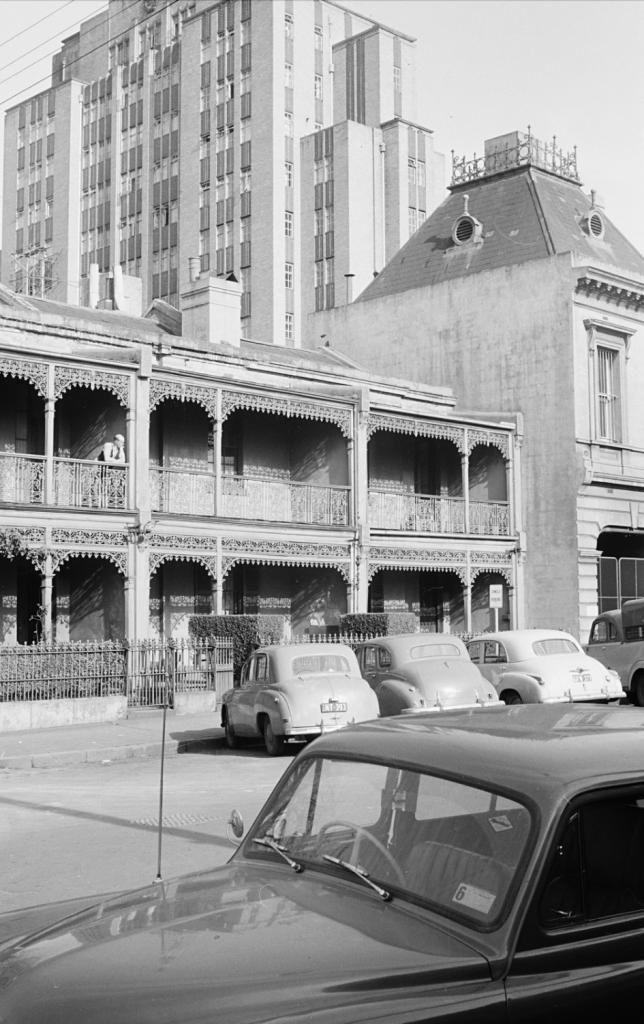
Figure 4: Terrace houses on MacKenzie Street with Russell Street Police Headquarters in background. Number 45 Mackenzie Street is on the right next to the old police complex. The Jacobs family shopped at Victoria Market, which was a 12-minute walk along Victoria Street. Source: Mark Strizic (photographer), State Library of Victoria, 1955, available at <https://viewer.slv.vic.gov.au/?entity=IE7240044&mode=browse>, accessed 20 April 2026.
The houses’ sloping slate roofs supported chimneys balancing circular clay stacks that were designed to expel smoke quickly to prevent it going back inside. Attics with small sash windows poked out of the slate, too. The backyards only had room for a clothesline and a small table and chairs, having also to accommodate a washhouse with a copper and an outside kitchen (Figure 5). My mum visited the home as a young girl with her mother in the 1950s and she distinctly remembers the kitchen: ‘We would sit in the kitchen out in the backyard … I did like the kitchen because you went up an iron spiral staircase to get into the larder. There was always chocolate in there.’
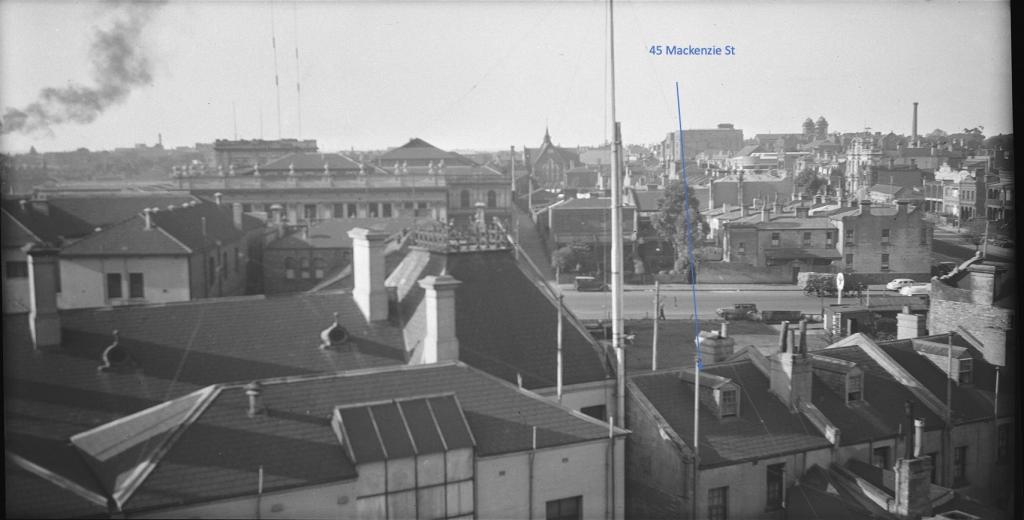
Figure 5: The back of terrace houses 41, 43 and 45 Mackenzie Street. Source: Mark Strizic (photographer), State Library of Victoria, 1955.
Number 45 had a special position on Mackenzie Street. It was next door to the rambling police offices on Russell Street. The police complex would go through numerous evolutions and would play a significant role in the demise of Number 45.
The renters: the Jacobs family
While the Moodys were content to rekindle memories of Nottingham, another family, the Jacobses, worked hard to forget their experience of being discriminated against in Kovno, part of the Polish–Lithuanian Commonwealth, because they were Jewish.[14] Solomon and Annie Jacobs had married in Kovno but fled to England along with thousands of other Jews who left Lithuania, Russia and Poland to escape persecution and poverty during the second-half of the nineteenth and beginning of the twentieth century. Many Jews, including Solomon and Annie, ended up in London’s crowded Spitalfields, living in tiny houses and cramped and damp tenements in the East End. George Arkell’s map of the Jewish East End indicates that the part of London that the Jacobs family lived in was inhabited almost exclusively by Jews.[15]
Solomon and Annie Jacobs had six children, all of whom were born in the Spitalfields. Rose, the second eldest and my great-grandmother, was born on 1 May 1875 at 2 Samuel Street, south of Commercial Road in the Spitalfields.[16] A few years later, the family moved to 5 Fashion Court in the heart of the Spitalfields, where Solomon worked as a boot finisher.[17] Fashion Court (Figure 6), a small curl of a lane, ran off Fashion Street, which was lined with tiny neighbourhood synagogues[18] and sweatshops.
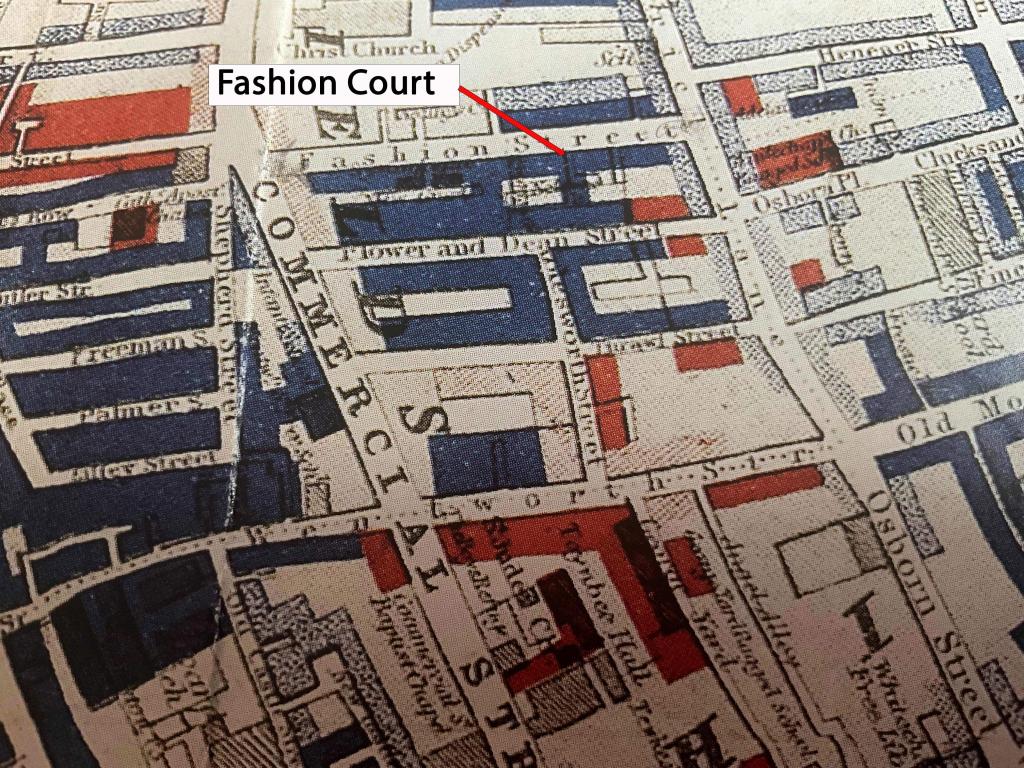
Figure 6: Fashion Court is where Rose Jacobs and her family lived. It backed onto the ‘notorious’ Flower and Dean Street. This street and the surrounding streets and courts had a reputation as the poorest and most dangerous in London’s East End. All five of Jack the Ripper’s victims lived in or had connections to Flower and Dean Street and the immediate area. Source: The Street Map of Jewish East London, 1899, Old House Books, Museum of London (purchased by the author in 2017).
Solomon Jacobs was the first in the family to sail to Melbourne. Aged 36, he left London in November 1886 on board the Winifred with a ‘fair complement of passengers’ and a large cargo of general merchandise, including 300 cases of brandy, 100 cases of wine, and, importantly, building materials such as nails, screws, bolts and cement.[19] Solomon arrived in the colony of Victoria on 15 February 1887 (Figure 7). I suspect he emigrated first to earn money to pay for his family’s passage to Melbourne, and to find a home to welcome his wife and six children.[20]
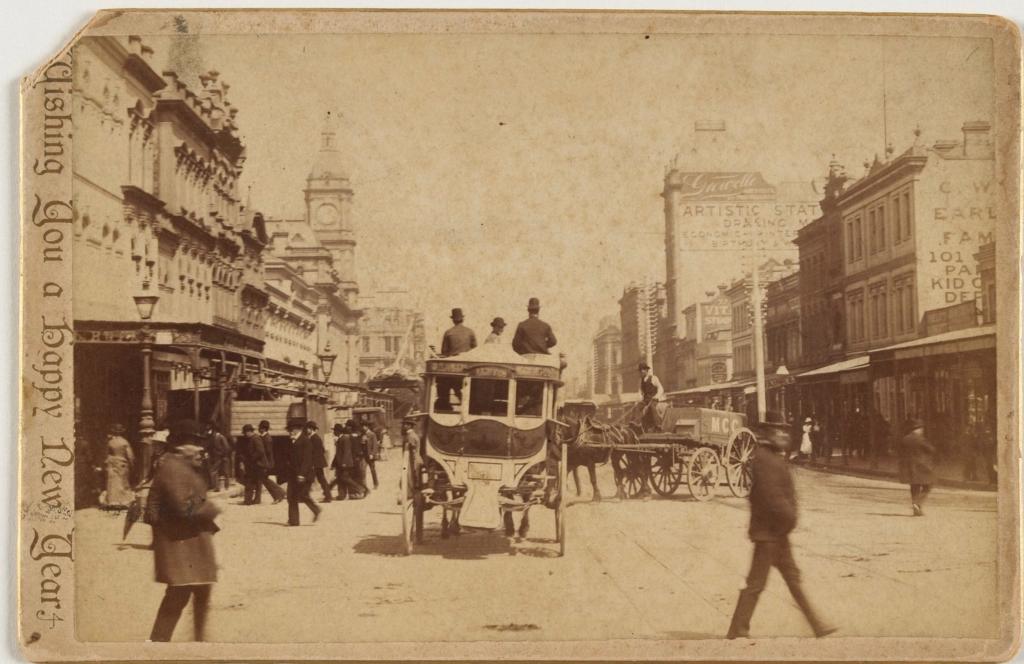
Figure 7: There is no way of knowing what Solomon Jacobs thought when he first saw Melbourne after living in the Jewish area of London’s East End. This photograph of Swanston Street in c. 1887 gives us some idea of what Solomon would have seen, including the Melbourne Town Hall. Source: State Library Victoria, available at <https://viewer.slv.vic.gov.au/?entity=IE401960&mode=browse>, accessed 20 April 2026.
Eighteen months after Solomon left London, Annie Jacobs, aged 40, and her six children—Samuel (18), Rose (13), Amelia (10), Leah (9), Morris (7) and baby Celia—set sail for Melbourne (Figure 8).[21]
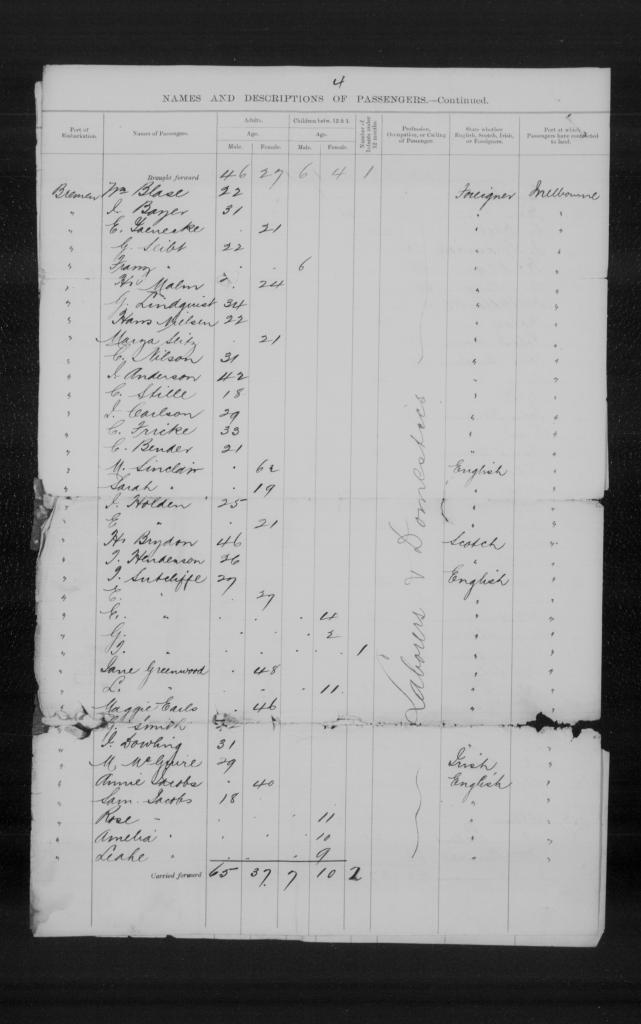
Figure 8: Annie Jacobs and her children were listed as passengers on board the Hohenstaufen. Source: Hohenstaufen passenger list dated 29 September 1888, PROV, VPRS 947/P0 Inward Overseas Passenger Lists, Sep – Dec 1888 British and Foreign Ports.
The Jacobses did not get to meet the man who built their home. George Moody died in September 1873 during a visit to Nottingham.[22] His wife, Sarah, stayed in Nottingham for another six months and then returned to Melbourne on board the Windsor Castle in 1874.[23] Sarah inherited George’s property portfolio, including 45 Mackenzie Street (Figure 9).[24]
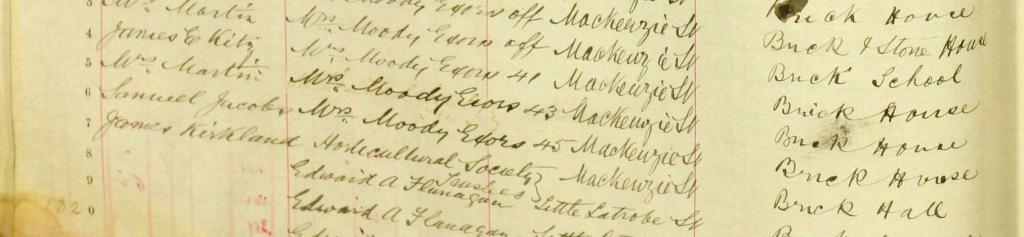
Figure 9: City of Melbourne rate book showing the Moody Estate owning 41, 43 and 45 Mackenzie Street. Sarah Moody died in 1889. Source: PROV, VPRS 5708/P0 Rate Books, 1892, p. 35.
Sarah lived at 3 Mackenzie Street, in one of five Lingwell Terraces built by George Chambers. Another early colonist and builder, Chambers also lived on Mackenzie Street.[25] Sarah was the sole occupant of the eight-room brick house she rented from Chambers for a small sum compared to what he charged other tenants.[26]
A religious and cultural life
George Chambers was a Protestant and Sarah Moody followed Wesleyan traditions, but the Jacobses were not the only Jewish family living on Mackenzie Street: Morris Mosely, Alfred Hyman, Isidore Holtz and Abraham Stern and their wives and children also called Mackenzie Street home.[27]
The Jacobses and their Jewish neighbours were part of an ongoing Jewish migration to Australia. There were at least eight Jewish convicts on the First Fleet that arrived at Sydney Cove in 1788.[28] Subsequently, more convicts and free Jewish settlers arrived, mainly from England, and by 1828 there were about 100 Jews in New South Wales and 50 in Van Diemen’s Land.[29] After this time, particularly from the 1870s, an increasing number of Jews came from Eastern Europe.
The original Jewish settlers who came to Melbourne in the 1830s and 1840s lived on Collins, Bourke, and Elizabeth streets, near Jewish businesses selling clothes and ‘British and Foreign Merchandise’.[30] By 1848, there were about 200 Jews in the burgeoning city, and they decided to open a synagogue in Bourke Street.[31] Their numbers continued to grow as they tried to find fortune during the gold rush or open shops for the gold diggers. Jews, particularly those from Germany and Eastern Europe, continued to settle in Melbourne in suburbs such as Carlton, Fitzroy and the north-eastern end of the CBD where the Jacobs family lived. By 1891, there were 2,272 Jews living in the City of Melbourne.[32] However, this number only represented a small percentage of the total population of the city, which was 73,000 that year.[33] After 1891, the city’s Jewish population continued to fall, as Jews moved to suburbs such as St Kilda and Caulfield.
Apart from the comfort and familiarity of living among other Jewish families, who, like the Jacobses, would probably have spoken Yiddish, Mackenzie Street also offered the family stability and freedom, compared with living under the threat of persecution in Kovno. The family could celebrate their Jewish traditions in Mackenzie Street, and, after settling into number 45, they began attending the East Melbourne Hebrew Congregation, also known as the East Melbourne Synagogue, a six-minute walk from their home (Figures 10 and 11). In the late nineteenth century, the synagogue, which has been located at its present site on Albert Street since 1877, became known as the shule (house of prayer) for Jews from Eastern Europe who had settled in the CBD, Carlton and Fitzroy.[34] It had a Hebrew school, which some of the Jacobs children, including Rose, attended for a short time. In 1898, Rose and her sister Millie volunteered at a ‘Bazaar Fancy and Doll Fair’ to raise funds for the Melbourne Hebrew School, then operating out of the Old Trades Hall, Carlton.[35]
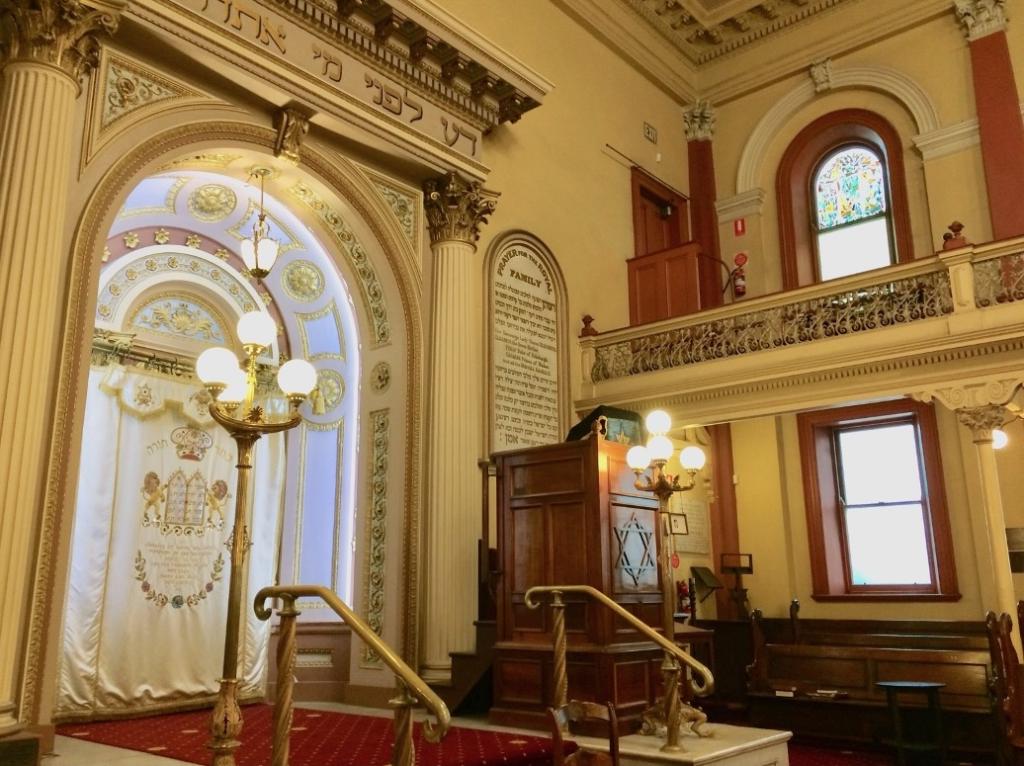
Figure 10: The interior of the East Melbourne Synagogue. Little has changed since my great-grandmother Rose Jacobs married Baron Pearlman there in 1900. The piano, according to Chief Rabbi Dovid Gutnick, would have been the same one at the synagogue when Rose and Baron married. Source: Erica Cervini, 2017.
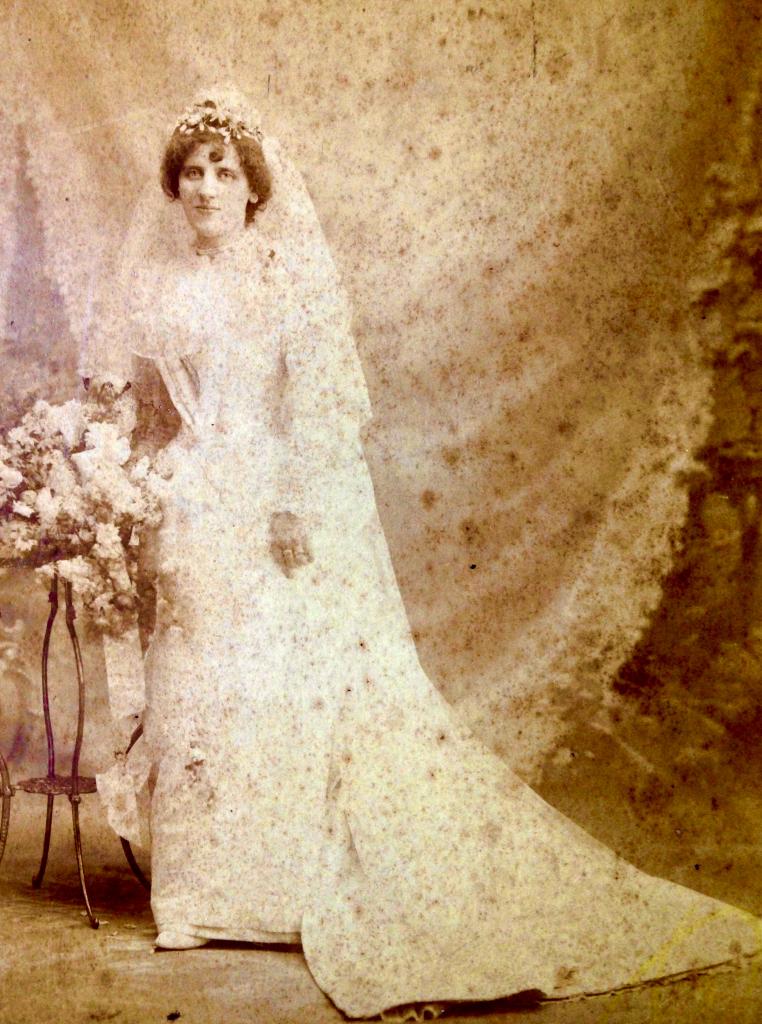
Figure 11: Rose (Jacobs) Pearlman on her wedding day. It is not known whether Rose and Baron met at the East Melbourne Synagogue or at dances, organised by the Society of Judeans, at the Cathedral Hall in Fitzroy, now part of the Australian Catholic University. Rose’s two younger sisters also married at the East Melbourne Synagogue and would return later with their children to live at 45 Mackenzie Street. One sister’s husband deserted her and the other became a widow. Source: Family photograph.
Due to the number of Jews in the city, the Jacobses were able to buy kosher foods, just as they had done in the Spitalfields. In 1888, the year Annie and her children began living at 45 Mackenzie Street, David Goldstein, who had qualified as a shochet (ritual slaughterer), opened a butcher’s shop at 170 Exhibition Street, a short walk away.[36] Goldstein promised to supply the Jews of Melbourne with kosher meat of ‘good quality, smallgoods, such as sausages, corned and smoked beef, killed and dressed poultry, all at a cheaper rate than that which the Jews have been paying hitherto’.[37]
Nor did the Jacobses have to rely solely on Goldstein’s meats. They could walk or take a cable tram to the kosher butcher on Little Collins Street at the rear of the old Eastern Market, where they could buy spiced beef. Alternatively, a three-minute walk from their home would take them to Issac Rotenberg’s butcher’s shop at 351 Swanston Street, where they could choose from a large selection of kosher meats and smallgoods such as ‘garlic and plain Worsht Sausages’ and sheep’s tongue (Figure 12).[38]
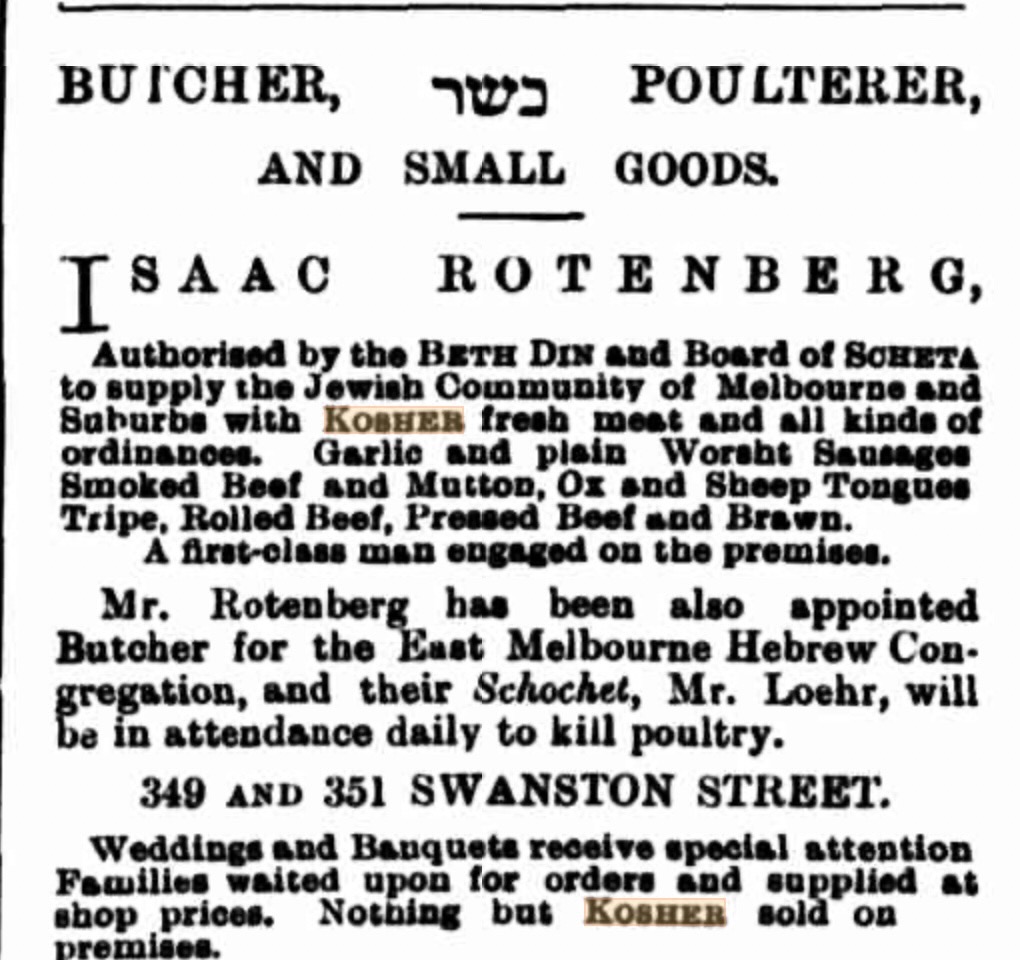
Figure 12: Many advertisements for kosher food appeared in Jewish and non-Jewish newspapers. This advertisement for Issac Rotenberg’s butcher’s shop shows the variety of meats available. Source: Jewish Herald, 6 April 1894, p. 11, <http://nla.gov.au/nla.news-article149756488>, accessed 20 April 2026.
Benzion Lenzer, from the East Melbourne Synagogue, killed the poultry at Rotenberg’s butcher between 8 and 11 am most days.[39] Then a small group of women would pluck the birds dry (rather than loosening the feathers with hot water, which was the habit of non-Jews), readying them for customers to take home. Birds intended for soup—the older hens or fowls that had stopped laying egg—would be salted and washed clean before being boiled with peppercorns, onions and carrots. Although they took longer to cook, the older birds were cheaper than roasting chickens and made a more fulsome soup.
The Jacobses did not have far to walk to buy matzo (unleavened bread) for the Passover Festival, as it was available at 196 Elizabeth Street in the CBD. They could be assured that the bakehouse kept to Jewish regulatory food preparation rules because rabbis would visit the bakehouse and other food premises to ensure compliance.[40] The family could also walk to nearby Carlton to buy bakery items, their home on Mackenzie Street acting as a gateway to the inner-city suburb that housed many Jewish immigrants from Eastern Europe before World War II.
In fact, sometimes the Jacobses did not have to walk to the shops at all—the food came to them. Due to its number of Jewish residents, Mackenzie Street and neighbouring streets attracted Jewish hawkers selling fruits and wares in the late 1880s and 1890s.[41] From the laden carts, the Jacobses could buy apples and walnuts and spices to make charoset, a sweet, dark-coloured mixture of finely chopped fruits and nuts, for the Passover Seder meal. Hawkers also sold kosher wine, which was added to the spiced apples in charoset to symbolise the mortar used by the enslaved Israelites in Egypt, and for the Shabbat meal each Friday night. The apple and walnut version of charoset made by Ashkenazi Jews from Eastern Europe would have been the recipe the Jacobs family used.
By the mid-1890s, the Jacobses were secure in their home at 45 Mackenzie Street, and Solomon and his son Samuel had gone into the boot manufacturing business as Jacobs & Son. While it is unclear how long the partnership lasted, Solomon spent many years working as a boot finisher from his front room at 45 Mackenzie Street.[42] Samuel left home during this time and lived in nearby Carlton with his wife Nellie, who would later establish a profitable perfume business, the Perfecta Manufacturing Company. She named a rose-scented solid perfume after my great-grandmother Rose. The rest of the family remained at Mackenzie Street: Rose and Leah were boot machinists for Jacobs & Son,[43] Millie was a housekeeper, Morris was learning how to make boots and Celia was still at school. Annie was busy caring for her family. Every year she and her husband would send Jewish New Year greetings in the Jewish Herald: ‘Mr and Mrs Solomon Jacobs and family wish all their relatives and friends a Bright and Prosperous New Year, all well over their fast, 45 Mackenzie-street City Melbourne’.[44] In 1897, Solomon Jacobs was listed in the Age as one of two members of the local Jewish community from whom synagogue seats for the Jewish New Year could be purchased. His contact address was listed in the newspaper as 45 Mackenzie Street.[45] Clearly, during the 1890s, 45 Mackenzie Street was the centre of the Jacobs family’s universe.
Another owner: Charles Wright
The Jacobs family may have experienced a sense of unease in the mid-1890s when lawyers acting for the Moody Estate put 41, 43 and 45 Mackenzie Street on the market. Newspaper notices indicate that the homes were sold to another Mackenzie Street ‘lord’, Charles Wright, for £1,825 at auction on 5 June 1895.[46] Wright had lived on Mackenzie Street, in the 14-room Mistletoe Hotel, since the 1860s.[47] With this purchase, he continued the tradition of landlords owning multiple properties on the street and living alongside their tenants. Wright would continue renting number 45 to the Jacobs family.
Wright had amassed great wealth, much more than George and Sarah Moody, through owning hotels, dance halls (the Colosseum in Bourke Street)[48] and houses in the CBD and inner city. He had been married and divorced twice and was considered a colourful character. In 1933, a letter writer to the Age reminisced about the music played at the Colosseum and its owner Charles Wright: ‘I fancy I can see him riding around the city in his dog cart curling his moustache. He always had a young woman with him.’[49] Wright died at the age of 81 in his room at the Mistletoe Hotel in June 1903. He left all his money—£40,000—to charity and was buried in the Mornington Cemetery, 77 kilometres from Melbourne’s CBD (Figure 13).[50]
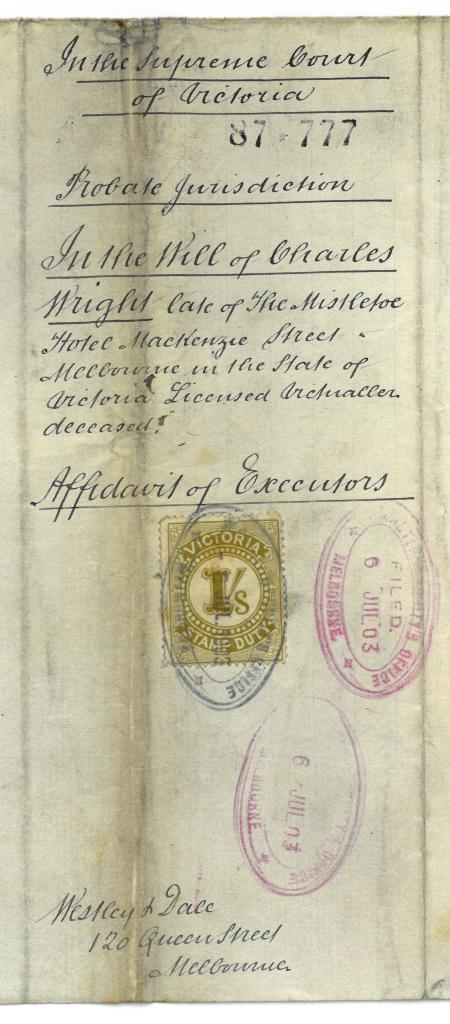
Figure 13: Charles Wright’s will. Source: PROV, VPRS 7591/P2 Wills, 87/777 Charles Wright: Will; Grant of Probate , available at <https://prov.vic.gov.au/archive/B54F76D8-F53B-11E9-AE98-058DDCBB181B?image=1>, accessed 20 April 2026.
After Charles Wright
Forty-Five Mackenzie Street would continue having new owners, but, after Charles Wright, they would live in more salubrious suburbs and the home would eventually be managed by trusts. The Victoria Police Association owned 45 Mackenzie Street from 1954 until the 1960s, when it demolished the residence, erecting a new brown-brick building to house its association. In June 2025, a Singapore-based company bought the former police association building, which had remained empty for years, with a view to erecting student accommodation.[51]
Letty Cohen, the granddaughter of Solomon and Annie Jacobs, was the last member of the Jacobs family to live in the home. She had been born there and returned to 45 Mackenzie Street as a two-year-old with her mother Leah in 1900 (Figure 14) when her father deserted them and moved to Sydney.[52]
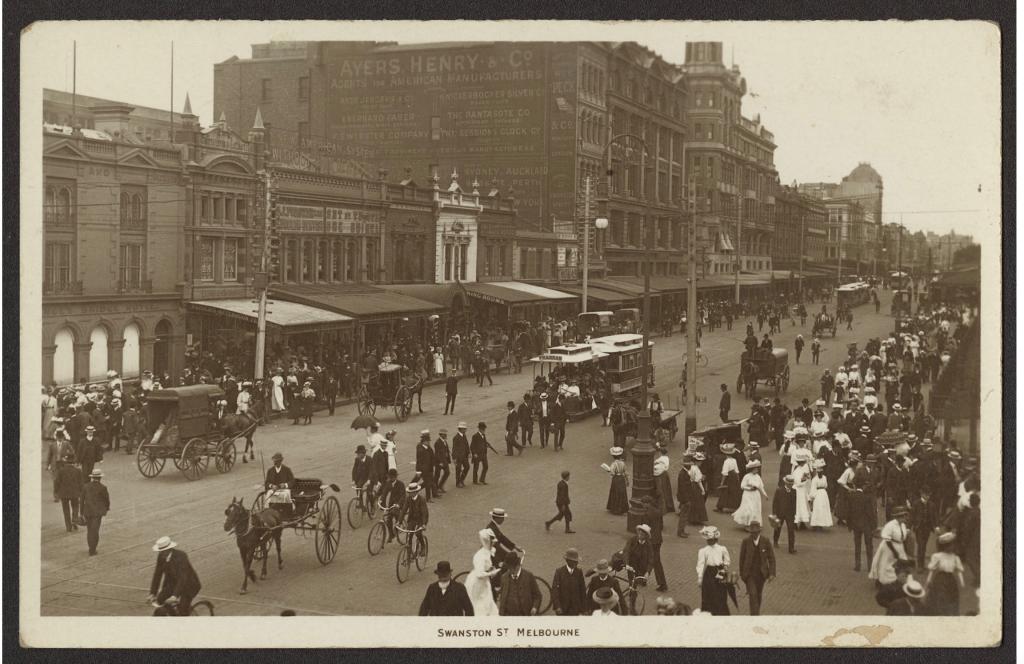
Figure 14: When Letty and her mother Leah returned to 45 Mackenzie Street in 1900 they would have seen cable trams, tearooms and businesses, including dentists and lawyers.
Letty, who worked in administration at Myer on Bourke Street, would have stayed at 45 Mackenzie Street, but she was forced out by the Victoria Police Association. She moved to St Kilda in 1960. By the time she left, there were few Jews living in the CBD and inner north. By contrast, but the number of Jews resident in St Kilda in 1961 had grown to 6,931 (from 705 in 1901). My mum says that Letty never recovered from having to move: ‘She didn’t survive for much longer after the move’. Mackenzie Street is unrecognisable today: it mainly comprises multistorey, glass-fronted apartment blocks (Figures 15–19).
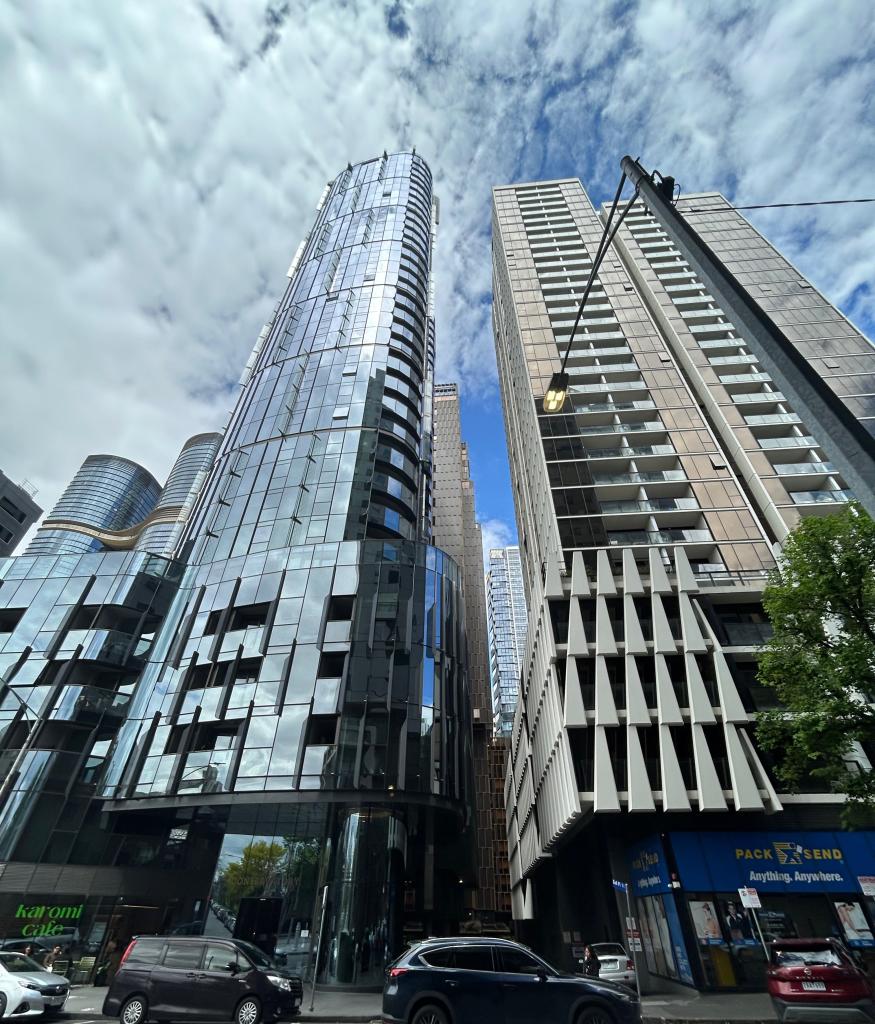
Figure 15: High-rise apartment blocks on Mackenzie Street. Source: Erica Cervini, 2025.
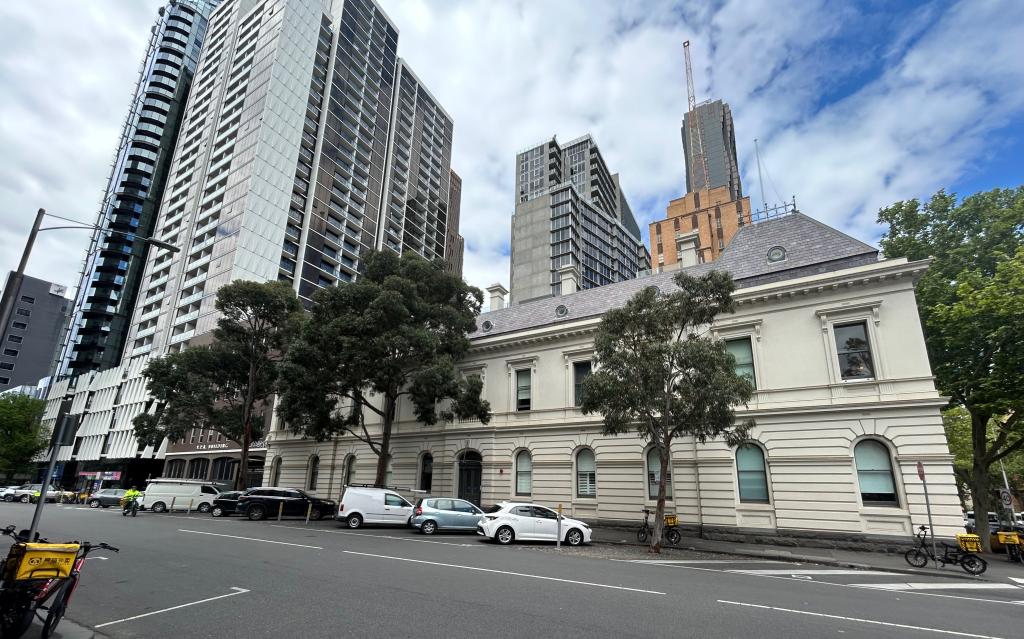
Figure 16: The two-storeyed Italian Renaissance Revival–style former police office stands on the corner of Mackenzie and Russell streets (now apartments). Next to it stands the empty, brown-brick former Victoria Police Association Building, where 45, 43 and 41 Mackenzie Steert once stood. Source: Erica Cervini, 2025.
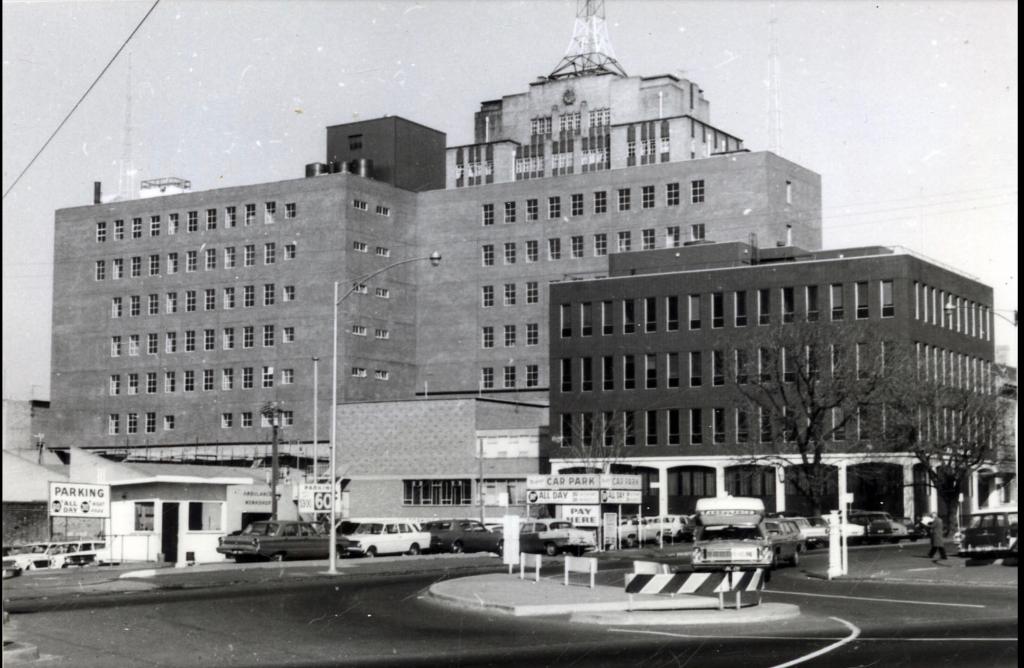
Figure 17: Mackenzie Street showing the Victoria Police Association Building in 1969. By this stage, other houses along the street had been demolished for parking bays. The Russell Street Police Headquarters, built between 1940 and 1943 (now apartments) is in the background. Source: Victoria Police Historical Society Facebook page.
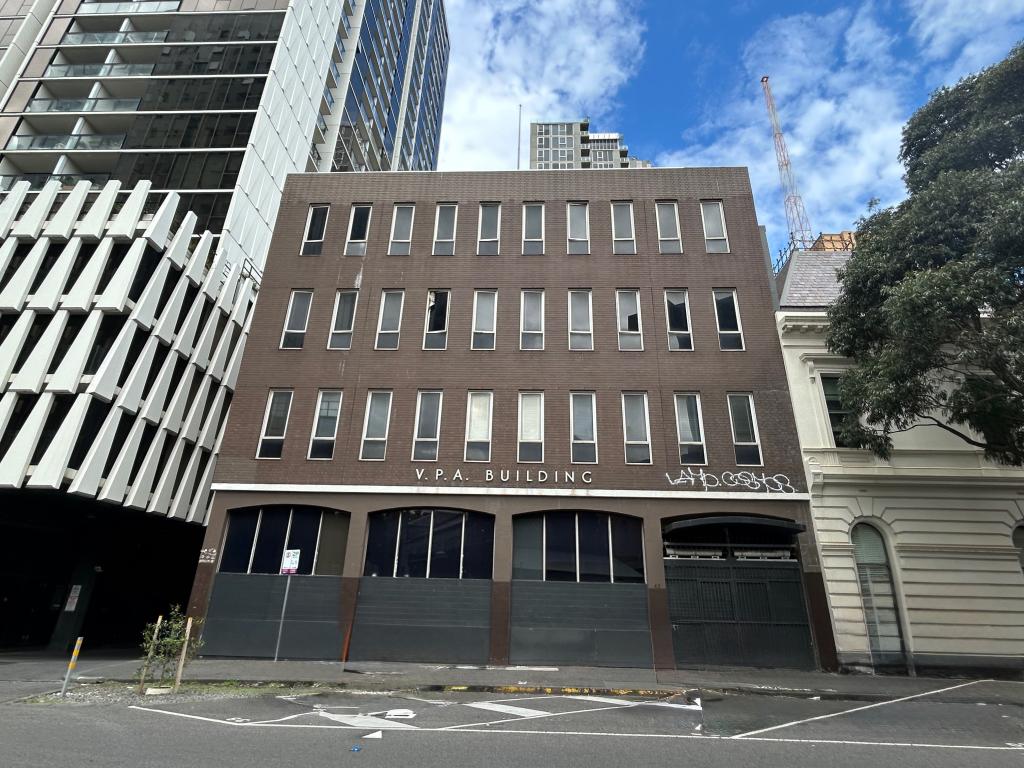
Figure 18: Close-up of the Victoria Police Association Building, with smashed windows. Erica Cervini, 2025.
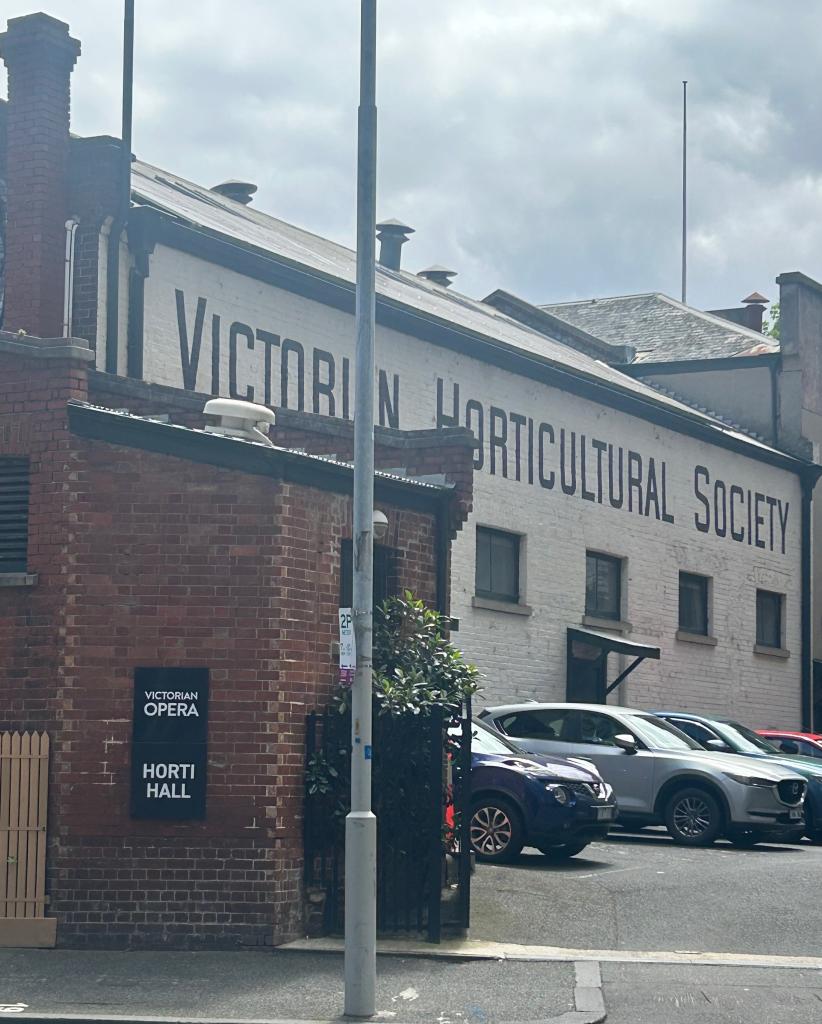
Figure 19: The premises of the Victorian Horticultural Society is the only building to survive the street’s transformation. Source: Erica Cervini, 2025.
Conclusion
Through examining the life of a house and its early owners and renters, I have retrieved lost stories about early settlers and my ancestors who lived in Melbourne’s CBD. Moreover, telling the story of a house has brought to life a lost landscape, bridging the gap between the present and past. Walking up and down Mackenzie Street, collecting photographs and perusing archival materials helped me to build notions of my sense of place in the present and the past, connecting me to family—both living and deceased. The research helped me understand that knowledge and whispers of stories reside in, and can be derived from, fragmentary and partial historical records and artefacts, and that these can be used to produce a compelling narrative.
The story does not end here. To the contrary: the story of the life of 45 Mackenzie Street is a story of time. As new archival material becomes available, I am writing micro-biographies of the owners and my ancestors and their relationship to 45 Mackenzie Street, and I am continuing to examine how the Great Depression, the two world wars and a dwindling CBD population affected the owners and renters of 45 Mackenzie Street.
Despite the CBD’s changing landscape and the rise and fall in the Jewish and wider city populations between the 1860s and early 1960s, there was one constant in my family: 45 Mackenzie Street. It was a home where babies were born and where Solomon and Annie Jacobs died. It was welcoming to family members who were widowed or divorced, and to extended family members who needed a place to stay. This is a story of how a home was lost and found.
Endnotes
[1] PROV, VPRS 948/P1 Outward Passengers to Interstate, UK and Foreign Ports, Jan–June 1873, Lord Warden passenger list dated 2 June 1873, available at <https://prov.vic.gov.au/archive/23B692F2-F7F0-11E9-AE98-A129A05C3564?image=391>, accessed 20 April 2026. See also ‘The Lord Warden’, Herald, 4 June 1973, p. 3, available at <https://trove.nla.gov.au/newspaper/article/245371445>, accessed 20 April 2026.
[2] PROV, VPRS 14/P0 Register of Assisted Immigrants from the United Kingdom, Book No. 1, p. 27, available at <https://prov.vic.gov.au/archive/E289FC3D-F1B1-11E9-AE98-4F5884FEEC7B?image=44>, accessed 20 April 2026.
[3] Kerr’s Melbourne Almanac and Port Phillip Directory: A Compendium of Useful and Accurate Information Connected with Port Phillip, 1842, p. 289, available at <https://nla.gov.au/nla.obj-2913110945/view?partId=nla.obj-2913166619#page/n300/mode/1up>, accessed 20 April 2026.
[4] Ibid, p. 291. See also ‘Census of Port Phillip’, Geelong Advertiser, 17 July 1841, p. 2, available at <http://nla.gov.au/nla.news-page8432080>, accessed 20 April 2026; PROV, VPRS 4/P0 Inward Registered Correspondence, Folder No. 60, 38/211 Census of Port Phillip – Sept 1838, available at <https://prov.vic.gov.au/archive/540ADE4D-F7F4-11E9-AE98-9BF746893740?image=1>, accessed 20 April 2026.
[5] [Advertising], Argus, 27 August 1856, p. 1, available at <https://trove.nla.gov.au/newspaper/article/7135559>, accessed 20 April 2026; [Advertising], Argus, 5 October 1858, p. 6, available at <https://trove.nla.gov.au/newspaper/article/7302224>, accessed 20 April 2026; [Advertising], Argus, 27 January 1858, p. 6, available at <https://trove.nla.gov.au/newspaper/article/7145650>, accessed 20 April 2026.
[6] [Advertising], Argus, 15 January 1870, p. 3, available at <https://trove.nla.gov.au/newspaper/article/5810031>, accessed 20 April 2026.
[7] See PROV, VPRS 28/P2 Probate and Administration Files, 12/002 George Moody: Grant of Probate, available at <https://prov.vic.gov.au/archive/7F0B51AF-F1DF-11E9-AE98-4114854CBCBD?image=1>, accessed 20 April 2026.
[8] Census of Victoria, 1871, Part I: Inhabitants and houses, p. 2 (January 1872), available at <https://archive.org/details/vic-census-1871-part-2>, accessed 20 April 2026.
[9] Ibid.
[10] Ibid, pp. 8–12.
[11] For example, PROV, VPRS 5708/P0 Rate Books,1868, p. 75, available at <https://prov.vic.gov.au/archive/7E97F1EA-F4D1-11E9-AE98-0F92F5D360A1?image=75>, accessed 20 April 2026.
[12] The three, six-room homes owned by George Moody are listed in PROV, VPRS 5708/P0 Rate Books,1867, p. 87, available at <https://prov.vic.gov.au/archive/7E89E81F-F4D1-11E9-AE98-4146F53C5E89?image=87>, accessed 20 April 2026.
[13] For a description of the houses at 41, 43 and 45 Mackenzie Street, see [Advertising], Age, 3 June 1895, p. 2, available at <https://trove.nla.gov.au/newspaper/article/203617847>, accessed 20 April 2026.
[14] Solomon Jacobs’s naturalisation certificate identifies the town he is from. See National Archives of Australia, A712, 1900/M2212.
[15] A hard copy edition of the map was published in 2012 by Old House Books and Maps. Image @ Museum of London. Reproduced from George Arkell’s map of 1899.
[16] Rose Jacobs, birth certificate, General Register Office, England BXCG 473447, folio 44, p. 24.
[17] The 1881 census of England shows the Solomon and Annie Jacobs and their children living at 5 Fashion Court. Accessed via ancestry.com.au.
[18] For information about synagogues on Fashion Street/Fashion Court, see Jewish Community Records UK, available at <https://www.jewishgen.org/jcr-uk/london/EE_bikkur-cholim/index.htm>, accessed 20 April 2026.
[19] Solomon Jacobs’s naturalisation certificate gives the name of the ship and when he arrived in Melbourne. See National Archives of Australia, A712, 1900/M2212. Also see ‘Shipping intelligence. Hobson's Bay’, Argus, 17 February 1887, p. 4, available at <https://trove.nla.gov.au/newspaper/article/11590511>, accessed 20 April 2026.
[20] For further information on Jewish chain migration to Melbourne, see Margaret Taft & Andrew Markus, A second chance: the making of Yiddish Melbourne, Monash University Publishing, Clayton, 2018, pp. 12–16.
[21] PROV, VPRS 947/P0 Inward Overseas Passenger Lists, Sep–Dec 1888 British and Foreign Ports, Hohenstaufen passenger list dated 29 September 1888, available at <https://prov.vic.gov.au/archive/426B1A03-F96C-11E9-AE98-DB924F6A1A19?image=16>, accessed 20 April 2026.
[22] See George Moody: Grant of probate.
[23] PROV, VPRS 947/P0 Inward Overseas Passenger Lists, Jan–Jun 1874 British and Foreign Ports, Windsor Castle passenger list dated 16 February 1874, available at <https://prov.vic.gov.au/archive/3B4A4D5B-F96C-11E9-AE98-9777796065C5?image=206>, accessed 20 April 2026.
[24] See George Moody: Grant of probate.
[25] City of Melbourne rate books held at PROV show George Chambers owning homes on Mackenzie Street since 1868. See, for example, PROV, VPRS 5708/P0 Rate Books, 1888, pp. 75–76, available at <https://prov.vic.gov.au/archive/7637EE8C-F4D1-11E9-AE98-5D0D6156D8C6?image=76>, accessed 20 April 2026.
[26] The low rent Sarah Moody paid compared to other renters is reflected in City of Melbourne rate books held at PROV (VPRS 5708).
[27] See, for example, PROV, VPRS 5708/P0 Rate Books, 1892, p. 35, available at <https://prov.vic.gov.au/archive/763E0911-F4D1-11E9-AE98-3164095C2D2C?image=35>, accessed 20 April 2026.
[28] John Levi, These are the names: Jewish lives in Australia 1788–1850, The Miegunyah: Melbourne, Melbourne, 2013.
[29] CA Price, ‘Jewish settlers in Australia 1788–1961’, Australian Jewish Historical Society, vol. 5, no. 8, 1964, p. 8, available at <https://collections.ajhs.com.au/Detail/objects/52798>, accessed 20 April 2026.
[30] Ibid., p. 38.
[31] Australian Jewish Historical Society, AJHS timeline, available at <https://ajhs.com.au/timeline_ajhs/>, accessed 20 April 2026.
[32] Price, ‘Jewish settlers', p. 89.
[33] Peter Mcdonald, ‘Demography’, eMelbourne, available at <https://www.emelbourne.net.au/biogs/EM00455b.htm>, accessed 20 April 2026.
[34] Morris C. Davis, History of the East Melbourne Hebrew Congregation, ‘Mickva Yisrael’ 1857–1977, East Melbourne Hebrew Congregation.
[35] ‘Our Victorian letter’, Hebrew Standard of Australasia, 30 December 1898, p. 5, available at <https://trove.nla.gov.au/newspaper/article/121636714>, accessed 20 April 2026.
[36] ‘Local and general items’, Jewish Herald, 8 June 1888, p. 9, available at <https://trove.nla.gov.au/newspaper/article/149550247>, accessed 20 April 2026.
[37] Ibid.
[38] [Advertising], Jewish Herald, 30 September 1895, p. 14, available at <https://trove.nla.gov.au/newspaper/article/149757434>, accessed 20 April 2026.
[39] ‘Melbourne Hebrew congregation’, Jewish Herald, 8 September 1893, p. 8, available at <https://trove.nla.gov.au/newspaper/article/149756219>, accessed 20 April 2026; [Advertising], Jewish Herald, 30 September 1895, p. 14, available at <https://trove.nla.gov.au/newspaper/article/149757434>, accessed 20 April 2026.
[40] For details about the provision of kosher food in Melbourne (and squabbles over the manufacture of matzos), see Davis, History of the East Melbourne Congregation.
[41] My great-great grandfather Hyman Pearlman and his son Baron, who married Rose Jacobs, were hawkers who sold wares on the edge of the CBD, in Carlton and in Fitzroy. They sold the type of foodstuffs mentioned in this paragraph.
[42] Series of interviews with 99-year-old Lloyd Pearlman about his grandfather Solomon Jacobs conducted in 2017–18. Lloyd died in 2018. He often visited 45 Mackenzie Street and stayed there for a period of time after moving from Ballarat to Melbourne. Samuel was leasing a small factory, owned by the Moody Estate in Grange Lane, which runs off Mackenzie Street. Sarah Moody had died in 1889.
[43] Ibid. Rose’s occupation is also listed on her marriage certificate. See Births, Deaths and Marriages Victoria, marriage registration Rose Jacobs and Baron Pearlman, 4236/1900. Their marriage record is also held at the East Melbourne Synagogue.
[44] See, for example, ‘New Year Greetings’, Jewish Herald, 10 September 1920, p. 11, available at <http://nla.gov.au/nla.news-article149673001>, accessed 20 April 2026.
[45] [Advertising], Age, 18 September 1897, p. 9, available at <https://trove.nla.gov.au/newspaper/article/188147905>, accessed 20 April 2026.
[46] ‘Sales of property’, Age, 6 June 1895, p. 4, available at <https://trove.nla.gov.au/newspaper/article/203616559>, accessed 20 April 2026. The properties are also listed in the will and probate of Charles Wright, PROV, VPRS 7591/P2 Wills, 87/777 Charles Wright: Will; Grant of Probate, available at <https://prov.vic.gov.au/archive/B54F76D8-F53B-11E9-AE98-058DDCBB181B?image=1>, accessed 20 April 2026.
[47] PROV, VPRS 5708/P0 Rate Books,1868, p. 75, available at <https://prov.vic.gov.au/archive/7E97F1EA-F4D1-11E9-AE98-0F92F5D360A1?image=75>, accessed 20 April 2026.
[48] There are multiple news articles about Charles Wright’s run-ins with the law over his license at the Colosseum. There are also stories about him mixing with prostitutes.
[49] ‘To the editor’, Age, 4 November 1933, p. 6, available at <https://trove.nla.gov.au/newspaper/article/203364310>, accessed 20 April 2026.
[50] Charles Wright in ‘Australia and New Zealand, Find a Grave® Index, 1800s–Current’, accessed via ancestry.com.au.
[51] Marc Pallisco, ‘Developer swoops on ex-Victoria police building’, RealEstate Source,19 June 2005, available at <https://www.realestatesource.com.au/developer-swoops-on-another-melbourne-site/>, accessed 20 April 2026.
[52] Details about Leah and Solomon Cohen’s divorce were obtained from PROV, Petition for Dissolution, Cohen v. Cohen, 1904, no. 167. The document is 44-pages long. See also ‘Divorce Court’, Age, 10 August 1905, p. 8, available at <http://nla.gov.au/nla.news-article198589771>, accessed 20 April 2026.
Material in the Public Record Office Victoria archival collection contains words and descriptions that reflect attitudes and government policies at different times which may be insensitive and upsetting
Aboriginal and Torres Strait Islander Peoples should be aware the collection and website may contain images, voices and names of deceased persons.
PROV provides advice to researchers wishing to access, publish or re-use records about Aboriginal Peoples