
Last updated:
’Productive multiculturalism and the All-Australian calendar’, Provenance: the Journal of Public Record Office Victoria, issue no. 23, 2026. ISSN 1832-2522. Copyright © Ilona Fekete
This is a peer reviewed article.
The All-Australian calendar was published in Victoria between 1980 and 1987—a literal A2-sized poster child of a failed multicultural idea. The calendar aimed to enhance the productivity of migrants and contribute to multicultural education in schools. This article explores how the idea of multiculturalism changed in the 1980s, transforming from cultural pluralism into productive multiculturalism, and how the calendar embodied this transformation.
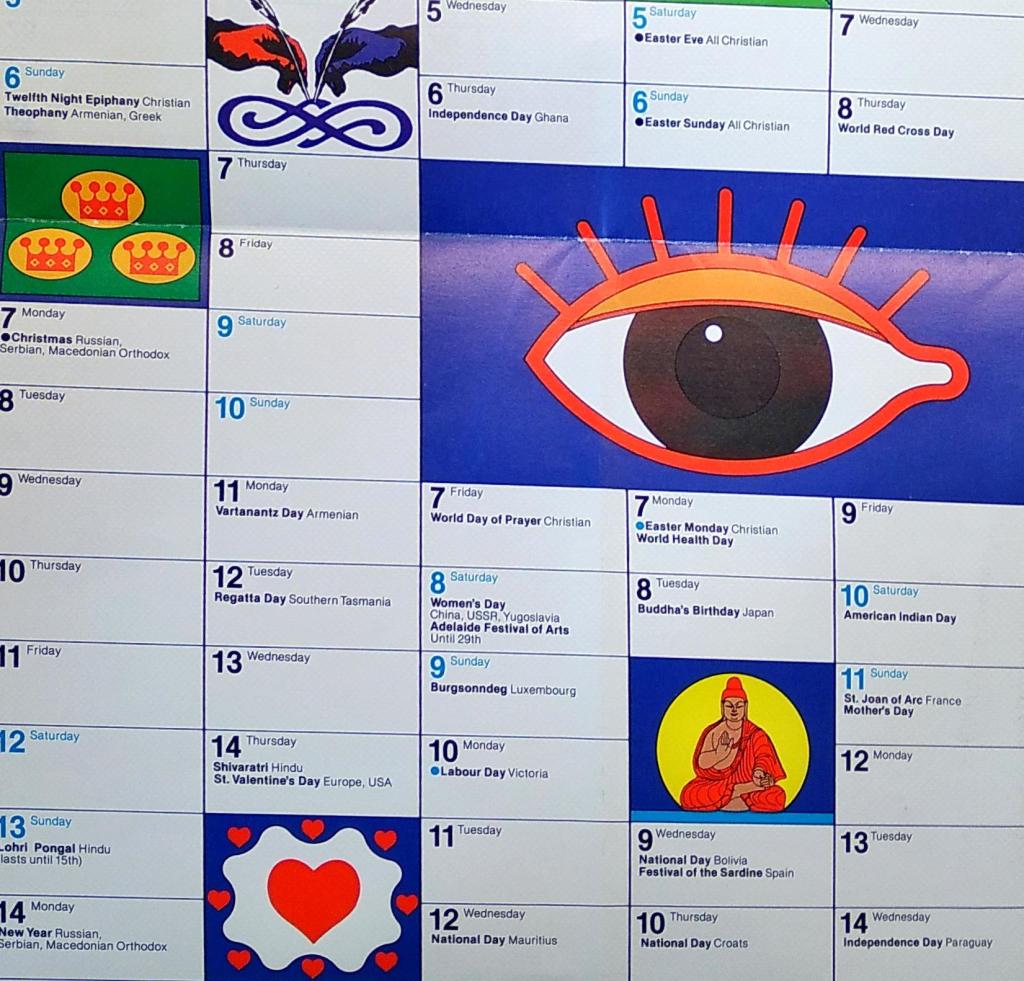
Figure 1: Extract from the All-Australian calendar 1980, Victorian Department of Education, Melbourne, 1980. Source: State Library Victoria, P 291.36 Al5. Photographed by the author.
Introduction
The All-Australian calendar, published in Victoria between 1980 and 1987, aimed to promote a productive multicultural society by targeting both industrial workers and primary school students (Figure 1). This article investigates how the calendar embodied the transformation of multiculturalism in the 1980s, particularly the concept of ‘productive multiculturalism’. The calendars were born on the threshold of cultural diversity as a preferred multicultural signifier and enabler of productive multiculturalism, while masquerading as a promoter of workers’ rights. This analysis is based on records of the Victorian Multicultural Commission (formerly Ethnic Affairs Commission) related to the calendars.
I argue that the production of the All-Australian calendar from 1983 can be seen as an early example of ‘productive multiculturalism’ within a neoliberal economy—one that blended cultural pluralism with an apparent promotion of workers’ rights. Ghassan Hage detected the productive migrant trope at play after the election of Bob Hawke’s Labor government in 1983. He argues that being productive as a migrant meant being assigned a more active role than merely providing rich culture for consumption by Australians, which is what most migrant communities expected. Cultural diversity became an asset in this essentially economic approach, both for the state to advance the country’s global economic connections, and for the migrant’s own individual and economic growth. Patrick Brownlee argues that the aims of productive multiculturalism—or productive diversity—were adjusted for the transnational workforce of the 1980s and, thus, did not have a connection to the labour migration of the 1950s and 1960s. While the original concept of the All-Australian calendar would have allowed certain workers to express their cultural heritage, this special, limited right was inseparable from the idea of cultural pluralism.
This article surveys the background of multicultural politics that encouraged the creation of the calendars; examines the introduction of the first calendar, the circumstances surrounding its production and reactions to it; and traces the evolution of the calendars until the final one in 1987.
Background to the calendars
Following World War II, the composition of the Australian population changed due to postwar migration, the Displaced Persons program, and the arrival of economic migrants from Italy, Greece, Malta, Yugoslavia and Turkey. Construction and manufacturing industries rapidly expanded due to this influx, and most of the new migrants took unskilled or semi-skilled labouring jobs. The concentration of non–English speaking migrants in blue-collar jobs continued to grow after the 1960s with the arrival of Italians, Greeks, Yugoslavs and migrants from Latin America and Asia.[1] By the early 1980s, overseas-born workers represented around one-third of the workforce in low-skilled or unskilled industries such as manual labour, construction and manufacturing.[2] Migrant workers tried to represent their interests through existing trade unions, forming the majority of members in many influential unions, such as the metal workers, public transport and clothing trades unions.[3] Another avenue of representation for Italian and Greek migrants was welfare organisations, like the Italian CoAsIt (Comitato Assistenza Italiani, founded in 1967) and the Australian Greek Welfare Society (Pronia, founded in 1972).[4]
Running parallel to these demographic changes, the vision of the ‘Family of the Nation’, introduced by Al Grassby, minister for immigration in the Whitlam Labor government, emphasised the idea of ‘unity through diversity’. This meant that, while new migrants were encouraged to maintain their heritage, they were also expected to uphold democratic values and become part of the Australian nation.[5]
Multiculturalism was present at a bureaucratic level by the mid-1970s. In 1976, Victoria became the first Australian state to create a Department of Immigration and Ethnic Affairs. At the federal level, the creation of the Australian Ethnic Affairs Council in 1977 was pivotal in defining and implementing public policy on multiculturalism.[6] That year, the federal government commissioned Frank Galbally to review post-arrival programs and services for migrants. The resultant committee, chaired by Galbally, was mainly made up of migrants, like Nick Polites, co-founder of the Greek Australian Welfare Society in Melbourne.[7] The committee produced a report that provided strategies to implement changes in policies catering for migrants’ needs.[8] According to Andrew Jakubowicz, the report’s most important contribution was its focus on cultural characters, which harshly separated economic factors from migrant experiences.[9] For conservative critics like Raymond Sestito, the report was overly vague and superficial and only attractive to ethnic voters.[10]
Multiculturalism was prone to criticism, in part because it lacked an official ideology. By contrast, the government’s previous policy of assimilation was often portrayed as a project with clarity—yet, in reality, this amounted to little more than extending Australia’s labour force. Postwar immigration policies often chased after scaffolding ideologies like assimilation. However, as Andrew Markus has shown, none of the promises associated with assimilation—such as alien registration, control of the ethnic press, avoiding enclaves and providing social workers—were fully or successfully implemented.[11] The only well-funded and realised assimilatory service was English language education.
The new bureaucracies of multicultural governance that emerged in the 1970s discouraged criticism of social issues and removed migrant workers’ issues from the mainstream political agenda.[12] They also began recommending new services for migrants, including settlement services, English language classes and translation services, and the establishment of migrant resource centres. These governing bodies used ‘ethnic’ as an essentialising term (in preference to ‘race’). As a result, ethnic came to have particular connotations in Australia: being ‘ethnic’ was often associated with being working class and disadvantaged. As Alexandra Dellios has pointed out, migrant workers used the term to describe themselves in relation to their communities, the state and trade unions.[13]
The early 1980s saw the expansion of multiculturalism into policies and practices that have been classified by Andrew Jakubowicz as ‘conservative multiculturalism’. He explains that, through conservative multiculturalism, the neo-conservative state aimed to maintain and extend the status quo of the Australian ruling class. Encouraging ethnic consciousness through expressions of cultural identity was part of this conservative multicultural idea.[14] Patrick Brownlee, in his study of the political economy of Australian migration, argues that cultural identity as a means of ethnic consciousness was constrained to an individual (instead of a class or group) who was assumed to be economically self-reliant.[15] According to Sneja Gunew, official multicultural policies often produced restrictive definitions of ethnicity adapted from extant assimilatory and racist beliefs.[16] She claimed that the version of multiculturalism constructed by the state relied on legacies of colonialism.[17]
Mark Lopez characterises these tensions within 1970s multiculturalism as stemming from four theoretical approaches: cultural pluralism, welfare culturalism, ethnic structural-pluralism and ethnic rights multiculturalism.[18] Of these, cultural pluralism, which recognised the importance of cultural preservation and maintenance of migrant cultures, and ethnic rights multiculturalism, which understood that most migrants were working class and disadvantaged by existing structures and institutions, were the most successful.[19] These two competing approaches were present in the All-Australian calendar, and this inherent tension was one reason for its ultimate demise.
By the early 1980s, multiculturalism was being criticised from both sides of the political spectrum. The political left argued that multicultural policies merely promoted superficial displays of cultural identity, which did not address social discrimination. The criticism from the right was often aligned with anti-Asian migration, as exemplified by the historian Geoffrey Blainey.[20] Blainey claimed that while multiculturalism gave migrants’ rights, such rights could amplify social divisions and weaken national cohesion.[21] Bipartisan support for multicultural approaches disappeared after 1984, and the multicultural space became overtly politicised.[22]
In 1989, Prime Minister Bob Hawke launched the National agenda for a multicultural Australia, shifting the official policy of multiculturalism.[23] The National agenda emphasised that multiculturalism not only included migrants’ cultural heritage and rights to social justice, but also ‘economic efficiency’, which was ‘about harnessing the skills and talents of all Australians’.[24] During the 1990s, the National agenda resulted in a new, skilled immigration program targeting businesses and professional, skilled migrants.[25] Arriving before the fully-fledged productive multiculturalism of the late 1980s and early 1990s, I argue that the All-Australian calendar is a hybrid phenomenon. It celebrated the cultural heritage of Australia’s migrant groups, but its purpose was to serve the neoliberal market by making its workforce more productive via the acceptance of their heritage into the national ethos.
Reactions to first calendar
Let us turn to the first calendar. In 1978, the Victorian Ministry of Immigration and Ethnic Affairs proposed the idea of a ‘high quality calendar for the community’; however, without financial resources, the project was shelved. When, the following year, the Productivity Promotion Council of Australia (PPCA) approached the ministry with funds for the calendar, it seized the opportunity to cooperate.[26] THE PPCA had been established in 1969 to research the human factors related to productivity and work.[27] It envisioned a calendar for industry that would enable businesses to plan schedules around important dates for migrant communities. Involving the Ministry of Immigration and Ethnic Affairs expanded this original vision to include migrant education. The ministry invited the Child Migrant Education Services (CMES) of the Victorian Department of Education, later Ethnic Education Services (EES), and Australian Consolidated Industries Ltd (ACI) to cooperate on the project. ACI was involved as a financial backer because its predecessor—Australian Glass Manufacturers Ltd, based in Spotswood, Victoria[28]—had expressed interest in a calendar that recorded the dates of migrant communities’ celebrations.[29]
The All-Australian calendar was not the first multicultural calendar. Two predecessors were the 1978 Ethnic calendar and the 1979 Dates to remember. Mainly detailing days of religious significance to migrant communities, these two calendars were produced in Melbourne by CMES, in conjunction with EES and the Department of Education, as a guide for classroom teachers.[30] Funded by the Australian Government, CMES’s programs started in 1971, and its focus was to provide ESL (English as a second language) teachers and materials to mainstream schools. Due to the efforts of teachers, union groups and so-called ‘multiculturalist’ academics like Jean Martin at La Trobe University and Michael Clyne at Monash University, Commonwealth funding for child migrant education programs expanded from $1.8 to $26.4 million between 1970 and 1977.[31] By 1979, the aim was to give ‘opportunity to all our citizens to study the language, customs and habits of a variety of cultures’.[32] Another prototype was issued in 1979 by the Inter-Church Trade and Industry Mission Victorian Division, a central body for industrial chaplaincy, which provided a calendar insert for the newsletter of the Victorian Employer’s Federation, showing national and state holidays, as well as ethnic religious holidays from a variety of migrant cultures.[33]
The Victorian Department of Education contributed to the project by providing researchers and two EES employees, Irene Donohue-Clyne and Varvara Athanasiou-Ioannou, who were involved from the outset.[34] They were chosen because they had ‘extensive experience in preparing materials for ethnic calendars’, as they had researched the two previously mentioned calendars at EES.[35] The purpose of the All-Australian calendar was made clear in the first press release announcing the new initiative. This emphasised that the aim of the calendar, besides helping to make all Australians aware of the rich cultures of migrants, was to encourage cooperation. The calendar would make employers aware of national and religious holidays, flagging possible work allocation issues for management.[36] It was meant to be used to improve morale, reduce labour turnover, and, perhaps, avoid stress, fatigue and accidents. For example, employers could use the calendar to schedule shift work so that employees could attend religious activities or keep their fasting periods during work.[37] Although its original audience was industrial migrant workers, its educational–cultural objective became as important as its original aim, due to the involvement of the Department of Education.
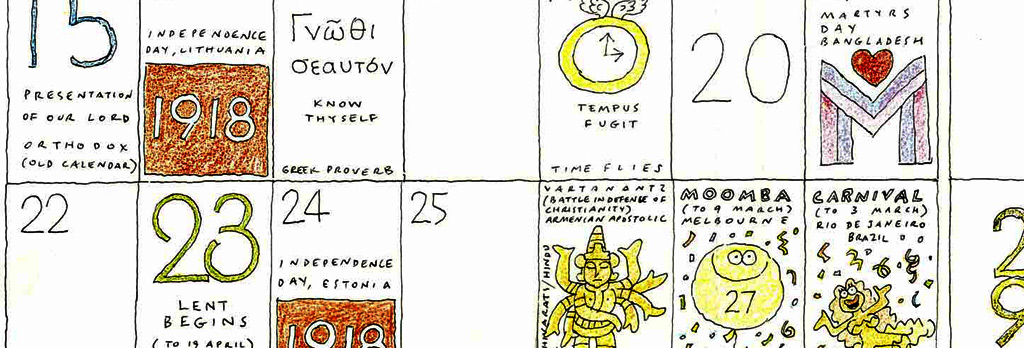
The first All-Australian calendar was published in 1979 for the year 1980. In the accompanying description, it was explained that the calendar had been prepared in consultation with members of migrant and religious communities, and that it recorded 137 days of significance to six world religions, 133 days of significance to members of migrant communities and 135 days of general community interest. It also recorded 20 public holidays celebrated in the various states of Australia.[38] Approximately 40,000 copies were distributed to schools, hospitals, community organisations, government departments and companies throughout the country. The Productivity Council distributed 16,000 calendars to companies, and the EES assisted with the distribution in schools.
While some conservative politicians criticised the calendar for perpetuating ‘foreign cultures instead of helping them [migrants] to develop one which is uniquely Australian’,[39] the public initially applauded the calendar. The organising committee received 2,000 letters and phone calls of thanks: only 16 letters expressed criticism.[40] However, the calendar would not remain uncontroversial. A few dates were contested or questioned, based on political and/or ethnic conflict between the homeland and the diaspora. Australia’s trade and diplomatic relations with Eastern Bloc countries expanded in the 1970s due to United Kingdom’s entry into the European Community. Calendar date disputes forced Australia, on a few occasions, to move from its stance of diplomatic neutrality to take a side with either the diaspora or the homeland.
One date in particular attracted criticism: 10 April, which was marked in the calendar as ‘National Day, Croats’. On 10 April 1941, the German and Italian armed forces had set up the Independent State of Croatia (including Bosnia and Herzegovina), and Ante Pavelic’s Ustaša, a previously supressed pro-fascist group, had taken control of the ‘independent’ state. Between 1941 and 1944, the Ustaša killed nearly 100,000 Serbs, Jews, Gypsies and anti-fascist Croats in concentration camps.[41] Ian Cathie, an Australian Labor Party politician and shadow minister for immigration and ethnic affairs in the Victorian parliament, described the inclusion of 10 April as ‘an insult to many Yugoslav migrants and those Australians who died in the war’, and demanded that the calendar be withdrawn.[42] Donohue-Clyne was responsible for the Yugoslav dates in the calendar.[43] She was affiliated with the ‘multiculturalists’ in Melbourne, being the wife of the linguist Michael Clyne who advised government on language education policies.[44] Donohue-Clyne had included all dates of significance to Yugoslav groups, not wanting to privilege any one particular view. Such editorial caution can be understood in the context of ongoing anti-Yugoslavian sentiment and ‘politically motivated violence’ initiated by Croatian extremist groups.[45]
Other individuals and community groups also expressed discontent regarding the inclusion of 10 April in the All-Australian calendar.[46] For example, the claims officer of the Australasian Meat Industry Employees Union worried that the inclusion of 10 April not only offended Yugoslavian migrants, but also hindered their integration into multicultural Australia.[47] The issue reached the level of foreign diplomacy: Peter Lombardic, acting consul general of the Yugoslavian Embassy, raised it at a senior foreign affairs meeting.[48] The issue was later raised in the Senate, too.[49] Due to such reactions, the date was removed from subsequent calendars amid the complaints of pro-fascist Croatian organisations.
A journalist from the Greek newspaper Nea Patrida identified a cause for disapproval in the Greek community: the inclusion of the Macedonian National Day or the Day of the Republic on 2 August.[50] This day, also called the Ilinden (St Elijah) Day Uprising, commemorates a failed revolt against the Ottoman Empire organised by Macedonian and Bulgarian revolutionaries, and the short-lived Kruševo Republic in 1903. The journalist, GS Iakovidis, stressing that a Macedonian nation had never existed, wrote that the date ‘was included only after a lot of pressure from the anti-Greek movement group’. According to the Greek narrative, Macedonia ‘was the state and civilisation of the ancient Macedonians which, beyond doubt, are part of Greece’s national and historical heritage’.[51] In fact, it took until 2018 for the Macedonian issue to be settled: that year, Macedonia and Greece agreed to rename the former the Republic of North Macedonia, acknowledging with the new name both the cultural heritage of ancient Greek Macedonia and the existence of a distinct Macedonian language and nationality.[52]
Another journalist, editor of the Russian newspaper Unification, objected to the inclusion of the National Day of the Soviet Union on 7 November, as it was ‘a day of destruction of democracy in Russia, [the] day of the establishment of the GULAG Archipelago’.[53] Likewise, president of the Hungarian Veterans’ Association of Victoria expressed shock at the inclusion of 4 April as Hungary’s National Day. Since many Hungarians recognised 4 April as a day of mourning, being the day when Soviet troops occupied Hungary in 1945, to him:
it appears that the feared infiltration of the left into key positions already took place I can find no explanation, how on earth such a bad mistake was allowed to happen. One has to wonder, are we supporting the right side?[54]
A similar complaint was sent to the Ministry of Immigration and Ethnic Affairs from the Council of Hungarian Associations in Victoria ,and from Reverend Kemeny in Western Australia. Kemeny illustrated the gravity of the date’s inclusion by likening it to the inclusion of ‘Pearl [Harbor] Day December 7 as a National Rejoicing Day in Japan’.[55]
In addition to such controversial date inclusions, there were a few notable omissions from the 1980 All-Australian calendar, including Türkiye’s Victory Day and Lebanon’s St Maroum’s Day. A few concerned citizens also noticed that the Queen’s Birthday was missing, which the publisher explained only occurred because the date had not been gazetted prior to publication.[56]
Overall, Alan Wood, minister for immigration and ethnic affairs, was satisfied with the response to the calendar from schools. He acknowledged that there had been insufficient consultation with migrant communities, but emphasised that Australia recognised the governments and national days of various countries. The minister hoped to find a compromise between honouring dates of significance to Australia’s migrant communities and those that were important to the nation’s diplomatic partners.
Consecutive calendars until 1987
The organising committee wanted to avoid any cause for criticism with the second All-Australian calendar in 1981. As such, it requested from the Department of Foreign Affairs a list of national holidays of countries recognised by the Australian Government.[57] The committee also circulated a community questionnaire asking about ‘days of major significance celebrated by your community in 1981’.[58] Each community was able to suggest four dates of significance. In total, 117 migrant organisations responded to the questionnaire.[59] Four dates were not enough for many organisations, some of whom misunderstood the assignment and listed dinner dances and picnics as ‘days of significance for the community’.[60]
The editors of the calendar also sought to learn from practices in other multicultural countries. Ivan Kolarik, senior research officer at the Victorian Ministry of Immigration and Ethnic Affairs, approached Marie F Zielinska, head of the Multilingual Biblio Service at the National Library of Canada. Ontario had initiated a similar publication, called Days to remember, which was well received; however, it was created specifically to help the police ‘identify special gatherings or understand ethnic group behaviour’.[61]
Hoping to learn from past mistakes, the calendar committee asked Donohue-Clyne to summarise the lessons learned from the first publication. She recommended that contested dates be observed in the context of ‘the ethnic groups to which [they] belong, not in light of protests from others’. In the Hungarian case, it was suggested that the contested date, 4 April, be replaced by 20 August, being the date Hungarians celebrated the feast day of the medieval founder of the Hungarian nation. Regarding the Croatian National Day, Donohue-Clyne suggested that it should be accurately labelled as ‘Croatians in exile or some Croats in Australia’ or as ‘proclamation of the independent state of Croatia 1941’. As for the Russians, she proposed the inclusion of 7 November, because it was ‘important to the national consciousness of Russians’.[62] However, this suggestion did not resolve the inherent dilemma of avoiding causing offence to migrant communities while simultaneously recognising the national days of regimes from which those communities had sought refuge in Australia, particularly migrant communities from the Soviet Bloc.[63] From 1981, the committee added a disclaimer to the calendars: ‘It should be understood that this calendar is neither an exhaustive nor a comprehensive list of celebrations or holidays.’
In 1982, Michael Cigler, a multicultural historian and editor of the Australian Ethnic Heritage book series (1983–89), joined the calendar committee.[64] The committee commissioned Cigler to write a multicultural history of Victoria, focusing on multicultural elements in the past—from the hundreds of languages of Indigenous peoples to the peak period of contemporary multicultural Australia. As Frank Bongiorno has argued, this approach—seeking multiculturalism’s roots in the past—aimed to legitimise the concept by providing it with a deeper and longer history.[65]
From 1982 onwards, an overarching theme was chosen for each year’s calendar. In 1983, the theme was communication, in 1984 it was sport, in 1985 it was music, in 1986 it was peace and in 1987 it was the future.[66] Each year, the calendar team was led by George Said from ACI, who acted as ethnic advisor, and a researcher commissioned by the Department of Education. Researchers used previous calendars and new sources to decide which dates to include.
The calendars’ production fees were covered by various organisations, including research, sponsorship and/or in-kind contributions, such as EES distributing the calendars to all public and private schools in Victoria.[67] The schools received the calendars free of charge, as did many community and welfare organisations, libraries, hospitals, members of parliament, government departments, educational institutions, hostels and members of the PPCA.[68]
The first four calendars (1980–83) were designed by Flett Henderson and Arnold; the fifth, in 1984, was designed by Hodja Educational Resources Co-operative Ltd. Flett Henderson and Arnold was an influential Australian design studio that, besides designing the logo for the Australian Productivity Council,[69] would have a long-lasting impact on Australia’s visual culture by rebranding Telstra and creating the visual identity for the Sydney 2000 Olympic Games.[70] Beyond financial reasons, the decision to change designers may have been influenced by the establishment of the Victorian Ethnic Affairs Commission in 1983, and a desire to promote the calendar’s educational value, as Hodja, a multilingual publishing cooperative, also worked on multicultural educational curriculum material in the 1980s.[71] The final two calendars were designed by Peter Viska,[72] a cartoonist known for creating children’s pages for Australian newspapers.[73] His whimsical illustrations not only appeared on the 1986 and 1987 calendars, but also on the cover of the calendar book for 1986 (Figure 2).[74]
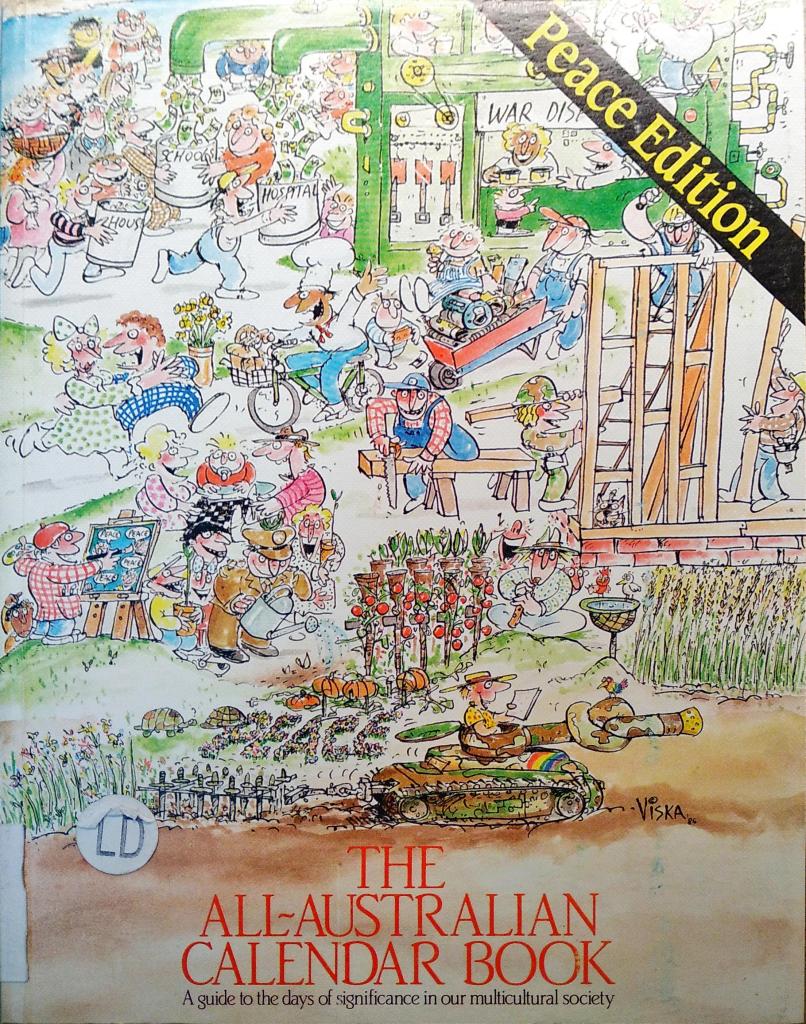
Figure 2: Cover, The all-Australian calendar book, a guide to the days of significance in our multicultural society, Hodja, Richmond, 1986. Source: State Library Victoria, SLT 394.26994 N62B. Photographed by the author.
The success of the Victorian initiative soon led to plans to make the calendars into a federal project.[75] The PPCA was supportive,[76] but the All-Australian calendar never expanded beyond Victoria—although the Western Australian Department of Education ordered 5,000 copies in 1982.[77]
Despite the editors’ best efforts, some editions of the calendar contained errors or omissions. In 1983, for example, all the diacritical marks were missing from the typesetting and had to be added by hand after printing. The problem was pointed out by Taki Eftis from Polyprint, a foreign language specialist printer, who considered the omission disrespectful of ethnic communities.[78] In 1987, several major dates were missing, like the Chinese and Vietnamese New Year, the national days of the Soviet Union and Chinese Republic, and even Remembrance Day.
The 1987 All-Australian calendar was the last to be produced, a decision that could have been induced for many reasons. From its inception, the project’s main financial contributor was the PPCA, which also distributed most of the calendars to its members annually.[79] Although there is no documentation regarding the decision to discontinue the calendars, I suggest that PPCA’s decision to cease funding the project was key. It is likely that the initial aim of the calendars—to raise productivity—was not met, and their educational value would not have been a major factor for the PPCA. Recurring budget problems, criticisms and complaints, and changes to the organisations involved may have contributed to the demise of this multicultural project.
By 1988, the focus of multiculturalism had shifted from encouraging migrant productivity through cultural engagement to a program specifically targeting skilled migrants. The Hawke Labor government (1983–91) was the last to propose federal multiculturalism legislation. The Howard Coalition government (1996–2007) opposed multiculturalism.[80]
Conclusion
The All-Australian calendar has several important legacies. It was an initiative created by several Victorian groups to assist employers in managing migrant workers while facilitating migrants’ cultural needs. Conservative versions of multiculturalism focused on tolerable aspects of the migrant presence—features that might enrich the Australian nation but would not overtly challenge Australian sensibilities. The controversies associated with the All-Australian calendar acted as an uncomfortable reminder of the divisiveness that could accompany the migrant experience. As we have seen, contested dates were handled differently depending on the political or economic context, but, ultimately, it was expected that migrants would leave their differences behind them in becoming Australian. At the same time, the calendars were widely used in schools around Victoria—and in Western Australia—to contribute to a multicultural curriculum, essentially a celebration of difference, which lay outside of the scope of economic productivity.
The All-Australian calendar, despite its short lifespan of eight years, is an important historical artefact and hybrid cultural document of Australia’s engagement with multiculturalism. The calendar illustrates the inherent tension around multiculturalism in the early 1980s—appearing to recognise the diversity of working-class migrant communities while projecting the future of productive multiculturalism.
The All-Australian calendar’s dual audience—migrant workers and school students—manifested neoliberal understandings of migrant identity. The calendar was at once a visual and conceptual embodiment of ‘unity through diversity’ and cultural preservation, and a means of fostering a more efficient workforce. This aligns with Ghassan Hage’s observations on the productive migrant trope of the late 1980s, and Patrick Brownlee’s definition of ‘productive diversity’.
Putting financial considerations to one side, the demise of the All-Australian calendar also reflects the conflict between competing approaches to multiculturalism that characterised the 1980s. If any attempt was made to measure the productivity of migrant workers in light of the All-Australian calendar, no data remain. The content of the calendars reflected a multiculturalism that embraced cultural pluralism and workers’ rights; however, it also served emerging ideas of productive multiculturalism—that is, supporting a more efficient work environment through acceptance of migrant workers’ heritage. As productive multiculturalism came to focus more on skilled migration in the latter part of the 1980s, the cultural wellbeing of industrial migrant workers became less of a priority. The calendar had ended before Australia’s bicentenary in 1988, when productive multiculturalism became solely an economic project of the neoliberal state. Multiculturalism, often framed ideologically as Australia’s new national identity, has always integrated an economic dimension.[81] By the end of the 1980s, multiculturalism not only defined the new national identity, but also, as Paul Ashton argues, left unanswered the legacies of colonialism, nationalism and inequalities in Australia (Figures 3a and 3b).[82]
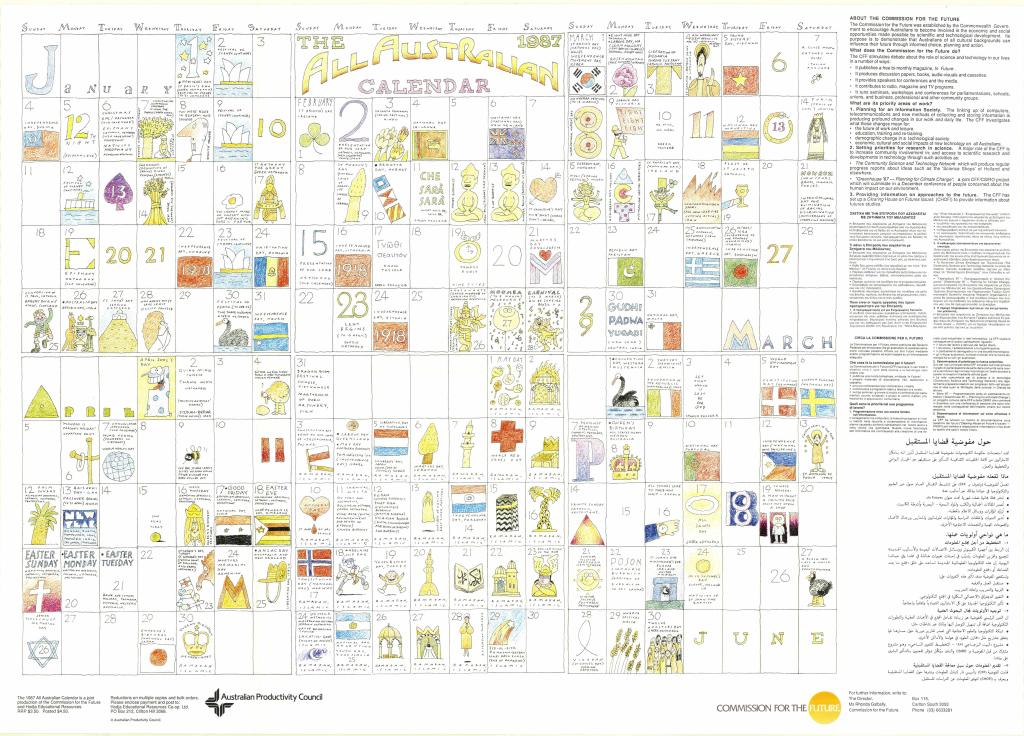
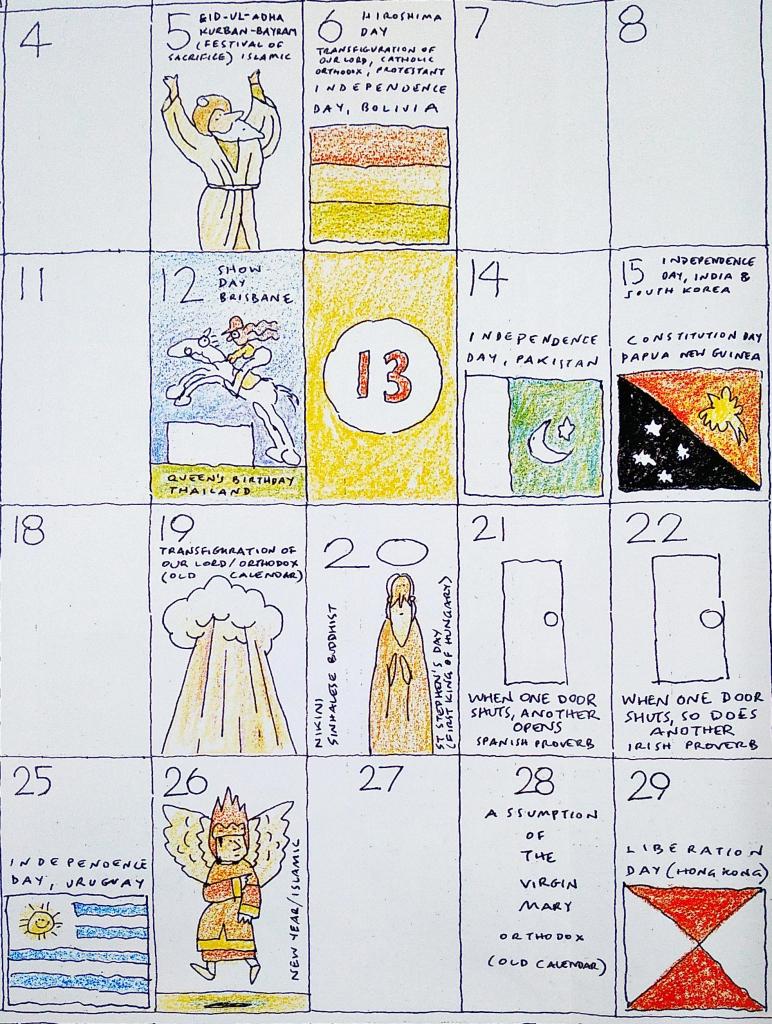
Figures 3a and 3b: Extracts from All-Australian calendar 1987. Source: PROV, VPRS 11790/P1, 87/041. Photographed by the author.
Endnotes
[1] Santina Bertone, ‘Unions, the workplace and social cohesion’, in James Jupp, John Nieuwenhuysen & Emma Dawson (eds), Social cohesion in Australia, Cambridge University Press, Melbourne, 2007, pp.133–134.
[2] Michael Quinlan & Constance Lever-Tracy, ‘Immigrant workers, trade unions and industrial struggle: an overview of the Australian experience, 1945–1985’, Economic and Industrial Democracy, vol. 9, 1988, pp. 7–41, p. 12.
[3] Bertone, ‘Unions, the workplace and social cohesion’, p. 134.
[4] Richard Broome, The Victorians—arriving, Fairfax, Syme & Weldon Associates, McMahons Point, 1984, p. 228.
[5] Al Grassby, A multi-cultural society for the future, Australian Government Publishing Service, Canberra, 1973, available at <http://www.multiculturalaustralia.edu.au/doc/grassby_1.pdf>, accessed 27 November 2024.
[6] Broome, The Victorians, pp. 230, 233–234.
[7] Pronia, ‘Nick Polites. Vale Nick Polite OAM’, available at <https://pronia.com.au/nick-polites/#>, accessed 10 September 2025.
[8] Andrew Jakubowicz, Multicultural arc: making multicultural Australia: past, present and future, Sydney Multicultural Community Services, Daceyville, 2023, pp. 30–31.
[9] Andrew Jakubowicz, Michael Morrissey & Joanne Palser, Ethnicity, class and social policy in Australia, Social Welfare Research Centre, University of New South Wales, SWRC Reports and Proceedings, no. 46, May 1984, p. 78.
[10] Raymond Sestito, The politics of multiculturalism, Centre for Independent Studies, St Leonards, 1982, p. 35.
[11] Andrew Markus & Margaret Taft, ‘Postwar immigration and assimilation: a reconceptualisation’, Australian Historical Studies, vol. 46, no. 2, 2015, pp. 234–251, 250.
[12] Alexandra Dellios, ‘The 1973 migrant workers’ conference and histories of multiculturalism’, Labour History, no. 126, 2024, pp. 139–161, 159–160.
[13] Ibid., p. 142.
[14] Andrew Jakubowicz, ‘Ethnicity, multi-culturalism and neo-conservatism’, in Gill Bottomley & Marie M. De Lepervanche (eds), Ethnicity, class and gender in Australia, Allen and Unwin, Sydney, 1984, pp. 28–48, 29, 34.
[15] Patrick Brownlee, The political economy of migration and post-industrializing Australia, Routledge India, New Delhi, 2020, p. 16.
[16] Sneja Gunew, Haunted nations: the colonial dimensions of multiculturalism, Routledge, London, 2004, p. 5.
[17] Ibid, p. 40.
[18] Mark Lopez, The origins of multiculturalism in Australian politics, 1945–1975, Melbourne University Press, Carlton, 2013, p. 433.
[19] Ibid, p. 447.
[20] Frank Bongiorno, The eighties: the decade that transformed Australia, Black Inc., Collingwood, 2015, p. 56.
[21] Ibid, p. 60.
[22] Jakubowicz, Multicultural arc, p. 37.
[23] Brownlee, The political economy of migration, p. 147.
[24] Bob Hawke, ‘National agenda for a multicultural Australia launch’, available at <https://www.multiculturalaustralia.edu.au/doc/hawke_1.pdf>, accessed 15 May 2024.
[25] Brownlee, The political economy of migration, p. 166.
[26] VMIEA, internal memorandum, 5 November 1979, All-Australian Calendar 1980—Production and Launching, PROV, VPRS 11790/P1, 83/0030/1.
[27] Australian Productivity Council, ‘About Australian Productivity Council’, <https://www.australianproductivity.com/about/>, accessed 15 May 2024.
[28] ‘Bakelite Company, polyethylene products, 1953’, Museums Victoria Collections, <https://collections.museumsvictoria.com.au/items/2036398>, accessed 19 March 2025.
[29] HR Downey, director, VMIEA, to WS Morrisson, general director, ACI Ltd, 20 November 1979, All-Australian Calendar 1980—Production and Launching, PROV, VPRS 11790/P1, 83/0030/1.
[30] Department of Education, Ethnic calendar, 1978, and Child Migrant Education Services/Ethnic Education Services, Dates to remember, 1979, All-Australian Calendar 1980—Production and Launching, PROV, VPRS 11790/P1, 83/0030/1.
[31] Margaret Bayly, Lessons learned: a history of migrant education in Victorian government schools, 1960–2006, Department of Education and Early Childhood Development, Melbourne, 2011, p. 27.
[32] Statement by the director-general of the Victorian Department of Education, Dr Shears, in News Exchange, no. 3, 14 March 1979, cited in ibid., p. 34.
[33] Victorian Employers’ Federation, employers’ report, All-Australian Calendar 1980—Production and Launching, PROV, VPRS 11790/P1, 83/0030/1.
[34] Ian Adams, assistant director, Ethnic Education Services, to Robert H Downey, director, Victorian Ministry of Immigration and Ethnic Affairs, 8 October and 8 November 1979, All-Australian Calendar 1980—Production and Launching, PROV, VPRS 11790/P1, 83/0030/1.
[35] ‘Multicultural education – dates to remember – rationale’, All-Australian Calendar 1980—Production and Launching, PROV, VPRS 11790/P1, 83/0030/1.
[36] All-Australian calendar 1980, cover, All-Australian Calendar 1980—Production and Launching, PROV, VPRS 11790/P1, 83/0030/1.
[37] Media release, ‘All-Australian calendar 1980’, All-Australian Calendar 1980—Production and Launching, PROV, VPRS 11790/P1, 83/0030/1.
[38] Minister of Immigration and Ethnic Affairs, ‘All-Australian Calendar 1980 Launch’, media release, All-Australian Calendar 1980—Production and Launching, PROV, VPRS 11790/P1, 83/0030/1.
[39] Darl J Cox, president, Liberal Party, Wattle Park Branch, to A Wood, Minister of Immigration and Ethnic Affairs, All-Australian Calendar 1981—Questionnaires and Suggested Dates, PROV, VPRS 11790/P1, 83/0033/1.
[40] Correspondence between HR Downey, director, Ministry of Immigration and Ethnic Affairs, and AJ Hardge, Australian Consolidated Industry Ltd, All-Australian Calendar 1981—Working File, PROV, VPRS 11790/P1, 83/0026/1.
[41] Kristy Campion, Chasing shadows: the untold and deadly story of terrorism in Australia, Allen and Unwin, Sydney, 2022, p. 63.
[42] Statement by Ian Cathie, 7 February 1980, All-Australian Calendar 1980, Correspondence Against, PROV, VPRS 11790/P1, 83/0032/1.
[43] Report on press release by shadow minister for Immigration and Ethnic Affairs, All-Australian Calendar 1980, Correspondence Against, PROV, VPRS 11790/P1, 83/0032/1.
[44] Lopez, The origins of multiculturalism, p. 399.
[45] Jayne Persian, Fascists in exile: post-war displaced persons in Australia, Routledge, London, 2024, pp. 105, 112.
[46] Australian Jewish Board of Deputies, All-Australian Calendar 1980, Correspondence Against, PROV, VPRS 11790/P1, 83/0032/1.
[47] Correspondence between D Davies, claims officer, Australasian Meat Industry Employees Union, and A Wood, minister for immigration and ethnic affairs, All-Australian Calendar 1980, Correspondence Against, PROV, VPRS 11790/P1, 83/0032/1.
[48] Correspondence between Department of the Premier, Victoria, and Ministry of Immigration and Ethnic Affairs, All-Australian Calendar 1980, Correspondence Against, PROV, VPRS 11790/P1, 83/0032/1.
[49] Senate question 2645, 15 April 1980, All-Australian Calendar 1980, Correspondence Against, PROV, VPRS 11790/P1, 83/0032/1.
[50] Translation of GS Iakovidis, ‘Serious mistakes in the ethnic calendar’, All-Australian Calendar 1980, Correspondence Against, PROV, VPRS 11790/P1, 83/0032/1.
[51] Zhidas Daskalovski, ‘The impossible reconciliation of historical narratives: the Macedonian name dispute and prospects for the future’, in R Hudson & I Dodovski (eds), Macedonia’s long transition, Palgrave Macmillan, Cham, 2023, pp. 61–75.
[52] Neophytos Loizides, ‘Symbolic right-sizing and Balkan nationalisms: the Macedonia name dispute and the Prespa Agreement’, Irish Political Studies, vol. 35, no. 3, 2020, pp. 492–508, 502.
[53] Correspondence between George Amosow, editor, Unifications, to the publishers of the calendar, All-Australian Calendar 1980, Correspondence Against, PROV, VPRS 11790/P1, 83/0032/1.
[54] Correspondence between president, Hungarian Veterans Association Victoria, and minister of immigration and ethnic affairs, All-Australian Calendar 1980, Correspondence Against, PROV, VPRS 11790/P1, 83/0032/1.
[55] Correspondence between Rev. PG Kemeny and minister of immigration and ethnic affairs, All Australian Calendar 1980, Correspondence Against, PROV, VPRS 11790/P1, 83/0032/1.
[56] Correspondence between John Paul, president, Royal Commonwealth Society, and Alan Wood, minister of immigration and ethnic affairs, All-Australian Calendar 1980, Correspondence Against, PROV, VPRS 11790/P1, 83/0032/1.
[57] Department of Foreign Affairs, national day messages, All-Australian Calendar 1981 Suggested Dates, PROV,VPRS 11790/P1, 83/0027/1.
[58] Draft letter with questionnaire by Victorian Ministry of Immigration and Ethnic Affairs, All-Australian Calendar 1981—Working File, PROV, VPRS 11790/P1, 83/0026/1.
[59] All-Australian Calendar 1981, Suggested Dates, PROV, VPRS 11790/P1, 83/0027/1.
[60] All-Australian Calendar 1981, Questionnaires and Suggested Dates, PROV, VPRS 11790/P1, 83/0033/1.
[61] Ivan Kolarik to Marie F Zielinska, June–July 1980, All-Australian Calendar 1981—Working File, PROV, VPRS 11790/P1, 83/0026/1.
[62] Irene Donoghue-Clyde, ‘More than a bunch of dates’, All-Australian Calendar 1981—Working File, PROV, VPRS 11790/P1, 83/0026/1.
[63] Ivan Kolarik to Marie F Zielinska, June–July 1980.
[64] Coordinating Committee Meeting, 1 May 1981, All-Australian Calendar 1982—Working File, PROV, VPRS 11790/P1, 83/0023/1.
[65] Bongiorno, The eighties, p. 54.
[66] Draft, All-Australian calendar 1983, All-Australian Calendar 1983—Working File, PROV, VPRS 11790/P1, 83/0021/1; Blurb for A.A.C., All-Australian Calendar 1984—Working File, PROV, VPRS 11790/P1, 83/0019/1; Ethnic Affairs Commission, internal memorandum, 8 February 1984, All-Australian Calendar 1985—Working File, PROV, VPRS 11790/P1, 83/1196; Alex Butler, The 1986 all-Australian calendar book: a guide to the days of significance in our multicultural society, Hodja, Richmond, 1986; All-Australian calendar 1987, VPRS 11790/P1, 87/041.
[67] Draft proposal for consideration, All-Australian Calendar 1981—Working File, PROV, VPRS 11790/P1, 83/0026/1.
[68] Ibid.
[69] Australian Productivity Council, [Logo], <https://recollection.com.au/archives/australian-productivity-council>, accessed 10 September 2025.
[70] Monash University, ‘Alumni: Richard Henderson’, <https://www.monash.edu/alumni/alumni-events/graduation/speaker-profiles/may-2021/richard-henderson>, accessed 27 June 2024.
[71] Michael Denholm, Small press publishing in Australia, volume II: the late 1970s to the mid to late 1980s, Footprint, Footscray, 1991, p. 54; Victorian Ethnic Affairs Commission, blurb, All-Australian Calendar 1984—Working File, PROV, VPRS 11790/P1, 83/0019/1.
[72] Notes of meeting, 15 April 1985, All-Australian Calendar 1985—Working file, PROV, VPRS 11790/P1, 83/1196.
[73] Penguin Books Australia, ‘Peter Viska’, <https://www.penguin.com.au/authors/peter-viska>, accessed 27 June 2024.
[74] Butler, The 1986 all-Australian calendar book, cover.
[75] Minutes, 22 April 1980, All-Australian Calendar 1981–Working File, PROV, VPRS 11790/P1, 83/0026/1.
[76] Ethnic Affairs Commission, internal memorandum, 14 October 1983, All-Australian Calendar 1984—Working File, PROV, VPRS 11790/P1, 83/0019/1.
[77] Coordinating committee, notes, 3 February 1981, All-Australian Calendar 1983—Working File, PROV, VPRS 11790/P1, 83/0021/1.
[78] Correspondence between Taky Eftis, Polyprint, and Garry Sheppard, Victorian Ethnic Commission, All-Australian Calendar 1984—Working File, PROV, VPRS 11790/P1, 83/0019/1.
[79] Coordinating committee meeting, 18 March 1981, All-Australian Calendar 1982—Working File, PROV, VPRS 11790/P1, 83/0023/1; Ethnic Affairs Commission, internal memorandum, 8 February 1984.
[80] Andrew Jakubowicz, ‘New knowing period of Australian ways of “multiculturalism” in rapid social change: when Ibn Khaldun engages southern theory’, in Martina Boese & Vince Marotta (eds), Critical reflections on migration, ‘race’ and multiculturalism: Australia in a global context, Taylor & Francis, London, 2017, pp. 47–67, 57.
[81] Martina Boese, ‘Theorising migrant work beyond economic multiculturalism and methodological nationalism’, in Boese & Marotta, Critical reflections on migration, pp. 88–105. 90–91.
[82] Paul Ashton & Paula Hamilton, ‘“Unfinished business”: public history in a postcolonial nation’, in Daniel Walkowitz & Lisa Maya Knauer (eds), Contested histories in public space, Duke University Press, Durham, 2020, pp. 71–98, 91.
Material in the Public Record Office Victoria archival collection contains words and descriptions that reflect attitudes and government policies at different times which may be insensitive and upsetting
Aboriginal and Torres Strait Islander Peoples should be aware the collection and website may contain images, voices and names of deceased persons.
PROV provides advice to researchers wishing to access, publish or re-use records about Aboriginal Peoples