
Last updated:
‘Revisiting the “Maryvale murders”: a circumstantial reconstruction of a century-old burial’, Provenance: the Journal of Public Record Office Victoria, issue no. 23, 2026. ISSN 1832-2522. Copyright © Nicholas E. Manganas
This article attempts to establish the likely burial location of the human remains associated with the Maryvale murders. Through archival research, local history interviews and the use of ground-penetrating radar, the likely location of a pauper grave at Edenhope cemetery is proposed as the place of burial, and the likely circumstances surrounding the burial in 1918 are reconstructed. It is my contention that the skeletal remains of Maria Cook, née Langley, and her infant daughter Louisa Jane, are buried in this pauper’s grave at Edenhope cemetery, along with the remains of a third person, a male whose identity was never established. The burial took place 34 years after the discovery of the human remains at Maryvale Station, during which time they were held at the Edenhope police station stables, seemingly forgotten. Although the murderer was never brought to trial and the identity of the male human remains continues to be a mystery, the likely resting place of the murder victims has given family descendants some solace and the opportunity to commemorate their place of burial.
The pastoral property of Maryvale Station lies north-east of Edenhope, 25 km from the Edenhope–Horsham Road, now known as the Wimmera Highway. There, on 21 June 1884, the skeletal remains of an adult female and an infant were discovered in the fork of a fallen tree (Figures 1a and 1b). Fears of a double murder spread throughout the district. The adult female had a saddle strap around her neck and the infant’s skull had a hole, thought to have been caused by a blow from a hammer or tomahawk. The news horrified the local community and shocked the colony.
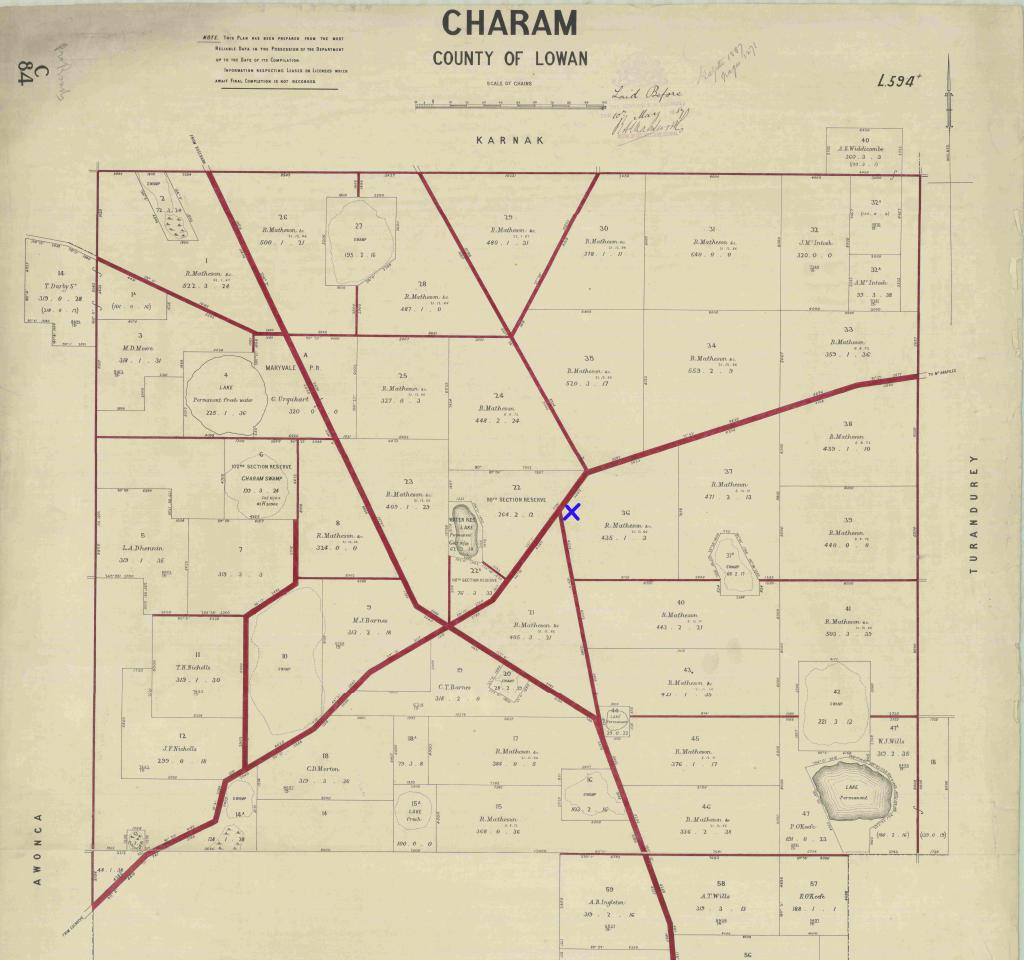
Figure 1a: Map of Charam, County of Lowan, showing the rough location of the skeletons found on Maryvale Station. The location is marked with a blue X. Source: PROV, VPRS 8168/P2 Historic Plan Collection, PROCC84; CHARAM.
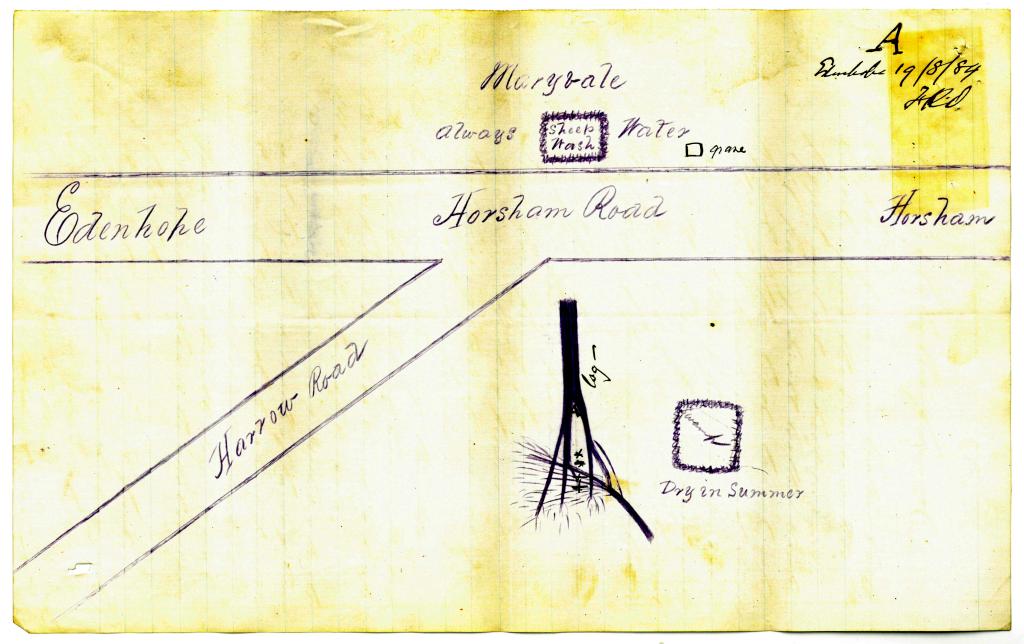
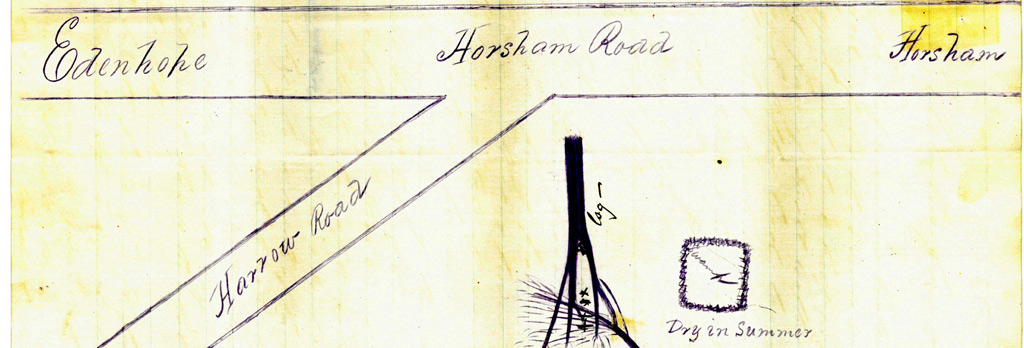
Figure 1b: A sketch produced by Constable Toohey in 1884 that was provided as evidence at the inquest into the Maryvale murder victims, showing the location of the skeletal remains relative to the junction of Harrow and Horsham roads. Source: PROV, VPRS 24/P0 Inquest Deposition Files, 1884/831 Maria Cook, Louisa Jane Sugers: Inquest.
Following the discovery of the human remains, the Kowree Ensign and Harrow Advertiser ran an article entitled ‘Terrible discovery at Maryvale’, noting that ‘the awful discovery made on the Maryvale Station this week has engrossed a large amount of public attention in the Edenhope and Harrow district’ (Figure 2).[1]
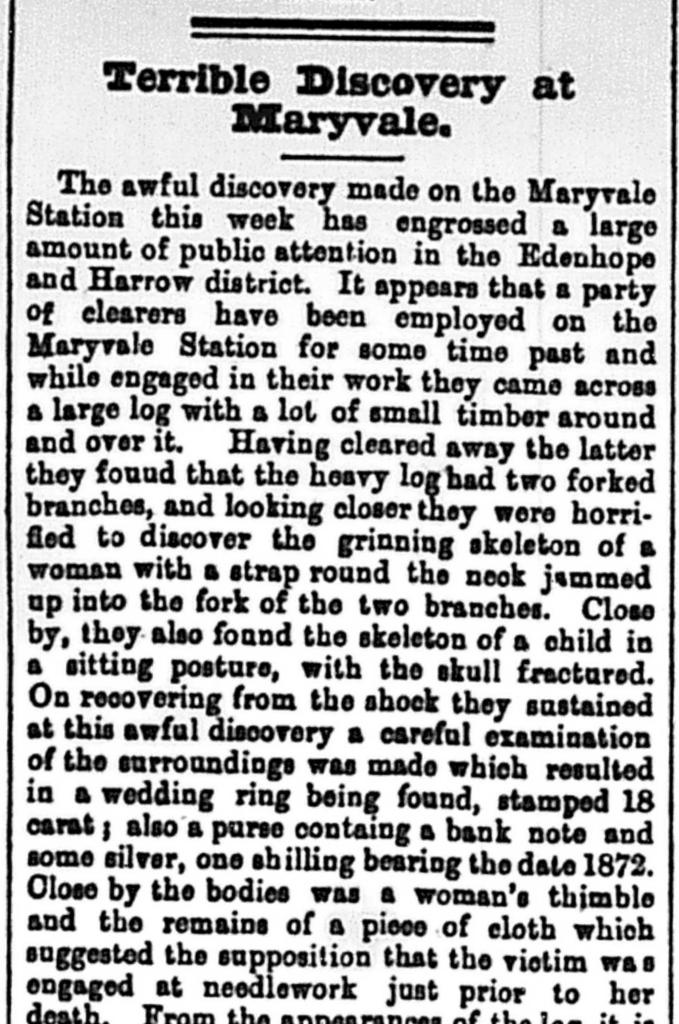
Figure 2: The article ‘Terrible discovery at Maryvale’ reflects the concern of the local community following the discovery of the remains of an unidentified woman and child. Source: Kowree Ensign and Harrow Advertiser, 27 June 1884, p. 3.
An inquest held at Edenhope in August 1884 concluded that the remains were those of Maria Cook, née Langley, and her infant daughter Louisa Jane Sugars Langley (Figure 3).[2] At the time of the discovery of their remains, Maria and Louisa had been missing for 10 years. The man suspected of killing them was Robert Cook, Maria’s husband and Louisa’s stepfather.[3] The couple had only been married for three days when Maria and Lousia disappeared.
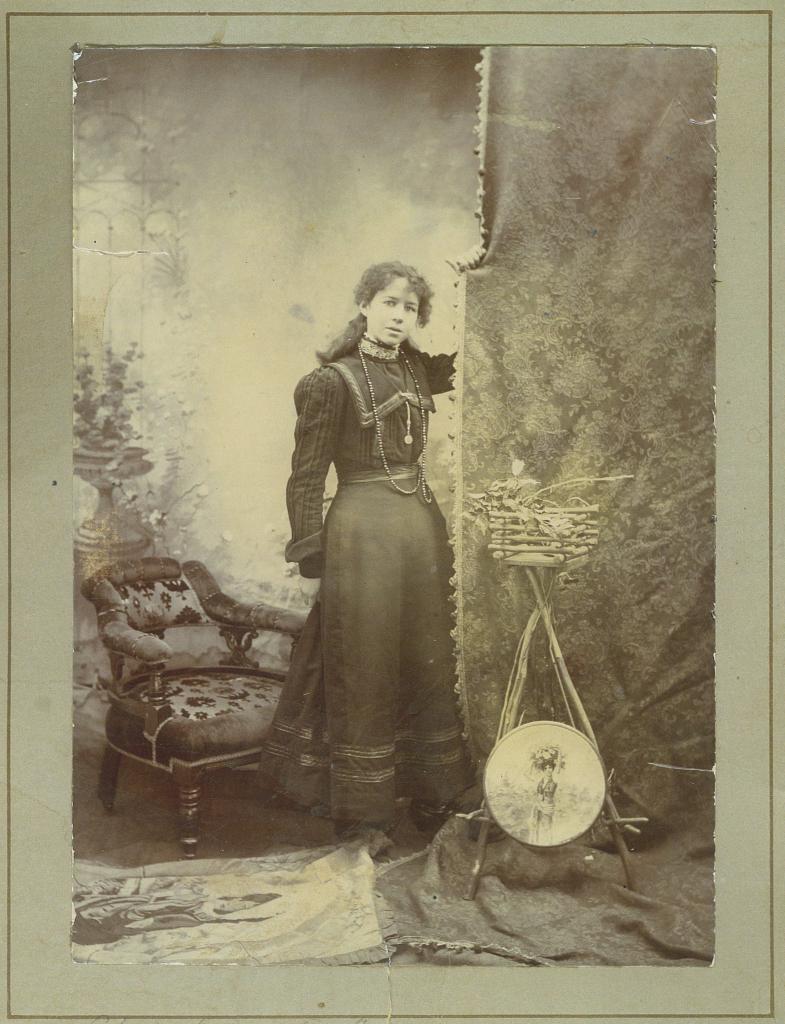
Figure 3: Photograph of Maria Langley taken in 1872, about one month after giving birth to Louisa and 16 months before her marriage to Robert Cook in March 1874. Source: Langley family archives, courtesy of Bev Langley.
In 1886, the remains of an adult male were also found at Maryvale.[4] These remains were dated to the same period as Maria’s and Louisa’s, raising suspicion that it was the missing Robert Cook. The man’s skull had been cut through above the right ear and splintered by a blow from an axe or tomahawk. The male skeleton was never positively identified; however, the possibility of it being Cook was ruled out, as the remains did not match his known height and hair colour. Nevertheless, it was clear that Maryvale had been the scene of three murders in 1874.
For over 30 years, the remains of all three victims were held at Edenhope police station as exhibits in the case known as the ‘Maryvale murders’. By the end of the century, the case remained unsolved. No active investigations took place after 1898 and Robert Cook was never found. Despite repeated requests by the Langley family and the wider community for a ‘Christian burial’ (Figure 4), the remains were not released until 1918. That year, the premier of Victoria ordered their immediate interment, closing the chapter on one of Victoria’s best-known manhunts. However, while the bones were put to rest, the burial unwittingly sparked another mystery that would prevail for over a century, as, remarkably, no records were kept of where, exactly, the remains were buried.
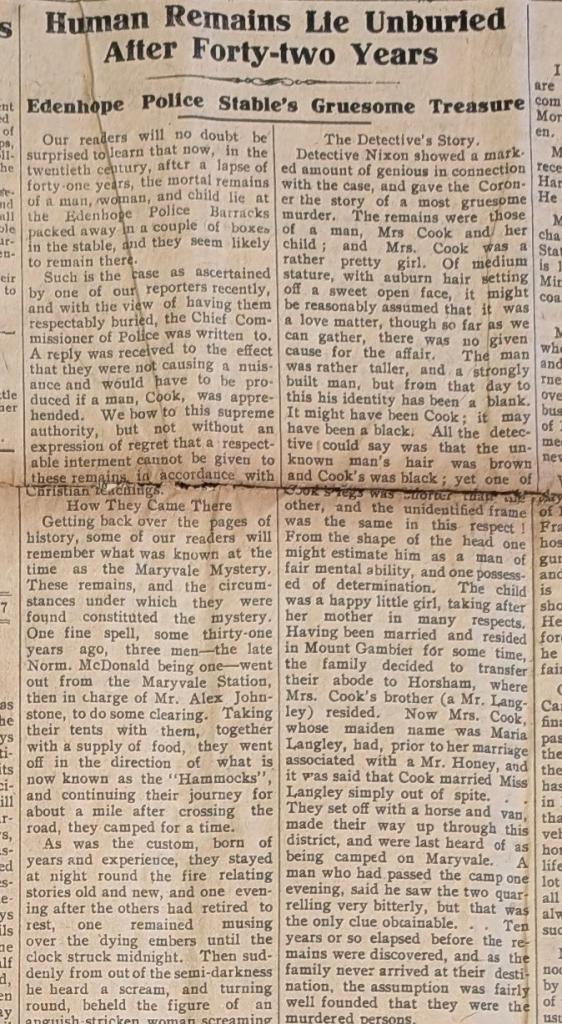
Figure 4: The Kowree Leader brought the story of the Maryvale murders into the public consciousness in 1917. Versions of this article would be reprinted throughout the country over the next 16 months, sparking a campaign to give the remains a ‘Christian burial’. Source: ‘Human remains lie unburied after forty-two years’, Kowree Leader, 6 July 1917.
The Maryvale murders were well known in the Western and Wimmera districts and have remained a part of the area’s history. News about the Maryvale murders frequently made the local and colonial/state newspapers, reflecting wide interest in the case at the time. For the Langley family, the mystery surrounding the location of the graves has been a source of enduring uncertainty and unresolved loss. Today, the case is still remembered by the local community and the Langley family. Offering a small amount of closure to the Langley family, this article attempts to establish the likely burial location of the human remains associated with the Maryvale murders.
A box is buried
Over time, the Maryvale murders became legend. The case evolved from the documented killing of a woman and her daughter to a ghost story in which, in one version of the story, Maria appeared as an apparition to a party of clearers, beckoning them to find her bones and hunt for her murderer.[5]
The burial in 1918 was quietly done, without ceremony or media attention. In the more than 100 years that followed, the facts were forgotten, misremembered and conflated. According to one story, the bones of the victims were stored in lead boxes at the Edenhope police stables.[6] In other versions, their remains were buried in 1927. Neither family history nor the official inquest recorded the location of the burial of Maria’s and Louisa’s remains. Maria’s death certificate, issued in 1884, included no information about her burial.[7] According to The true story of the Maryvale murders and the Langley family ghost, published in 2013, the Langley family understood that Maria’s and Louisa’s remains lay ‘in the pauper’s part of the cemetery’, but nobody knew exactly where.[8]
During the COVID-19 lockdowns in 2020 and 2021, I frequently surfed Trove, the National Library of Australia’s online research portal, while preparing my online lessons. I stumbled across the story of the Maryvale murders and quickly became captivated by the historical details: three skeletons kept in the stables of a police station for 34 years, awaiting the capture of a murderer who was never found. I read The true story of the Maryvale murders and was further intrigued by the mystery of the unknown grave site. So, between the lockdowns of 2021 and 2022, I flew to Melbourne and visited Public Record Office Victoria (PROV) numerous times to see if I could find the police files relating to the case. I hoped these would shed some light on where Maria and Louisa were buried and why it has been so difficult to find their grave. Through the kind assistance of the staff in the reading room, I was able to navigate my way through the Inwards Correspondence Files of the Chief Commissioner of Police.
Since most of the newspaper reporting stated that the burial had taken place in 1918, I concentrated on that year. After a crash course on using the Register of Correspondence, I ordered the relevant registers for 1918, of which there were two—a ‘Y’ Register and a ‘Z’ Register. Scanning through the ‘Y’ Register, I was disappointed to find no mention of the remains from Edenhope. There were so many thousands of entries occupying police time and resources that I began to fear that the burials had not been recorded at all. Finally, on page 540 of the ‘Z’ Register, I found a file with an entry dated 17 October 1918: ‘Edenhope, re 3 skeletons supposed to be at [station] since 1875 of persons alleged to have been murdered.’[9]
The reference to 1875 was incorrect (likely sourced from a major article in the Kowree Leader published in 1917; see Figure 4). Despite this discrepancy, this was very likely the report I was looking for. I ordered the box containing the police correspondence file and found the report from the Edenhope police station, dated 22 October 1918 (Figure 5). The report was written by Constable John James Hughes who was stationed at Edenhope. Needing a way to convey the remains to the cemetery, Hughes had engaged James Francis Ryan, a local man with access to a cart, to assist him. Hughes wrote:
I have to report that I had the human remains buried today in the Edenhope Cemetery. I had a great difficulty in getting a conveyance to cart out the boxes of the skeletons. JF Ryan undertook to convey the remains to the cemetery and to assist me to dig the grave for 15/- fifteen shillings, I was of the opinion that the charge was a reasonable one and got him to do the job.[10]
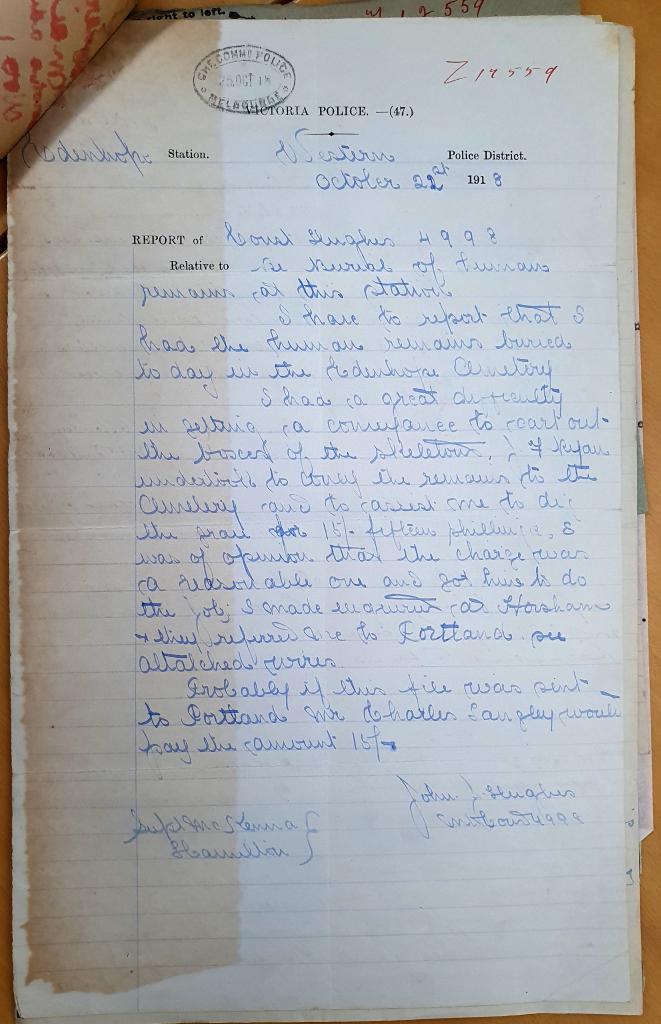
Figure 5: Constable Hughes’s report confirming burial of the remains held at Edenhope police station in October 1918. Source: PROV, VPRS 807/P0, file no Z12559.
Tantalisingly, Hughes’s report answered three broad, interrelated questions: when; by whom; and where, generally speaking, were the remains buried? The remains were buried on 22 October 1918 by Constable John Hughes and James Francis Ryan in the Edenhope cemetery. However, two further questions remained: how and where, exactly, were they buried?
No lead boxes
On the basis of these reports and further research, I am confident that the remains were neither stored nor buried in lead boxes. For the 34-year period during which the remains were stored at Edenhope, the surviving documentary records, though fragmentary, are strikingly consistent regarding their storage and location. A report from the 1884 inquest published in the Herald contains the following significant observation: ‘All the bones of both skeletons were brought into court in a small common deal box, from whence they were produced as required.’[11] Further corroboration is found in a report from the South Australian Advertiser, which stated that the remains of the female victims were produced in court ‘in a small box, being handed out as required’.[12]
On 31 December 1897, the Herald speculated that ‘the bones of the three skeletons—those of Mrs Cook and her child and that of the unknown man—are still, we believe, kept in a box at the Edenhope police station’.[13] This is confirmed by statements in the police correspondence file. Kirkby Robinson, editor of the Kowree Leader, wrote to the chief commissioner of police on 18 December 1915 enquiring whether the remains of the victims of ‘the Maryvale Mystery’ could now be buried. The letter was referred to Mounted Constable Colin Arblaster, who, on 29 December 1915, wrote on the back that ‘the remains of the deceased persons mentioned are at present in two boxes in the stable at this station’.[14] Additional annotations by various officers in charge of Edenhope police station during the period in which the remains were held there confirm Arblaster’s claim. Constable James Byrne stated that ‘the human remains referred to in attached letter were in boxes in the Edenhope police stables when I took charge of that station in 1900’.[15] Likewise, Constable Pickett, in charge of Edenhope police station from July 1906 to August 1913, recalled that the ‘remains were at the Edenhope station during the time I was in charge. They were in boxes in the stable.’[16] Read collectively, these newspaper and police statements produce a consistent interpretation: the remains were not buried in a lead box, but in the same box (or boxes) in which they had been stored for more than three decades.
Loss of knowledge of the grave
In the years that followed the burial of Maria’s and Louisa’s remains, knowledge of the exact location and manner of their interment was quietly forgotten. John Hughes died in 1955, aged 75, and James Francis ‘Butcher’ Ryan died in 1957. With their passing went knowledge of the exact location of the grave of Maria and Louisa, as there is no record of them having ever communicated its location to anyone.[17]
In early 2023, I was put in touch with Kevin Ryan, Maria’s great-great-great nephew, from her older brother Charles Langley’s side of the family. Kevin invited me to Edenhope to share some of my research with him and his family. This took place in April 2023 at the Edenhope Council Chambers in the presence of members of the Langley family, academics and members of the council. It was encouraging to see that the case had the interest and support of so many people.
One of the things discussed that day was the possibility of a joint venture between Edenhope Council and Edenhope Tourism for a grant for the use of ground-penetrating radar (GPR) to locate the unmarked graves at the cemetery. The grant application process took more than 18 months to complete, pushed along by the energetic support of people like Helen Mulraney-Roll, local historian and lifelong Edenhope resident; James Bentley, director, Corporate and Community Services, West Wimmera Shire Council; and Kevin and Ricki Ryan. Finally, Dr Andrew Frost from Flinders University and S.E.E. Spatial & Geophysics in South Australia was engaged to do the work. Frost attended Edenhope cemetery on 23 and 24 January 2025. He scanned the monumental (oldest) section of the cemetery and detected at least 67 unmarked graves. Among these resting places, in a location not previously known to contain any graves, a reflection in the shape of a small box was detected by the radar.[18] The top of the box was approximately 50 cm beneath the ground and it measured 60 cm x 63 cm at a depth of 80 cm (Figure 6).[19] The measurements did not match the shape or size of a normal coffin, either for an adult or a child. Was this the box buried by Constable Hughes in 1918?
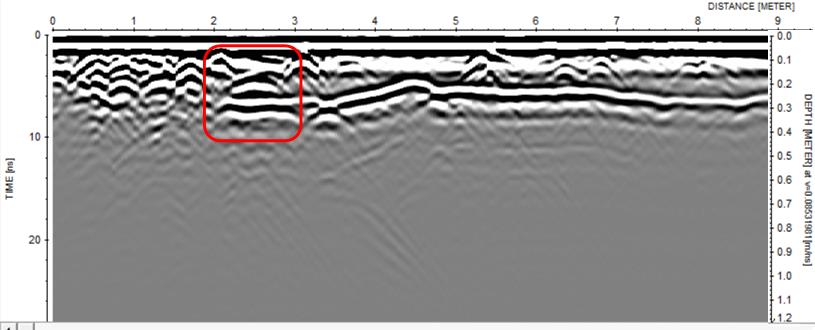
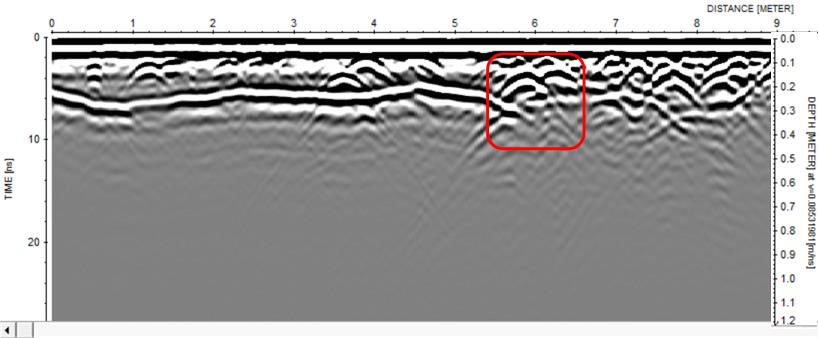
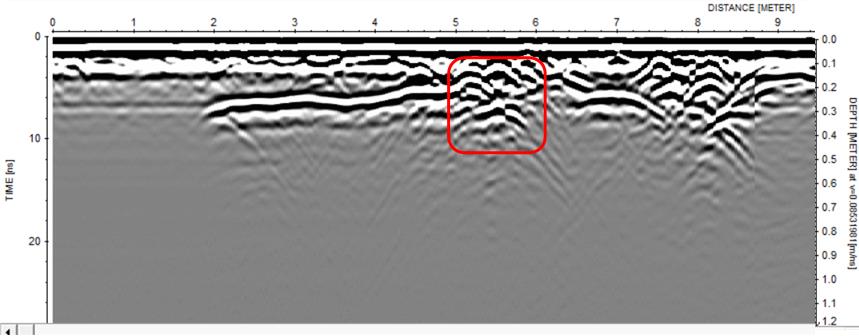
Figure 6: GPR imaging showing disturbed soil over a single location in the Edenhope cemetery. According to Dr Andrew Frost, the measurements are 60 x 63 cm. The reflections start at a depth of approximately 50 cm and reach a depth of 80 cm. Source: images courtesy of Andrew Frost.
A pauper burial
In an article printed in the Age on 18 October 1918 entitled ‘Boxes of bones’, an unidentified government source stated that ‘accumulations’ of human remains in police stations were ‘no uncommon thing’ and were usually buried ‘with the first available pauper’.[20] In the early years of policing, human remains were frequently stored at police stations as part of an inquest or inquiry. In modern times, such remains would usually be stored in specialist forensic storage facilities, depending on the stage of the investigation and the type of evidence being preserved. A December 2021 media release by the Australian Federal Police stated that more than 850 sets of unidentified human remains were stored in police and forensic facilities across the country awaiting DNA identification.[21] Some of these had been in storage for up to 70 years. More recently, in 2023, human remains stored for over 40 years by South Australia Police were formally identified as William Henry Hardie, who had been missing since the 1970s.[22] His remains were identified using DNA technology under the National DNA Program for Unidentified and Missing Persons.[23]
Maria’s and Louisa’s remains were initially retained as evidence of their murder. The remains would have been presented at trial should the suspected killer, Robert Cook, have been apprehended. Sometime between May 1900 and July 1906, Constable Byrnes requested that the remains be removed from the Edenhope police stables. However, the chief commissioner of police, believing that Cook was still alive, denied the request. Byrnes recalled: ‘I requested that the remains should be removed, but the Chief Commissioner of Police (Mr O’Callaghan) stated that as they were exhibits and that the offender Cooke [sic] was still at large the bones would have to be retained.’[24] When Kirkby Robinson wrote to the chief commissioner in 1915 about the possibility of the remains being buried ‘out of respect for the victims’,[25] he was also told that they could not be buried because they would need to be produced should the suspect ever be caught: ‘As these remains would have to be produced if Cooke were arrested, I do not feel justified in ordering their burial.’[26]
This explains why the remains were kept for more than three decades after their discovery: they were evidence in an open, but dormant, murder case. The procedural explanation is understandable within policing logic, but what about the victims’ family and community? The lack of a burial resulted in decades of uncertainty, delayed mourning and social silence for the family. Growing up, Lynette Van Vondel, née Langley, was warned by her grandmother against asking too many questions about her family’s history ‘for fear of what would be uncovered’.[27] In his foreword to The true story of the Maryvale murders, Neil Langley, son of Nelson Langley, Maria’s youngest stepbrother, intimated that the family’s grief over the loss of Maria and Louisa was private and hidden, rather than communal and open:
In 1925, my eldest sister, Isabel, and her siblings were put to bed early as an Uncle and Auntie were visiting. Isabel’s bed, being against the hessian wall adjoining the sitting room, she was able to listen to the adult conversation. They were reading newspaper cuttings regarding our father’s sister, Maria, who at the age of 19 had been murdered along with her 18 month old daughter, Louisa, near Edenhope in 1874.[28]
Lost burial register
The usual way to research burials and their locations is by consulting a cemetery’s burial register. Edenhope cemetery’s burial register was believed to be missing for a long time, supposedly destroyed in a fire in the 1960s.[29] However, there was evidence to contradict this, including eyewitness sightings of the register in the early 1980s and references to the register in a Department of Health file from the 1970s.[30] This information was relayed to Edenhope Council and, as a result, the burial register was located in late 2023.[31] Unfortunately, no burial was recorded in the register for the month of October 1918, the date given in Constable Hughes’s report (Figure 7). This is not surprising, as the burial register only recorded paid burials. As mentioned, Hughes stated that he paid JF Ryan 15 shillings for assistance with cartage and burial; however, there is no record of payment to the cemetery trust for the burial.
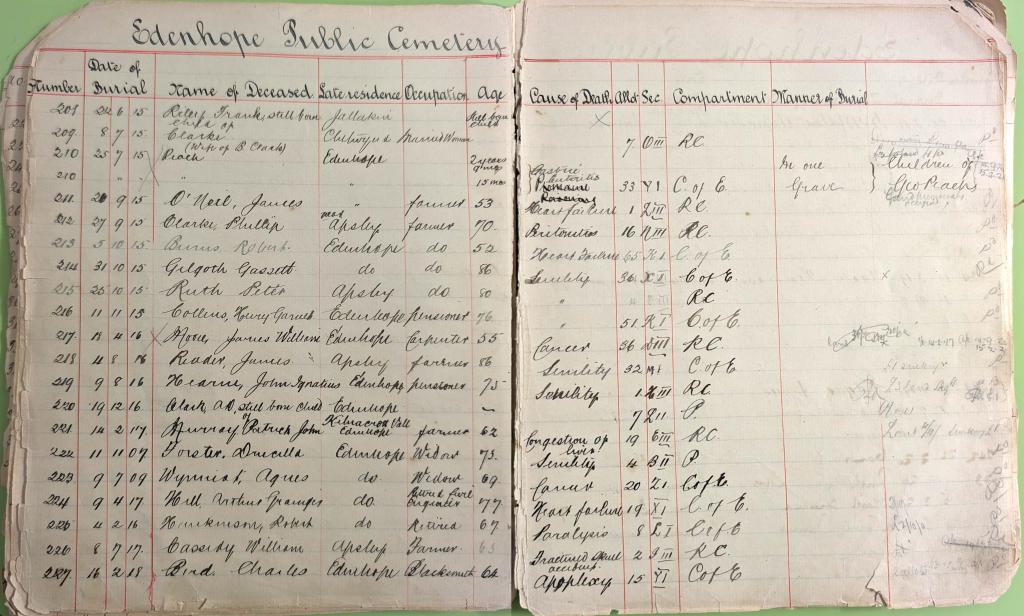
Figure 7: Edenhope cemetery’s burial register showing records of burials conducted between 1915 and 1918. Source: Author’s photographs.
Further evidence for a pauper burial can be inferred from how the police correspondence file that contains Hughes’s report of the burial was indexed.[32] As shown in Figure 8, the police recorded the details of deceased individuals whose names were unknown under separate headings for males, females and unknown sex. In this last section, one of two entries in 1918 was: ‘Re skeletons at Edenhope [Station]’.[33] This entry confirms the burial of the human remains that had been stored at the Edenhope police station and, in doing so, reveals the last tragic development of the Maryvale murders story.
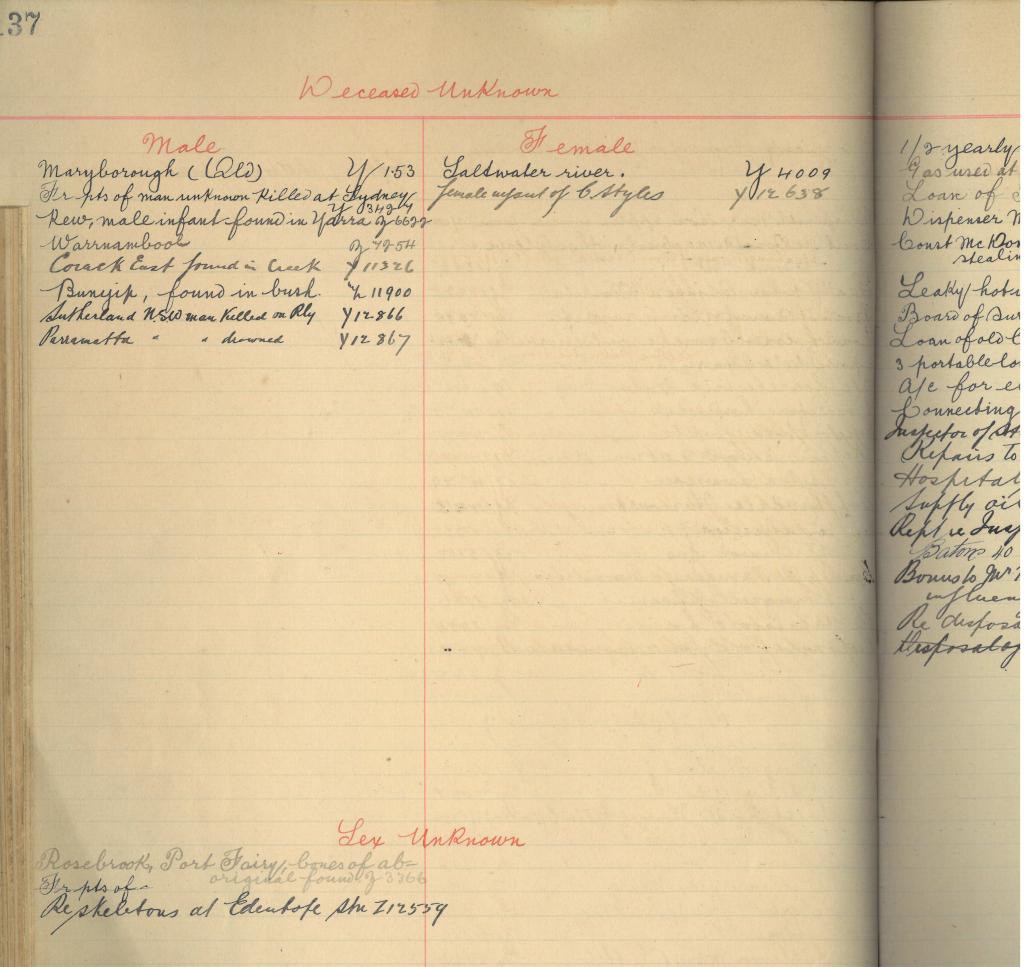
Figure 8: Entries in the Victorian Police Index to Correspondence for 1918, listing the burial of deceased persons whose identities were unknown. The burial of Maria, Louisa and the unknown male is listed under the heading ‘Sex Unknown’ at the bottom of the page, suggesting that, by 1918, the identity of the remains and the reason for their long storage had been obscured. Source: PROV, VPRS 10257/P0, 1918, p. 137.
Following the discovery of human remains at Maryvale Station in 1894, the case had stalled, frozen in ‘official oblivion’, as the Argus complained in 1896.[34] When political and social pressure finally resulted in the order to bury the remains, the police correspondence index referred to them anonymously as the ‘skeletons at Edenhope’ and filed the matter under ‘deceased unknown’ and ‘sex unknown’. Yet the identities of two of the victims were known. Maria and Louisa had not been forgotten by the locals of Edenhope. Why were their names not recorded? Was it a matter of carelessness or intentionality?
The records reveal that the police contacted Charles Langley junior, then living in Portland, to arrange the burial and defray the costs, but he refused to do so unless Maria’s clothing, jewellery and money were handed over to him.[35] Among the evidence presented at the 1884 inquest was a gold wedding ring and brooch belonging to Maria, and these items were still at Edenhope police station when Constable JC Pickett was in charge (1906–13).[36] However, by 1918, only a pair of women’s boots and the leather strap believed to be the murder weapon remained. Consequently, and understandably, Langley refused to pay for the burial. Therefore, the police appear to have proceeded with a pauper burial. Constable Hughes recorded that all three victims were buried in the same grave, along with the boots and the strap.[37]
Examples of other pauper burials
A study of pauper burials conducted by the police during the late nineteenth and early twentieth centuries reveals a process and procedure that is consistent with the one undertaken by Constable Hughes.[38] For example, the pauper burials of ER Mills, who died on 23 March 1897 when the dray he was travelling on overturned near Cobram East, and William Richard, a swagman who likely died of heat stroke on 27 November 1919 at Avanmore, share features with the remains buried at Edenhope in 1918.[39] When no living relatives of a deceased person could be found, or were found but were unwilling or unable to pay the costs of the burial, police had no option but to undertake a pauper burial. In Mills’s case, a receipt from the Cobram Timber Yard was attached to the police report indicating the particulars of the burial costs, which typically included three distinct charges: casket, conveyance of the body and sinking (i.e. the digging) of the grave (Figure 9).[40]
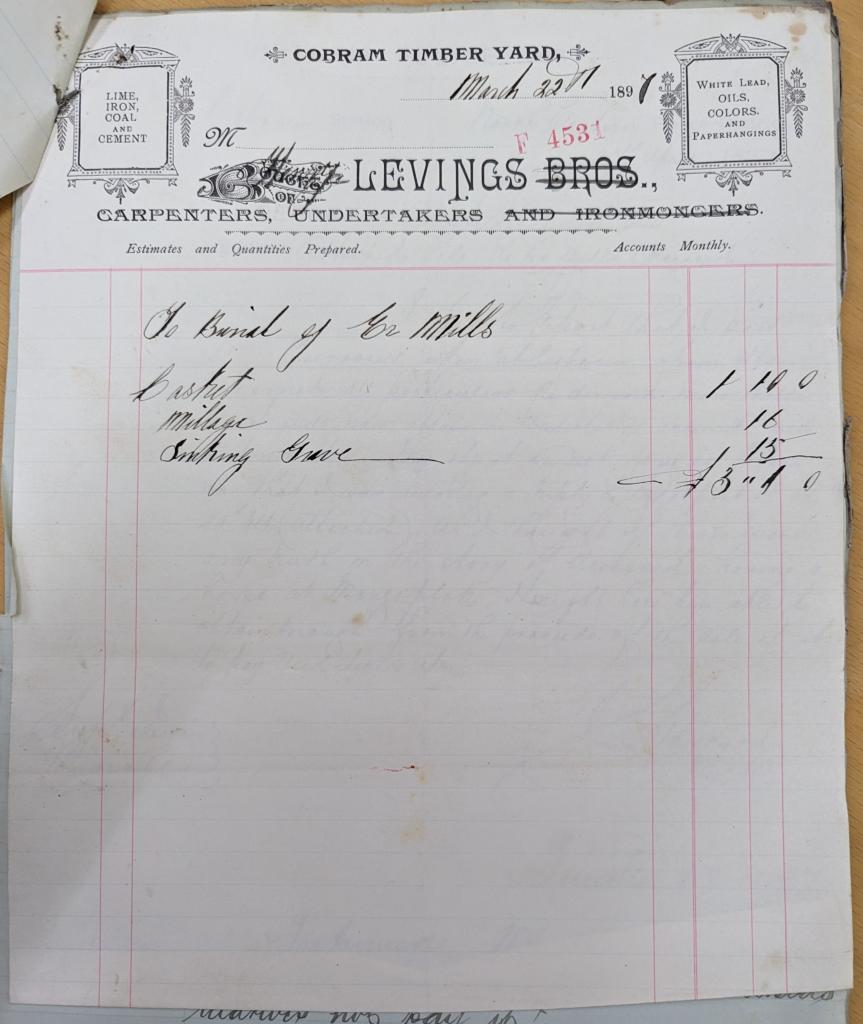
Figure 9: Receipt for pauper burial of ER Mills. Source: PROV, VPRS 807/P0, Unit 1216, File F4531.
The invoice from undertaker W Hagedorn for Richards’s funeral, forwarded to the chief commissioner of police on 29 November 1919, included the same services and added a small charge for a clergyman:
Supplying coffin for one Adult Pauper £4/ 0/ 0 Conveying Remains to Elmore Cemetery £1/10/0 Grave Sinking £0/17/6 Clergyman’s fee £0/10/6 Total £6/18/0[41]
These services were usually itemised separately, and, where not listed, were almost certainly not purchased. The only expense listed in Constable Hughes’s report was 15 shillings, stated to be for mileage and grave sinking. Both services were provided by JF Ryan. No coffin was itemised. Further, as already discussed, it is highly unlikely that a lead box was purchased for the internment of the remains.
Not a normal burial
Was the box discovered using GPR in January 2025 the same one buried by Constable Hughes and JF Ryan in 1918? The box lay at a depth of almost exactly 80 cm (2.62 feet)—an unusual depth according to Edenhope cemetery’s burial register. Where ‘manner of burial’ is recorded in the register, the depth is typically ‘4 feet’ (121 cm). Confirming this, Edenhope cemetery’s scale of fees and charges, published in the Victoria Government Gazette in 1915, shows that the least expensive graves were between 121 cm (4 feet) and 244 cm (8 feet) deep.[42] The shallow depth of the box suggests that it was buried by someone inexperienced with grave digging or unfamiliar with the regulations.
Gravedigging at Edenhope cemetery is an extremely difficult task, even for an experienced team of diggers. According to Evan Arnold, a retired sexton of Edenhope cemetery, the process is complicated by water seepage, which occurs at a depth of 60 cm (2 feet), causing mud and clay to cake to digging equipment and making shovels heavy, resulting in exhausting work for a traditional team of three. A ‘turnabout’ system was usually employed, enabling a 1.2 metres (4 feet) deep grave to be dug in two to three hours with one man digging at a time and changing over as needed.[43]
Several factors could explain the shallowness of the box discovered at Edenhope cemetery in January 2025. First, it is likely that neither Hughes nor Ryan were experienced at gravedigging. Second, data from the Bureau of Meteorology show that Edenhope experienced rain in the days leading up to the burial, increasing the probability of water seepage and mud at the cemetery, for which neither man would have been prepared.[44]
Local knowledge of Edenhope cemetery
Written sources on the history of Edenhope cemetery are scarce.[45] For the most part, I relied on newspaper articles, Department of Health files held at PROV and oral history interviews with long-time Edenhope residents. These enabled me to determine the location of the original entrance to the cemetery (Figure 10) and details about local gravedigging practices.
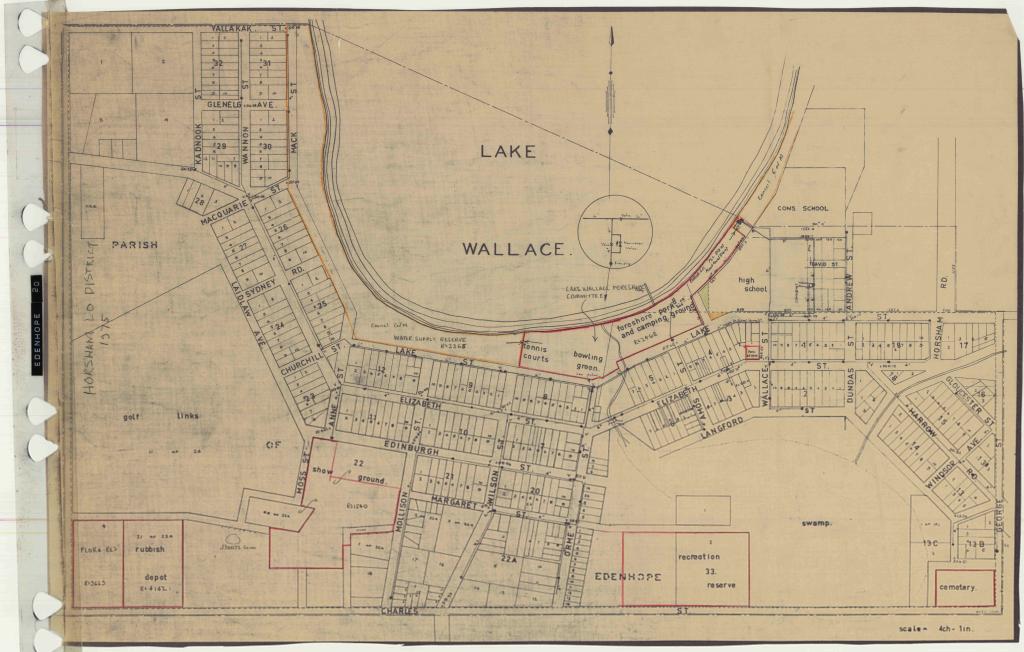
Figure 10: In this 1975 plan of the parish of Edenhope, the location of the cemetery can be seen in the lower right-hand side of the town, at the end of Langford Street. Source: PROV, VPRS 16171/P1 Regional Land Office Parish and Township Plans Digitised Reference Set, Edenhope Township Plan 1, imperial measure 5266.
Figure 11 shows the location of the box discovered in 2025, being a short distance from the end of Langford Street. According to local knowledge, this was the original street entrance to the cemetery.[46] The original fence line marking the cemetery’s western edge ran from this entrance towards the centre of the current western edge, along Charles Street.[47] Local accounts suggest that the pauper section occupied a single row of graves along this original fence line, marked by wooden grave markers. These markers were visible to visitors up until the early 1980s, as recalled by local resident Carolyn Gemmel: ‘When I was a young teen there were definitely wooden grave markers … they were scorched and half burnt away, but definitely still there [in the] early 1980s.’[48] The box discovered in 2025 lies within the original fenceline of the cemetery.
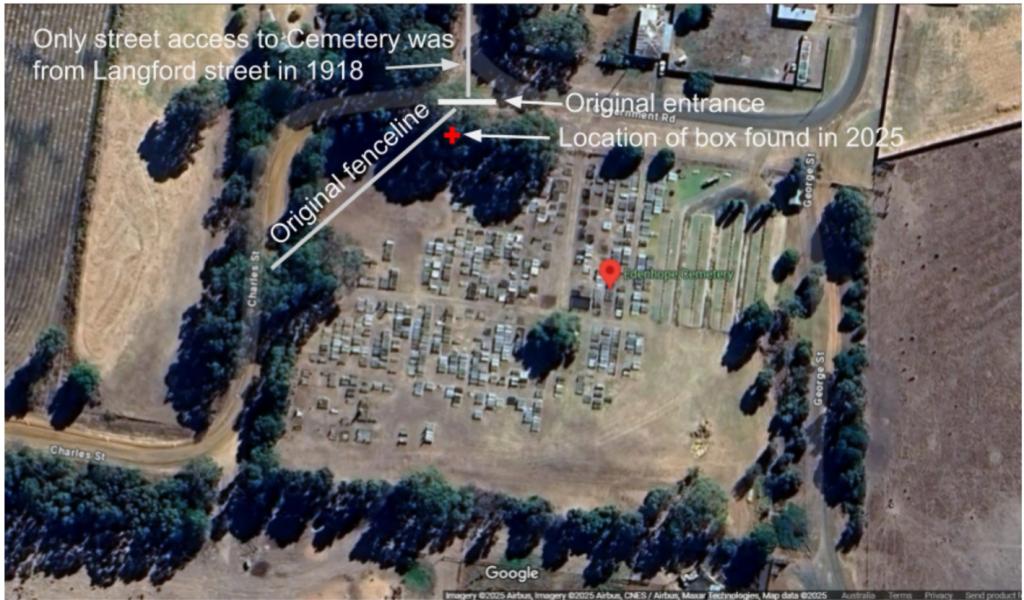
Figure 11: This annotated map of Edenhope cemetery shows the location of the box found in 2025 in relation to the original fence line, original entrance and original street access from Langford Street. Source: Google Maps, [Edenhope cemetery], available at<https://www.google.com/maps/@-37.0418618,141.3040045,220m/data=!3m1!1e3?entry=ttu>, accessed 27 April 2025.
The shortest and most direct route from the police station stables to the cemetery is also indicated in Figure 11. As conveyance costs were calculated by the mile, this is the route that Hughes and Ryan are likely to have taken.
Conclusion: a circumstantial case
The contents of the box discovered under the ground at Edenhope cemetery in 2025 are currently unknown. Exhumation and DNA analysis could offer certainty but that is not currently under consideration. Nevertheless, the evidence presented here forms a powerful circumstantial case, suggesting that the box contains the remains of Maria Cook, Louisa Jane Langley and an unknown man, solving a mystery that has endured for the last 107 years (Figures 12 and 13).
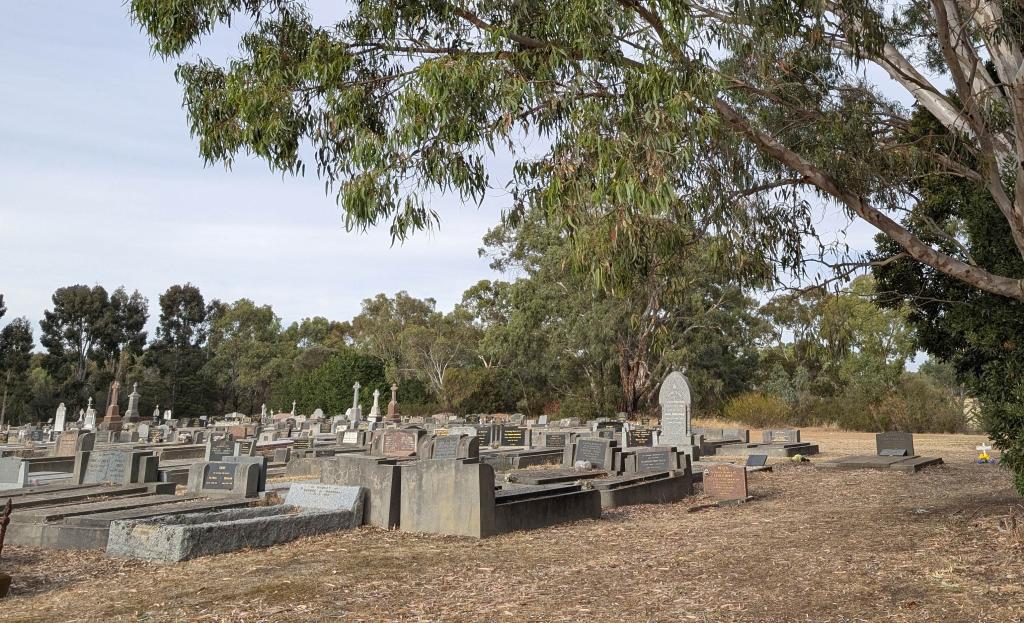
Figure 12: Photograph of Edenhope cemetery. The open section in the background is one of the large areas scanned for unmarked graves. A small white cross on the far right marks the recently discovered unmarked grave that is likely to be that of Maria Cook, née Langley, and Louisa Jane Sugars Langley, buried in 1918. Photograph taken by Nick Manganas, 25 January 2025.
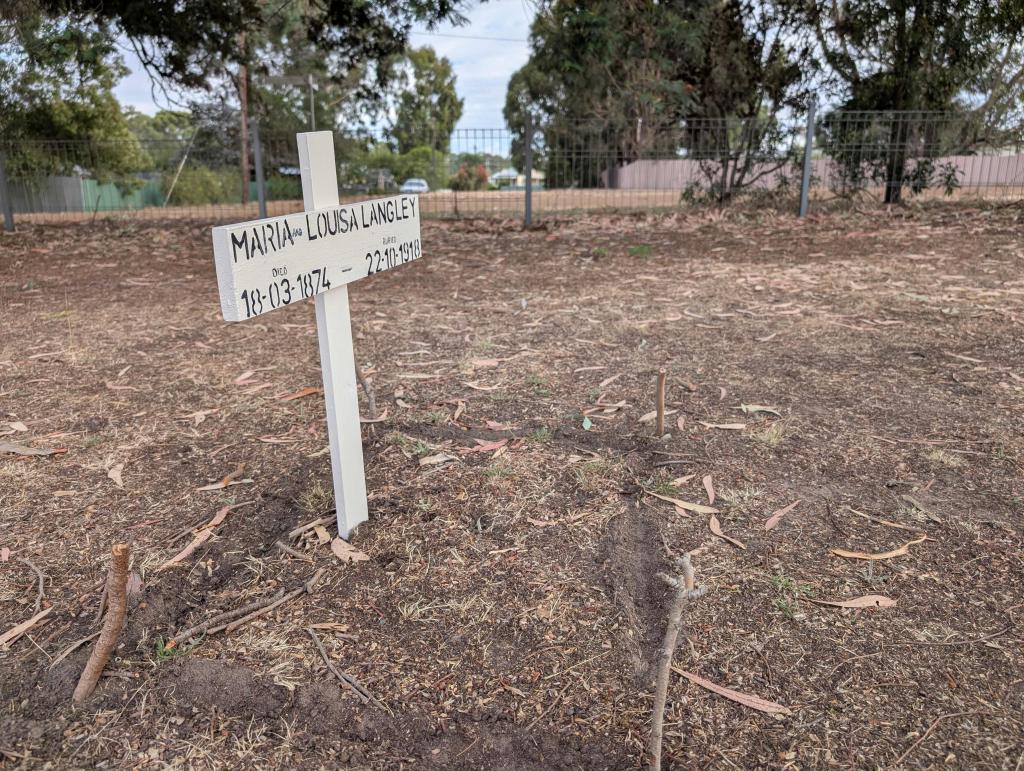
Figure 13: A rectangular tracing marks the location and dimensions of the box discovered by GPR in January 2025. A cross was placed on the site in January 2025 by the Langley family. Note the cemetery fence and Langford Street in the background. The fence now blocks what was once the original entrance to Edenhope cemetery. Constable Hughes and JF Ryan most likely travelled directly down Langford Street, through the entrance and dug a grave in the first available place. Source: Photograph taken by Nick Manganas, 25 January 2025.
Would further forensic, archaeological and historical investigation help shape a more conclusive answer? Yes; undoubtedly. However, disinterring the graves is not desired. Regardless, much good has resulted from the research for this article. The discovery of police records about the burial of human remains has added to our understanding of the conclusion of the case known as the Maryvale murders. The records have shed new light on the lives of the victims, of whom scarcely any records previously existed, as well as the lives and hardships of the families of the victims, and of the suspects and witnesses, weaving an even more fascinating story that deserves to be told. A book is currently being written that includes all newly found information. The long-lost burial register of Edenhope cemetery was found and steps are underway for its digitisation so that it can be shared with the entire community, enabling researchers of family history to locate burial plots that may have been previously lost. In total, 67 unmarked graves have been found and, even though their identities are not known, steps have been taken to commemorate the lives of these farmers, merchants, residents and travellers buried without record in the cemetery. Finally, interviews with locals revealed aspects of the history of Edenhope cemetery that risked being lost forever and helped to forge friendships for which the author is very grateful.
Endnotes
[1] ‘Terrible discovery at Maryvale’, Kowree Ensign and Harrow Advertiser, 27 June 1884, p. 3.
[2] PROV, VPRS 24/P0 Inquest Deposition Files, 1884/831 Maria Cook, Louisa Jane Sugers: Inquest.
[3] Ibid.
[4] PROV, VPRS 24/P0 Inquest Deposition Files, 1886/1305 Unidentified man: Inquest.
[5] ‘Human remains lie unburied after forty two years’, Kowree Leader, 6 July 1917, p. 2.
[6] Neil Langley, interview by Ben Knight, ABC Radio, August 2000 (printed transcript provided to author by Langley family).
[7] Births, Deaths and Marriages Victoria, death certificate 8668/1884 (Maria Cook), and death certificate 8669/1884 (Louisa Jane Langley).
[8] John Henry Ellen, The true story of the Maryvale murders and the Langley family ghost, John Henry Ellen, Rupanyup, 2013, p. 120.
[9] PROV, VPRS 675/P0, Register of Correspondence, Z26-15165, 1918, p. 540.
[10] Constable Hughes’s report on burial of human remains, 22 October 1918, PROV, VPRS 807/P0 Inward Correspondence Files, Unit 673, File no. Z12559.
[11] ‘Double murder in the western border district’, Herald (Melbourne), 20 August 1884, p. 3.
[12] ‘The Maryville mystery’, South Australian Advertiser (Adelaide), 20 August 1884, p. 5.
[13] ‘Maryvale murders. An old crime. An important detail. Apparently forgotten’, Herald (Melbourne), 31 December 1896, p. 1.
[14] Arblaster’s annotation (dated 29 December 1915) on the back of Kirkby Robinson’s letter to the chief commissioner of police, 19 December 1915, PROV, VPRS 807/P0, Unit 673, File no. Z12559.
[15] Constable Byrne’s annotation (dated 9 January 1916) on the back of Kirkby Robinson’s letter to the chief commissioner of police.
[16] Constable Pickett’s annotation (dated 5 January 1916) on the back of Kirkby Robinson’s letter to the chief commissioner of police.
[17] Births, Deaths and Marriages Victoria, death certificate 10489/1955 (John James Hughes), and death certificate 21882/1957 (James Francis Ryan).
[18] GPR operates by transmitting electromagnetic waves into the ground and detecting the reflected signals from subsurface features. These reflections produce detailed images of buried objects and structures, allowing for the precise identification of forms beneath the surface, including tree roots, water pipes, coffins and other disturbances.
[19] Andrew Frost, Square box report, S.E.E. Spatial & Geophysics, unpublished, copy provided by email attachment to author 25 January 2025.
[20] ‘Boxes of bones’, Age, 18 October 1918, p. 9.
[21] Australian Federal Police, ‘AFP DNA program to help identify unknown and missing Australians’, 3 December 2021, available at <https://www.afp.gov.au/news-centre/media-release/afp-dna-program-help-identify-unknown-and-missing-australians>, accessed 24 February 2026.
[22] James Wakelin and Jessicah Mendes, ‘DNA discovery: police are using genetic genealogy to solve some of Australia’s coldest cases’, ABC News, 8 October 2023, available at <https://www.abc.net.au/news/2023-10-08/how-genetic-genealogy-is-solving-australias-coldest-cases/102870058>, accessed 24 February 2026.
[23] Australian Federal Police, ‘AFP DNA program’.
[24] Constable Byrnes to Superintendent Knox, 9 January 1916, PROV, VPRS 807/P0, Unit 673, File no. Z12559.
[25] Kirkby Robinson’s letter to the Chief Commissioner of Police, 19 December 1915, PROV, VPRS 807/P0, Unit 673, File no. Z12559.
[26] Chief commissioner of police, letter in response to Kirkby Robinson, 12 January 1916, PROV, VPRS 807/P0, Unit 673, File no. Z12559.
[27] Gillian Aeria, ‘Grave hunter finds burial site believed to be of murdered mother and child’, ABC News, 15 March 2025, available at <https://www.abc.net.au/news/2025-03-15/unmarked-grave-found-in-search-for-langleys-final-resting-place/105035954>, accessed 26 February 2026.
[28] Ellen, The true story of the Maryvale murders, p. 2.
[29] Gillian Aeria, ‘Regional Victorian family attempts to solve century-old mystery to find burial plot of Maria and Louisa Langley’, ABC Wimmera, 23 February 2023, available at <https://www.abc.net.au/news/2023-02-26/grave-hunters-maria-louisa-langley-edenhope-cemetery/102020750>, accessed 25 March 2026.
[30] Carolyn Gemmel, interview by author, April 2023; PROV, VPRS 14836/P1 General Correspondence Files (General Health Branch ?1944–1978; Public Health Division 1978–1986), Unit 47, H.CEM.176-01.
[31] Edenhope Burial Register, 1918, currently held at West Wimmera Shire Council Edenhope office.
[32] PROV, VPRS 10257/P0 Index to Correspondence, 1918.
[33] PROV, VPRS 10257/P0 Index to Correspondence, 1918, p. 137.
[34] ‘Undetected crimes’, Argus, 31 December 1896, p. 5.
[35] SC Rowley (Portland) annotation (dated 31 October 1918) on the back of Constable Hughes’s report, 22 October 1918, PROV, VPRS 807/P0, Unit 673, File no. Z12559.
[36] A list of the personal belongings found with the human remains can be found in the inquest file: PROV, VPRS 24/P0 Inquest Deposition Files, 1884/831 Maria Cook, Louisa Jane Sugers: Inquest. This is confirmed by newspaper reporters who attended the inquest hearing and sighted the items. See ‘Double murder in the western border district’, Herald, 19 August 1884, p. 3. Constable Pickett’s sighting of the belongings during his tenure can be found in his annotation (dated 5 January 1916) on the back of Kirkby Robinson’s letter to the chief commissioner of police.
[37] Constable Hughes’s report, 6 November 1918, PROV, VPRS 807/P0, Unit 673, File no. Z12559.
[38] This is based on numerous pauper burials I came across in VPRS 937 and VPRS 807 during my research that established a pattern of procedure in regard to these kinds of burials. I chose two examples to show that the procedure remained essentially the same over a long period of time.
[39] For further details about the death and burial of ER Mills, see the various police reports and other documents contained in PROV, VPRS 807/P0, Unit 1216, File F4531 and the deposition of William Corbett in PROV, VPRS 24/P0 Inquest Deposition Files, File 1897/361, E Mills: Inquest. For further details on the death and burial of William Richards, see the various police reports and other documents contained in PROV, VPRS 807/P000, Unit 1259, File A17431.
[40] Burial of ER Mills, PROV, VPRS 807/P0, Unit 1216, File F4531.
[41] Report of Constable Hinkley on cost of burial of Pauper Richards, 29 November 1919, PROV, VPRS 807/P0, Unit 1259, File A17431.
[42] ‘Scale of fees and charges, Edenhope cemetery’, Victoria Government Gazette, 18 April 1889, available at <https://gazette.slv.vic.gov.au/view.cgi?year=1889&class=general&page_num=1367&state=V&classNum=G45&id=>, accessed 26 February 2026.
[43] Evan Arnold, interview by author, 21 April 2024.
[44] ‘The weather’, Leader, 26 October 1918, p. 26, available at <http://nla.gov.au/nla.news-article89074539>, accessed 26 February 2026. See also daily rainfall data for Edenhope (Elizabeth St) for October 1918, Bureau of Meteorology, available at <http://www.bom.gov.au/jsp/ncc/cdio/weatherData/av?p_display_type=dailyDataFile&p_nccObsCode=136&p_stn_num=079011&p_c=-1248665591&p_startYear=1918>, accessed 17 September 2025. Constable Hughes’s report was first dated 21 October and later amended to 22 October, indicating a possible postponement of the burial, possibly due to rain, though the reason for the change is not recorded: PROV, VPRS 807/P0, Unit 673, File no. Z12559.
[45] The research is currently being undertaken by Helen Mulraney-Roll and Toni Domaschenz of Edenhope.
[46] Helen Mulraney-Roll, interview by author, 2024.
[47] Ibid.
[48] Carolyn Gemmel, interview by author, April 2023.
Material in the Public Record Office Victoria archival collection contains words and descriptions that reflect attitudes and government policies at different times which may be insensitive and upsetting
Aboriginal and Torres Strait Islander Peoples should be aware the collection and website may contain images, voices and names of deceased persons.
PROV provides advice to researchers wishing to access, publish or re-use records about Aboriginal Peoples