

Author: Natasha Cantwell
Communications & Public Programming Officer
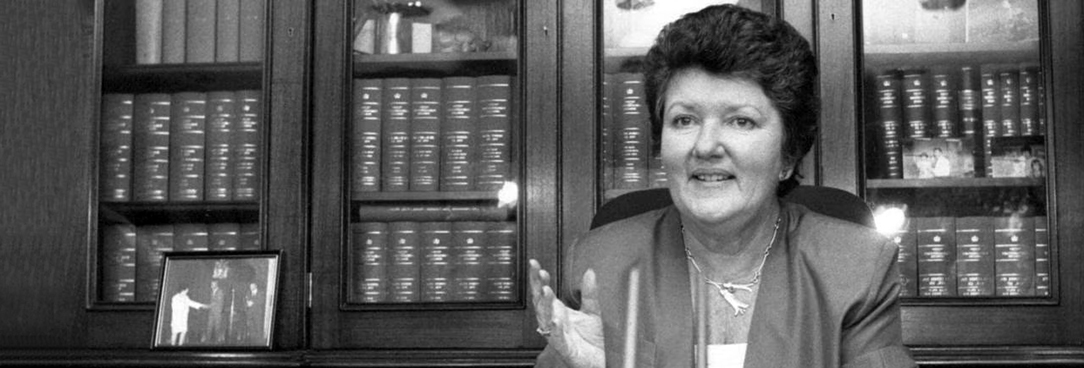
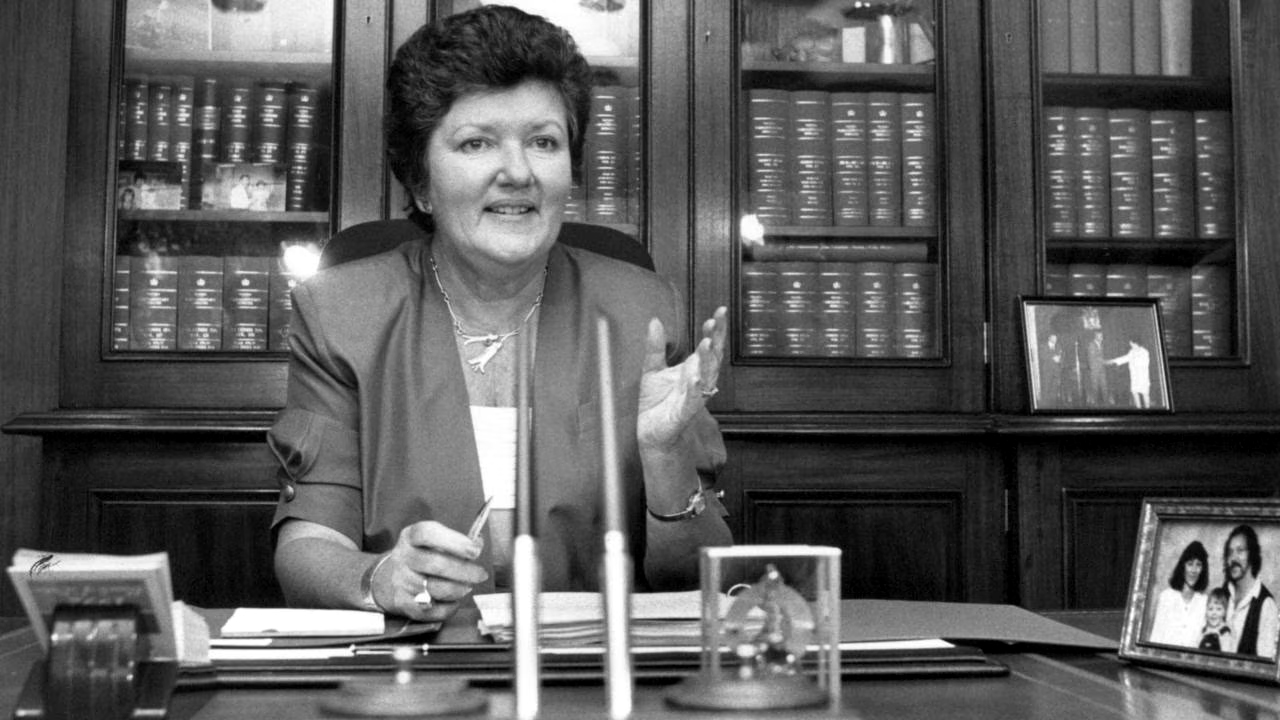
Long before Joan Kirner entered Parliament, she was already holding people's attention. She built her reputation through grassroots parent advocacy campaigns, driven by a belief that social justice and community were not abstract political ideals, but everyday responsibilities. When she was elected to the Victorian Parliament in 1982, that same belief shaped wide-ranging initiatives across education and environmental policy. In 1990 she made history as Victoria's first female Premier, inheriting an economy in freefall and a state mired in debt, yet never losing sight of the principles that brought her there. "She had a magnetic presence," recalls former political adviser Hutch Hussein, who would later work alongside Kirner on her most enduring project: getting more women into Parliament. "You really wanted to be around her and wanted to be part of whatever change she was creating."1
With the 2026 release of Cabinet in Confidence records from her time in office, we reflect on some of the ways Joan Kirner left her mark on Victoria.

Champion for inclusive education
In the late 1980s, Victoria’s education system was radically reshaped. The state government abolished the technical school system, folding vocational education into mainstream high schools. Critics framed it as a cost-cutting exercise. However, newly released internal cabinet papers from this era show a different side. As Victoria’s Minister for Education from 1988 to 1990, Kirner was concerned that cultural expectations, school location, economic pressures, and teacher bias often diverted working-class students from academic pathways, regardless of the young person’s abilities or interests.
In hindsight, not all students benefitted from the move to a comprehensive model, and later governments repeatedly revisited vocational education in different forms, seeking to get the balance right. But for Kirner, the goal was a fairer system. She sought to “ensure that the needs of all students are catered for, with appropriate strategies to redress educational disadvantage.”2
As a bright student who had received scholarships to Penleigh and Essendon Grammar School, as well as University High School, Kirner had first-hand experience of the opportunities that education created for kids from working class backgrounds. In a 2002 Radio National interview she recalled being the first in her community to go to university, and how education opened up her life.3

While government reviews in the mid-1980s had already outlined recommendations for secondary school reform, it was Kirner who became the key advocate, driving the implementation of a new unified education system. She introduced the Victorian Certificate of Education (VCE), which standardised and modernised the curriculum. Under the VCE, students worked towards a common certificate, with subjects designed to cater “for a wider range of student interests and aspirations”.4
The new certificate introduced subjects reflecting the modern world, including Media, and Business Management, while traditional vocational subjects were elevated to the same status as academic studies, often with a greater focus on technology. Home Economics, for example, evolved into subjects such as Food Technology and Textiles / Design & Technology.
Kirner anticipated a backlash about the reforms potentially diluting academic standards, noting in an internal document that the government would need to “counter assertions that the VCE is the road to mediocrity”.5 But despite some scepticism from the public, statistics show that the new system kept more students engaged through to Year 12. Between 1985 and 1992, retention rose from 46 per cent to 77 per cent. For many previously marginalised students, this meant gaining access to senior secondary qualifications and pathways that had previously been out of reach.
Under Kirner’s leadership, education for children with disabilities also became more inclusive. Policy shifted to give parents the right to choose between mainstream and specialist schooling, rather than enforcing segregation. This integration program also provided support and qualified special education teachers where needed within the mainstream schools. In 1998 Kirner told The Age that her most satisfying moment was “getting kids with disabilities into normal schools.”6
Leadership in a difficult time
“I had two choices really. I could run for Premier and fill John Cain's position, or I could disappoint the many people who'd supported me and let it go to another bloke,”
Kirner explained in a 2008 interview.7 Hussein insists that Kirner’s integrity left her little choice but to step up from her deputy role and take on the leadership. Standing back “would be denying everything she believed in and what she'd been encouraging other women to do.”8 And yet the opportunity could hardly have come at a worse time.

When Cain resigned in August 1990, Victoria was facing a financial crisis of historic proportions. Following the 1987 share market crash, recession spread across much of the Western world, but in Victoria it hit extra hard. During the economic boom years of the 1980s, Cain’s government had invested heavily in ambitious projects and backed risky property developments, and when property prices fell and financial institutions collapsed, the state had to absorb the debts. The situation was so dire that selling state assets seemed to be the only way out and Kirner’s government will unfortunately always be linked with getting the ball rolling on privatisation, a move that has had lasting repercussions.
And nothing made her more unpopular than selling the State Bank of Victoria. Once an icon of Victoria, now, thanks to “questionable lending and business practices”9 by its merchant arm, Tricontinental, it was a serious liability. Cabinet papers record Treasurer Tom Roper warning in August 1990 that “The magnitude of the losses and the cost to the budget places the Government in jeopardy.”10 A week later, Kirner approved its sale to the Commonwealth Bank of Australia. It wasn’t a decision she made lightly, and Kirner recalled her process started by writing down ‘people must be respected’ and she kept coming back to this, ultimately concluding that selling the State Bank would help Victoria’s ability to distribute resources more fairly.11

Reflecting later, she said “I may or may not have made the right decision, but I still had to make the decision, and I don't think I've ever felt as alone in a political decision.”12 Kirner is remembered as a leader in a no-win situation, attempting to balance financial repair with concern for the social consequences of cuts, unemployment, and service pressures. As Hussein puts it,
“It was a thankless task. It was a thankless time. As Premier, she was really dealt with a bunch of cards that she didn't really have much control over. And they impacted how others saw her and how she was judged ultimately in the election.”13
Strengthening women's representation
After Labor’s landslide loss in 1992, Kirner spent six months as Leader of the Opposition and a further year as the Member for Williamstown before retiring from Parliament. But Hussein is clear: “She didn't just leave Parliament and walk off. She made sure that there was a ladder left, so that other people could step into Parliament and open those doors.”14
Through advocacy, mentorship and leadership roles, Kirner remained committed to improving women’s representation and influence within political institutions. Hussein says fondly, “
Despite the fact she was quite a few decades my senior, she would often have more energy than all of us, and amazing stamina. You'd get faxes from her with really squiggly writing at 2am in the morning. She was just tireless.”15
Kirner played a central role in strengthening the Labor Party's affirmative action rules, which required at least 35 percent of women to be preselected in safe seats. This gave those women the security to make a long-term impact in Parliament, serving their electorate without having to spend all their time simply holding onto their seats.
But changing the rules only has true impact when you also change the culture, which is why she also helped to set up EMILY’s List Australia, an organisation dedicated to mentoring and financially supporting progressive women candidates. Working together for EMILY’s List was how Hussein first met Kirner.
“She was seeking to inspire the next generation. I had been involved in the Labor Party, which I found very macho. There were lots of egos, and it was refreshing to get involved in EMILY’s List where people were just generally interested in action.”16

The impact of getting more women into Parliament extends beyond fairness. By better reflecting the diversity of the community, the policy agenda broadens and decision-making becomes more inclusive. Today women make up half of Victoria’s Parliament and Australia’s Federal Parliament, which Hussein credits as the direct result of Kirner’s advocacy: “She got people like Paul Keating on side and made sure that Labor recognised that it needed to be a modern party.”17 Julia Gillard, Australia’s first and only female Prime Minister, cited Kirner as an inspiration and mentor.18 And with Jacinta Allan our current Premier and Jess Wilson leading the opposition, women’s leadership in Victorian politics finally feels normalised.
The change Kirner set in motion continues still. Her legacy reminds us that political leadership is not measured solely by electoral success or longevity, but by the capacity to widen opportunity, strengthen democratic participation, and remain committed to fairness in the most challenging circumstances.
Thank you to Hutch Hussein for speaking with us for this article.
Endnotes
1, 8, 13 -17.) Interview with Hutch Hussein, by author, Teams interview, 27 April 2026.
2, 4, 5.) PROV, VPRS 11944, P3, 000018-CD5662
3, 11, 12.) Peter Thompson, “The Wisdom Interviews: Joan Kirner,” ABC Radio National, 18 August 2002 https://www.abc.net.au/listen/programs/bigideas/the-wisdom-interviews-joan-kirner/3517928
6.) Karen Kissane, “Joan Kirner Rocks On,” The Age, 22 June 1998 https://karenkissane.com/joan-kirner-rocks-on
7.) “Joan Kirner recalls her time as Victorian premier, 2008” Education Services Australia, July 2008 https://www.scootle.edu.au/ec/viewing/R9536/transcript.html
9.) PROV, VPRS 11944, P1, 000113-6640
10.) PROV, VPRS 11944, P1, 000119-7069
18.) “Julia Gillard joins leaders in paying tribute to former Victorian premier Joan Kirner,” ABC News, 1 June 2015 https://www.abc.net.au/news/2015-06-01/julia-gillard-joins-leaders-in-paying-tribute-to-joan-kirner/6513378
Continue exploring Victoria’s political evolution
The records referenced in this article were previously closed under Section 10(1) of the Public Records Act 1973 (Vic) which protects sensitive information like cabinet deliberations, Ministerial submissions, or internal processes of government bodies. 2026 marks the first year that records closed under this Section of the Act have been opened and made available to the public. You can read more about these records here: https://prov.vic.gov.au/victorian-cabinet-records-1982-92#2989_1992

Material in the Public Record Office Victoria archival collection contains words and descriptions that reflect attitudes and government policies at different times which may be insensitive and upsetting
Aboriginal and Torres Strait Islander Peoples should be aware the collection and website may contain images, voices and names of deceased persons.
PROV provides advice to researchers wishing to access, publish or re-use records about Aboriginal Peoples